Categories: Dropshipping Guides

AI Customer Service for E-commerce: Top 8 AI Agents in 2026

By: SIB Content Team
May 29, 2026
16 min read
avatar

SIB Content Team

The SourcinBox Content Team is dedicated to providing insightful, data-driven, and actionable content for dropshippers and eCommerce entrepreneurs. With expertise in product sourcing, supply chain management, branding, and fulfillment automation, we help online sellers navigate the ever-evolving world of cross-border eCommerce.
Discover the best AI customer service agents for e-commerce in 2026. Learn how to automate customer support, reduce costs, and improve customer experience.

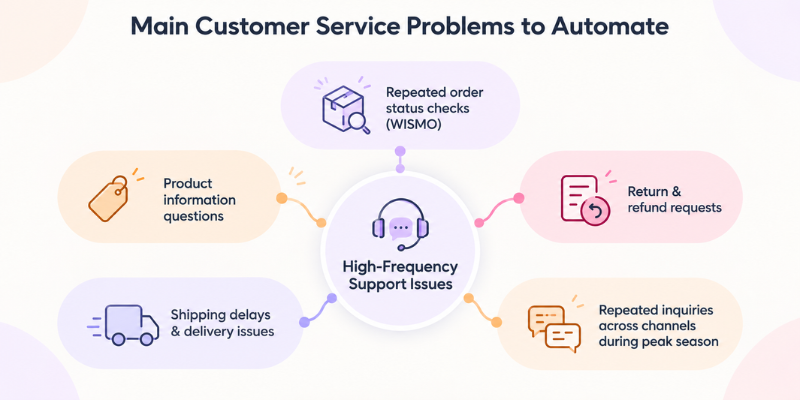
Before customers place an order, they often ask about size, materials, and other product details.

After payment, they start sending “Where is my order?” (WISMO) messages.

When shipping is delayed, refund requests can quickly pile up. 

During peak order periods, support messages from social media can quickly stack up. 

Human agents may respond late or miss important issues. Simple customer inquiries can then turn into complaints and negative reviews. 


This is a common customer service challenge for many dropshippers once daily orders grow to around 15–20.


In today’s highly competitive e-commerce market, customer service is no longer just after-sales support. It directly affects conversion rates, repeat purchases, refund rates, and customer trust.


The challenge is that small and mid-sized dropshipping teams usually do not have the resources to run a 24/7 customer support team like large brands. At the same time, the cost of hiring and managing human agents keeps rising.


That is why more sellers are paying attention to AI customer service agents. An AI customer service agent can help your store automatically handle repetitive questions such as WISMO requests, order status inquiries, and shipping updates. Human agents can then focus on complaints, complex after-sales issues, and high-value customer conversations. 


So, what exactly is AI customer service? 

What practical benefits can it bring to a dropshipping business? 

Which real use cases and tools are worth paying attention to? 

And how can you build a customer service automation workflow that fits your own store?


This guide will walk you through everything you need to know about AI customer service.


What Is AI Customer Service?


AI customer service uses artificial intelligence to understand customer questions, generate responses, automate support workflows, and help human agents resolve issues faster. 


For dropshippers, this means AI can do more than answer routine questions like “How long does shipping take?” or “What is your refund policy?” 


Once authorized and connected to backend data, AI can help sellers automatically handle order inquiries, shipment tracking, return and exchange requests, customer tagging or segmentation, and CRM data updates. 


It is becoming an increasingly common customer service solution for e-commerce sellers and dropshipping businesses. 


How Is AI Customer Service Different From Traditional Customer Service Automation?


Customer service automation refers to tools that can automatically handle common customer questions, after-sales support, and other customer service processes without heavy human involvement. 


However, different types of customer service automation tools vary greatly in their level of intelligence and automation. 


Traditional automated systems usually run on manually created scripts and keyword-based rules. When a customer’s message includes a specific keyword, the system either sends a preset reply or routes the issue to the relevant human support team. 


Such systems provide basic information services but still rely heavily on human agents. As a result, their automation capability is limited. 


In contrast, an AI customer service agent has stronger contextual understanding and information processing capabilities. It can quickly understand customer needs and handle common tasks with a higher level of automation. 


Types of Customer Service Automation Solutions


Common automation solutions in dropshipping include customer service chatbots, customer service automation workflows, and AI customer service agents. 


∎ customer service chatbot


Customer service chatbots represent the earliest form of automation. They rely mainly on preset keywords, scripts, and FAQs created by human teams. 


For example, when a customer asks about shipping time, a rule-based chatbot matches the keyword and sends a preset shipping policy. 


These chatbots are good at answering simple, repetitive questions such as: 


✦ Shipping time inquiries

✦ Common after-sales questions

✦ Order status checks

✦ Refund policy explanations 


However, the limitations of this type of chatbot are also clear. Because it lacks contextual understanding, it often fails to respond accurately when customers use more complex wording or ask questions outside its preset rules. This can lower customer satisfaction. 


customer service automation workflow


Customer service automation workflows use rules to route tickets to the right team. For example, “shipping delay” can be assigned to the logistics team, while “return request” can be assigned to the after-sales team.  


Compared with basic chatbots, this type of workflow improves the customer service process by identifying keywords and assigning tasks automatically. It can reduce the time human agents spend sorting customer requests. 


However, in real dropshipping operations, online sellers often need to handle order inquiries, shipment tracking, refund requests, and after-sales support at the same time. 


Customer service automation workflows still rely heavily on human agents. Although the system can assign tasks, the actual speed depends on how quickly the support team follows up. 


When a customer’s request involves multiple issues, such as an order inquiry combined with a refund request, these systems often lack the flexibility to handle more complex cases


This is where AI customer service agents become useful. 


∎ AI customer service agent


AI customer service provides dropshippers with a more efficient and intelligent solution. 


Powered by natural language processing and machine learning, AI customer service agents can analyze customer sentiment, understand what the customer really needs, and generate more natural, human-like responses. 


When connected with e-commerce, logistics, CRM, and helpdesk systems, an AI customer service agent can help with:


order lookup

shipment tracking

return and refund request collection

customer issue tagging

CRM note updates

ticket summaries for human agents


However, AI customer service cannot replace reliable fulfillment. For dropshippers, many support tickets still come from shipping delays, unclear tracking, stock issues, damaged items, or inconsistent product quality. 


This means AI works best when supported by stable sourcing and fulfillment operations


8 Best AI Customer Service Tools 


There are many AI customer service tools on the market, but for dropshippers, the key is not choosing the platform with the most features. It is choosing a tool that fits your current business stage, order volume, customer service workload, and budget. 


The following eight tools each have different strengths. Whether you are just starting out, handling steady daily orders, or managing multiple brands and markets, you can find an AI customer service agent that fits your needs. 


Let’s take a closer look. 


Platform Best for chat/voice price model

Shopify Inbox

Shopify Magic

small stores chat free
Tidio small and mid-sized stores chat

Free plan available 

Tiered pricing 

Freshdesk small and mid-sized stores chat & voice Tiered pricing 
Kummunicate small and mid-sized stores chat & voice

30-day free trial available 

Tiered pricing 

Intercom Mid-sized and large stores chat Tiered pricing 
Gorgias Mid-sized and large stores chat & voice Tiered pricing based on business scale
Zendesk Mid-sized and large stores chat & voice Tiered pricing 
Kustomer AI Mid-sized and large stores chat & voice Custom pricing model 


Shopify Inbox & Shopify Magic


Used together, Shopify Inbox and Shopify Magic can provide a basic and lightweight AI customer service solution for small Shopify stores


Shopify Inbox mainly supports live chat, FAQ, product recommendations, and access to customer information. Customer Support agents can view customer profiles, order details, cart activity, and product information directly in the chat. This makes it easier to answer common customer questions. 


Shopify Magic provides AI-generated suggested replies and instant answer suggestions. It helps sellers respond faster, reduce manual typing, and save time on repetitive customer conversations. 


shopify


Key Features:


➤ Deep Shopify integration: Shopify Inbox can access orders, customer information, and product data, making customer conversations smoother. 

➤ Low cost: Most features of Shopify Inbox and Shopify Magic are free.

➤ Easy to set up: No complex configuration is required. Sellers can start using Shopify Inbox after installation. 


Pricing: Free


Pros & Cons From Users:


For sellers who are just starting dropshipping, Shopify Inbox and Shopify Magic can be enough to handle basic customer service needs. They are simple, low-cost, and easy to use. If your support volume is still low and most questions are basic, Shopify Inbox and Shopify Magic can work well as entry-level AI customer service tools. 


However, their limitations are also clear. When customers ask detailed product questions, raise complex refund policy issues, or require a longer context to be understood, Shopify Magic may not be advanced enough. 


Tidio


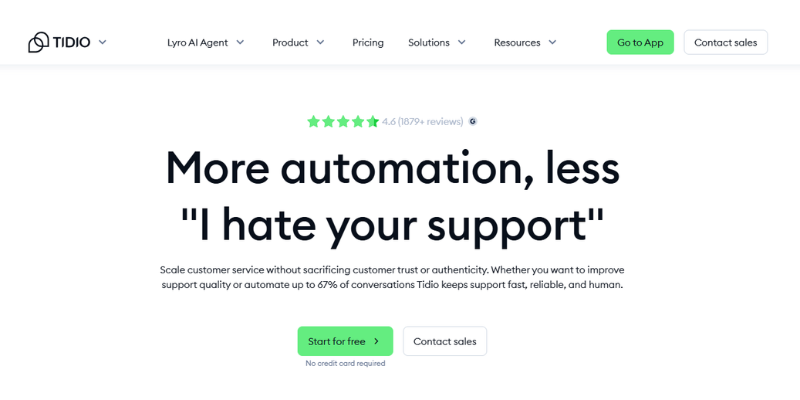
Tidio is better suited for small and medium dropshipping teams. If you want to set up AI customer service and manage website chat, social media messages, and emails in one place, you can choose it.


It offers a more complete customer service automation solution. It combines live chat, an AI customer service agent, automation workflows, ticket management, and multichannel message management. Tidio’s AI agent can help answer common repetitive customer questions, reduce pressure on human agents, and keep support available even outside working hours. 


Tidio


Key Features:


➤ 24/7 AI agent: Tidio’s AI agent can provide round-the-clock customer support and help resolve common customer inquiries without human intervention. 


➤ Automation workflows: Dropshippers can create workflows for different service scenarios, such as greeting visitors, collecting leads,or routing support requests. 


➤ Multichannel inbox: Tidio can bring messages from live chat, email, WhatsApp, and other channels into one shared workspace. This makes it easier for teams to manage customer conversations.  


Pricing: Tidio offers a free plan. Paid plans and AI agent usage may vary depending on features, conversation limits, and Lyro AI agent usage. 


Pros and Cons From Users:


Based on user feedback, Tidio’s basic customer service features are easy to set up. Its website and backend integrations are convenient. This makes it a practical choice for sellers who want to quickly launch live chat and AI chatbot support


In practice, sellers still need to spend time training and optimizing the AI agent. This helps it respond more accurately. For complex customer issues, human agents may need to review chat histories, identify where the AI misunderstood the customer’s intent, and continue improving FAQs, knowledge bases, and automation workflows. 


Freshdesk


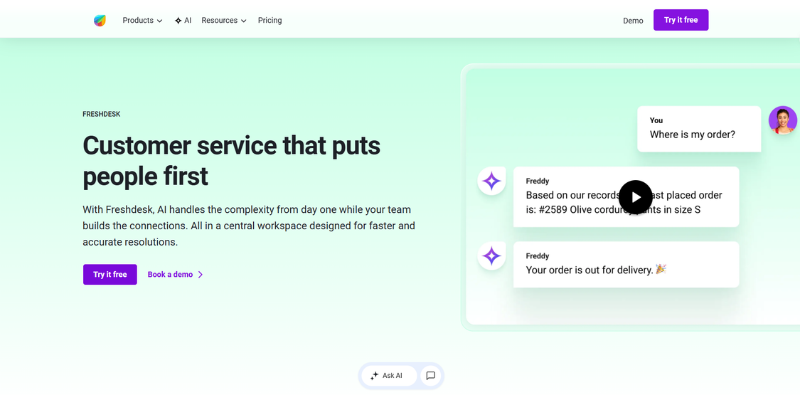
Freshdesk is suitable for dropshipping teams that already handle a certain level of customer service volume. It works well for teams that need to manage customer requests across multiple channels and improve support efficiency with a ticketing system. 


It can turn customer conversations from email, live chat, social media, phone, and other channels into tickets. This makes it easier for support teams to follow up on each customer issue. Freshdesk’s Freddy AI can automatically answer common questions. It can also help human agents summarize conversations, suggest replies, translate customer messages, and generate customer satisfaction insights. 


Freshdesk


Key Features:


➤ Comprehensive features: ticketing system, AI customer service agent, omnichannel live chat support, phone support, and a knowledge base. 

➤ AI and human agent collaboration: Freshdesk’s AI agent is not designed to fully replace human support. Instead, it helps support teams work faster and improve service quality. 

➤ Good value for money: Freshdesk offers a wide range of features at a relatively affordable subscription price. 


Pricing: The Growth plan starts at $23 per agent per month. The Pro plan with AI agent features starts at $66 per agent per month. 


Pros & Cons From  Users:


Freshdesk’s strengths are its relatively clean interface and full automation features that make ticket handling easier. It is suitable for small and mid-sized teams that want to build a more structured customer service workflow. 


At the same time, the full feature set also means there is a learning curve. Some users mention that Freshdesk’s workflow setup can be complicated. Its search function may also feel unstable at times. Teams may need time to get used to the system.  


When using WooCommerce, you should pay special attention to integration stability. Some users have reported issues with the Freshdesk and WooCommerce integration. These may include delayed tickets, unsynced order information, incomplete customer details, or missing order history. 


Kommunicate


Kommunicate is suitable for dropshippers who want to use an AI agent to handle common questions while still making it easy to transfer complex issues to human agentsThis tool combines AI agents with human support to improve overall customer service efficiency.


The AI agent can answer trained questions, such as FAQs, product information, and shipping policies. If a customer’s question goes beyond what the AI can handle, the conversation can be transferred to a human agent. The context can also be kept, so the customer does not need to repeat the issue. For dropshippers, this is a safer approach. 


Kommunicate


Key Features:

➤ AI and human agent collaboration: The AI agent can handle common questions and smoothly transfer conversations to human agents in more complex situations. 

➤ Easy setup: Supports no-code setup, templates, and quick website integration. 

➤ AI agent training: Sellers can upload FAQs, website content, and custom knowledge bases to help the AI agent answer common customer service questions. 


Pricing: The Starter plan starts at $40 per month. 


Pros & Cons From  Users:


Kommunicate receives generally positive reviews. Its main advantages are a simple setup, fast launch, and a clear interface. It can also automatically handle some common customer questions and help teams save time. 


Yet Kommunicate is not a fully autonomous AI customer service agent that requires no human involvement. It is better suited for issues with clear rules and answers covered in the knowledge base. For complex questions or emotional complaints, human support is still needed. That means if your goal is to let AI handle around 40%–50% of common customer questions, Kommunicate can be a practical choice. But if you expect AI to fully take over customer service, it may not be the best fit. 


Intercom


Intercom is suitable for mid-sized and larger teams with a sufficient budget and a strong focus on customer experience. It can help you achieve your goal of connecting AI customer service with customer growth. 


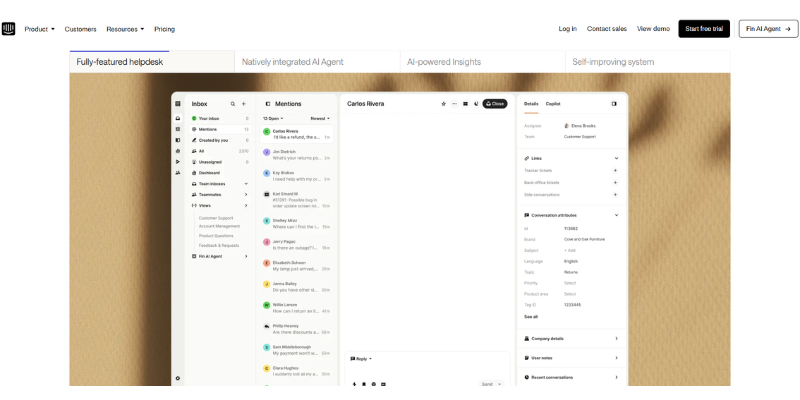
Intercom is a well-known global AI customer service platform. It supports multichannel customer support and automation workflows. Its Fin AI Agent offers natural conversations and can help handle customer inquiries, pre-sales guidance, customer activation, and marketing messages. 


intercom


Key Features:


➤ Fast, smooth, and personalized replies: Strong native AI help automate customer interactions quickly and smoothly. 

➤ Omnichannel and multilingual support: Intercom brings website, email, Instagram, Facebook, and WhatsApp conversations into one inbox and supports 45 languages. 

➤ High level of automation: Teams can build powerful workflows to automate repetitive customer service tasks. 


Pricing: Plans start at $29 per agent per month. 


Pros & Cons From Users:


Intercom offers a strong user experience, an attractive interface, smooth usability, and powerful features. If you care about brand image and the quality of customer communication, Intercom’s overall product experience can be very appealing


Its main disadvantage is cost. As business volume grows, the total cost can rise quickly. For this reason, Intercom is better suited for teams with stable revenue and a clear support budget, not beginner dropshipping sellers. 


Some users also mention that context may be lost when the AI agent transfers a conversation to a human agent. It means the human agent may need to understand the customer’s issue again. Others feel that although Intercom’s AI replies are smooth, its ability to pull deeper information from a custom knowledge base can be somewhat limited


Gorgias


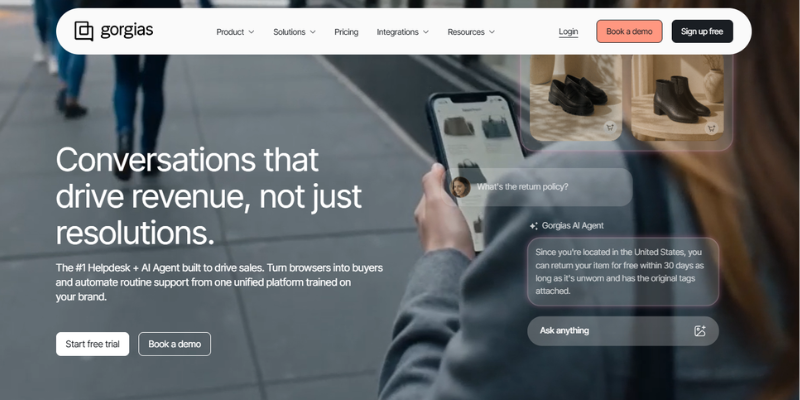
Gorgias is an AI customer service tool built specifically for e-commerce. This feature makes it highly suitable for dropshippers and online sellersOne of Gorgias’s strengths is its deep Shopify integration. Human agents can view orders, process refunds, edit order information, and check customer history directly inside Gorgias, without constantly switching back to the Shopify backend. 


Gorgias’ AI agent can automatically handle order tracking, returns, FAQs, and common after-sales questions. It can also send personalized replies based on customer context. In addition, Gorgias provides customer support-driven revenue analytics. This helps sellers understand how customer service contributes to order revenue. 


gorgias


Key Features:


➤ Multichannel message management: Centralizes conversations from email, live chat, Instagram, Facebook, and SMS into one shared inbox. 

➤ Deep Shopify integration: Agents can view orders, process refunds, and edit order information directly without jumping back to the backend. 

➤ Revenue analytics: Tracks revenue generated through customer service interactions and helps sellers optimize their support strategy. 


Pricing: Gorgias uses pricing based on business scale. The Starter plan starts at $10 per month. 


Pros & Cons From Users:


Based on user feedback, Gorgias integrates closely with Shopify stores and can effectively reduce repetitive work. Support teams can handle common after-sales issues faster. 


Some experienced users mention that Gorgias may not always be accurate when answering highly product-specific questions. For example, when customers ask whether a product is compatible with a certain system, exact dimensions, material differences, and usage limitations, the reply depends heavily on the accuracy of your product data and knowledge base


When using Gorgias, dropshippers need to organize a clear product catalog and use real customer conversation records to improve the quality of AI agent responses. 


Zendesk


Zendesk is suitable for a large team. It supports not only AI customer service, but also unified customer support across chat, email, phone, WhatsApp, Instagram, and other channels. Zendesk also offers AI chatbot features, live chat, and Zendesk Talk for phone support. 
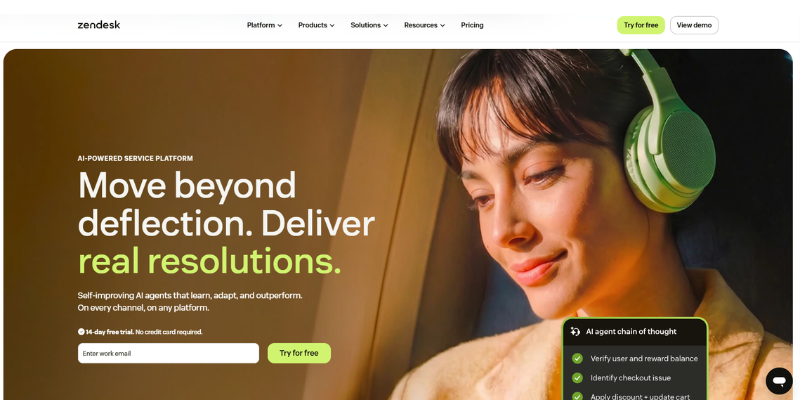
 

zendesk

Key Features:


➤ Powerful automation workflows: Zendesk supports complex support processes such as support escalation, automated tagging, and team collaboration. 

➤ Mature ticket management system: It can manage customer requests from email, chat, WhatsApp, Instagram, phone, and other channels in one place. 

➤ Advanced AI agent:  It provides ticket summaries, reply suggestions, helping support teams improve efficiency and automate part of the customer service process. 


Pricing:The basic plan starts at $25 per agent per month. Plans with AI agent features start at $69 per agent per month. 


Pros & Cons From Users:


Zendesk’s strengths are its ticketing workflows, reporting system, and customer service team management capabilities. It is suitable for teams that need standardized customer support operations. 


Its drawbacks are also clear. Zendesk has many paid add-ons, and the overall cost can be high. Some features may be unnecessary for dropshippers. Data migration and historical data handling is a little bit complicated, so sellers should plan ahead if they need to migrate existing support data. 


Some users also feel that Zendesk is better suited for ticketing workflows and reporting. If most of your customer conversations have already moved to WhatsApp, live chat, and social media DMs, Zendesk may not be the best fit for your scenario. 


Kustomer AI


Kustomer AI is suitable for mid-sized and larger e-commerce teams.  If you care about customer history, complete customer profiles, and personalized service experiences, it is worth trying.


Kustomer can bring together customer order history, social media messages, browsing behavior, refund records, and CRM data. It displays this information in a timeline view, giving support agents a complete customer background. This means agents do not need to repeatedly search for past conversations and order records when handling customer issues. 


Kustomer AI


Key Features:


➤ Omnichannel customer data integration: Brings together customer order history, social media messages, browsing behavior, refund records, CRM data, and more. 

➤ Automation workflows: Provides transparent automation workflows to make sure they follow custom rules. 

➤ Complete customer profiles: Gives human agents more background information, helping them understand customers better and improve service quality. 


Pricing: Kustomer offers customized pricing based on business needs. 


Pros & Cons From Users:


Kustomer’s timeline view is very useful. It helps human agents quickly understand customers’ past orders and service history. This feature is valuable for e-commerce teams handling complex after-sales cases, VIP customers, or long-term customer relationships. 


Some users report that Kustomer’s voice channel may not be stable, with possible call drops or audio quality issues. Although Kustomer can integrate customer information from multiple channels, it may still have limitations in importing social media comment data and replying to comments. 


If your core need is complete customer profiles and context management, Kustomer AI is worth considering. But if your main customer service scenarios are social media comments and voice support, you should test whether it fits the business in advance. 


The AI customer service agents recommended above can help dropshippers respond to customers more efficiently on the front end. However, a truly stable customer experience still depends on reliable sourcing, fulfillment, and after-sales support. 


SourcinBox helps online sellers with product sourcing, order fulfillment, inventory management, shipment tracking, and after-sales assistance. In this way, your AI customer service agent will work more effectively. 


How to Automate Your E-commerce Customer Service?


How can you apply an AI agent to your actual business? Based on extensive practical experience, we have summarized six key steps: 


  1. Audit repetitive inquiries
  2. Build a knowledge base
  3. Choose the right AI support tool
  4. Set automation and handoff rules
  5. Test with real conversations
  6. Review and improve after launch


We have also prepared a comprehensive guide for you.


Start with the Most Repetitive Customer Inquiries 


Before automating customer service, identify the repetitive inquiries that consume the most support time. 


For many dropshipping stores, these are not complex issues, but daily questions about status, shipping times, tracking updates, returns, refunds, and discount codes.


Look for inquiries that are: 

✦ asked repeatedly every day

✦ easy to answer with a fixed rule or policy 

✦ related to order status, shipping, returns, refunds, or discounts 

✦ slowing down your response time


Avoid vague goals like “improve customer satisfaction with AI” or like “boost sales conversion with AI”.


Instead, set operational goals that are easy to measure, such as:


Reducing WISMO  tickets with AI customer service agents 

shortening first response time 

decreasing repetitive refund-policy replies


These specific customer inquiries are ideal starting points for automation. 


Build a Customer Service Knowledge Base for Your AI Agent


A reliable AI customer service agent needs a clear and regularly updated knowledge base.


For dropshipping stores, the knowledge base should start by reviewing real customer support conversations to identify the most frequently asked questions


At a minimum, an AI support knowledge base should cover:


✧ Shipping policy: shipping times, delivery schedules, tracking methods

✧ Return and refund policy: return conditions, refund procedures, refund timelines

✧ Product FAQ: product dimensions, materials, colors, applicable scenarios, usage instructions

✧ Order modification rules: address changes, order cancellations, product exchanges

✧ Payment and discount rules: payment failures, invalid discount codes, discount usage policies

✧ Complaint handling process: damaged, missing, or incorrect items; shipping exceptions

✧ Human handoff rules: which issues must be escalated to human agents


For dropshippers, product information should be as detailed as possible because the response to size, material, compatibility, and usage restrictions depends heavily on your complete and detailed product data. 


To ensure AI reads information accurately, each inquiry should be organized in a fixed format


Customer inquiry: Track an order

Standard answer: You can track your order using the tracking number sent to your email. If your tracking information has not updated for more than 5 business days, please provide your order number so we can check it for you.

Required information: Ask for the order number and email address.

Human handoff: Transfer to human support if the order has no tracking update for more than 10 business days. 


This format not only guides the AI on what to answer but also instructs it on what information to collect, what to do next, and when to stop automated replies and hand over to human agents. 


Meanwhile, avoid duplicate or conflicting entries in the knowledge base. The clearer the categorization, the easier it is for AI to find the right answer. 


After launching the AI agent, keep the knowledge base updated. Dropshippers should regularly review conversations where AI answers are incomplete. You should also check cases where customers ask follow-up questions repeatedly, or human agents often need to step in. Use these conversations to improve the knowledge base


Choose a Suitable AI Customer Service Agent Based on Business Size


Once your knowledge base is ready, how do you choose an AI customer service agent? 


Before selecting, dropshippers need a clear understanding of their business scale, customer support workload, main sales channels, and budget. When choosing an AI support tool, consider factors such as: 


store platform integration

order lookup ability

live chat support

ticket management

human handoff

automation workflow

multilingual support

pricing

support channels: email, chat, social media


Based on these needs, here are some common tool options for different business stages:


Business stage

Main need Possible tools Advantages
New store Basic chat and simple FAQs Shopify Inbox Basic customer service automation with low cost and easy setup 
Shopify Magic
Growing store AI chatbot + live chat Tidio Better for live chat, AI chatbot support, and basic automation 
Kommunicate Best for teams that want AI to handle common questions and smoothly transfer complex issues to human agents 
Growing support team Ticket management Freshdesk Systematically manage refunds, returns, shipping exceptions, and customer complaints 
Shopify-heavy store Order-based support automation Gorgias Deep Shopify integration with direct access to orders, refunds, and order edits. Suitable for e-commerce teams with heavy after-sales pressure 
Larger business Omnichannel support and CRM Zendesk Better for teams that need a mature ticketing system and reporting features 
Intercom Better for teams that care about user experience and sales conversion 
Kustomer Better for teams that value customer history and complete customer profiles 


Set Automation and Human Handoff Rules for AI Customer Service


The core of AI customer service automation is to handle simple but repetitive tasks, while complex, sensitive, or emotional issues should be smoothly escalated to human agents. 


AI can independently manage tasks such as: 


order tracking 

shipping policy questions 

FAQs

return/refund policy explanations 

basic product questions  

collecting order information 


Issues that must be handed off to human agents include: 


✧ angry customers

✧ customer complaints

✧ lost/damaged/wrong items

✧ refund disputes

✧ high-value orders

✧ safety/legal/platform policy issues

✧ unclear intent


One important area to focus on is the handoff process between the AI agent and human support. This is often where problems arise in real-world use. When setting up automated handoff workflows, make sure the AI keeps the full conversation history. This helps human agents quickly understand and handle the issue after taking over. 


Clearly define the AI agent’s response scope. It should not guess when it lacks information. Instead, AI should ask for the required details or hand the case over to a human support agent. 


Test Your AI Agent With Real Customer Service Conversations


AI support agents rarely perform at their best after the first setup. They need continuous testing and improvement based on real customer service conversations. 


  • Test with real support conversations


Before launch, test the AI agent with real support conversations. These should include order tracking, refund requests, address changes, product questions, shipping delays, and complaints. 


Real customer interactions help you gather common expressions and reactions. This is also helpful to verify whether the AI agent truly understands customer intent. 


  • Test with the integrated platforms


Beyond testing AI responses, you need to verify whether the AI tool integrates reliably with your existing platforms. It is especially important because AI Agent must read order data accurately. 


For example, some users have reported that Freshdesk’s integration with WooCommerce can sometimes fail to retrieve order history. Technical issues like this should be tested carefully before going live. 


  • Improve after launch


After launch, regularly review unresolved tickets and human handoff cases. Use them to improve your knowledge base and automation rules. An AI agent is a tool. You need to keep improving it after launch. 


Why Do Online Sellers Need AI Customer Service Agents in 2026?


Customer service has become one of the most important areas for online sellers to improve customer trust, reduce support costs, and handle growing order volume. 


Importance of Customer Service for E-Commerce


According to Google Trends, search interest in “customer service” remains consistently strong. This shows that support experience is a long-term concern for online businesses. 


At the same time, keywords related to “customer service” have reached a combined search volume of 201,000 per month across search engines, social media, and conversational AI platforms.


google trends for customer service

Source: Google Trends and Answer the Public


Shep’s Annual Customer Experience Research Report shows: 


❖ 59% of consumers consider excellent customer service more important than price advantages. 

❖ 83% of consumers say outstanding customer service significantly boosts their trust in a brand. 


In other words, high-quality customer service can reduce customer loss, build stronger brand trust, and improve sales conversion rates. 


Advantages of Automated Customer Service


Higher customer satisfaction, lower support costs, 24/7 responses, and stronger brand trust are all practical benefits of automated customer service. These advantages explain why dropshippers should take customer service automation seriously. 


✧ Enhancing Customer Satisfaction 


One of the biggest advantages of AI customer service is delivering a more personalized experience and improving customer satisfaction. 


According to research by leading global consulting firm McKinsey: 


❖ 71% of consumers want personalized interactions during their shopping journey.

❖ When this need isn’t met, 76% of consumers feel frustrated. 


Customers expect support agents to understand their questions. They need targeted help based on their order status and usage scenario, rather than sending generic replies. 


When connected to order and customer data, an AI customer service agent can provide more relevant answers. This kind of AI-driven personalization can increase customer satisfaction by 15–20%, which in turn drives a 5–8% increase in sales. 


✧ Reducing Service Costs 


AI customer service helps dropshippers significantly cut customer support costs. 


From our long-term experience serving dropshippers, online sellers often face a high volume of repetitive and time-consuming inquiries. 


AI customer service agents can handle these simple, high-frequency issues 24/7. They respond faster to customer needs and reduce wait times. 


IBM research shows that AI customer service can help companies save up to 30% of their customer service budget. This matters for dropshippers who need to control support costs as order volume grows. 


✧ 24/7 Timely Responses 


Customer response speed directly affects order conversion rates, refund rates, and customer satisfaction, especially for cross-border e-commerce businesses dealing with different time zones. 


Shopify points out that consumers increasingly expect answers within seconds. AI customer service is helping online sellers provide customer support around the clock. 


After introducing AI chatbots, 90% of companies reported faster complaint resolution, while 80% of routine support tasks could be handled automatically. 


This always-on support can improve key customer support metrics, such as first response time and average resolution time. Even when human agents are offline, an AI agent connected to store and order data can help maintain a high response rate. 


Future of AI in Customer Service


Looking ahead, AI customer service is becoming a long-term operational strategy across industries. 


According to Gartner’s forecast, by 2028, AI agents will be able to independently resolve 80% of common customer service issues without human intervention. They may also help companies reduce operational costs by about 30%


AI Agent Usage

Source: Creatio


In scenarios closely related to dropshipping and e-commerce operations, AI agent usage already accounts for 46%. Among these use cases, customer service accounts for 12%, and customer success accounts for 7%


For dropshippers, this signals a clear trend: 


The future of e-commerce competition will rely more on operational efficiency, customer experience, and AI automation capabilities. Sellers who understand and apply AI customer service early are more likely to gain a competitive advantage. 


AI customer service cannot fix every support problem on its own. Many customer complaints still come from fulfillment issues, unclear tracking updates, stock problems, damaged items, or delayed shipments.


That is why customer service automation works better when it is supported by reliable sourcing, inventory management, order processing, and fulfillment workflows.  


For dropshippers, working with a fulfillment partner like SourcinBox can help reduce the operational problems that often turn into customer service tickets. 


How Generative AI Is Used in E-commerce Customer Service


AI customer service is already being used in several practical e-commerce scenarios, from answering order questions to recommending products and supporting human agents. 


Let’s take a look at some real business examples. 


Customer Inquiry Handling


For online sellers, the most practical use case of AI customer service is handling repetitive, rule-based inquiries such as order tracking, shipping time, address changes, return policies, and discount code issues. 


These questions take up a large amount of customer service time. The value of an AI customer service agent is to automatically handle them with clear rules and predictable workflows


For situations involving strong emotions, complex after-sales disputes, product quality complaints, or high-value customers, AI should preserve the conversation context and smoothly hand the case over to a human agent


This combination of AI agents and human support helps reduce customer support costs while avoiding frustrating situations.


Pre-sales Product Guidance and Personalized Recommendations


The value of AI in personalized customer service is already being used in real shopping scenarios by major e-commerce brands. 


According to Amazon, Alexa for Shopping has been integrated into Amazon’s website and app. Customers can ask detailed shopping-related questions directly in the search bar. 


Based on product information, customer preferences, and shopping history, Alexa can help shoppers find more suitable products. 


This offers useful ideas for dropshippers and online sellers because customers often ask similar questions before placing an order: 


✧ Is there an option that works better for summer?

✧ Is this product suitable for outdoor use? 

✧ Which size would fit me better? 


This can help reduce pre-purchase hesitation and make it easier for customers to choose the right product. 


Customer Sentiment Analysis


Customer sentiment analysis is becoming an increasingly important part of AI customer service. 


Salesforce’s Formula 1 case shows how AI agents can help customer service teams scale support and reduce response time


Separately, sentiment analysis can help support teams identify negative emotions in customer messages and prioritize risky conversations. 


For dropshippers, many customer service issues naturally involve frustration or negative emotions, such as shipping delays, lost packages, or product quality issues. 


An AI customer service agent can help identify high-risk conversations early by analyzing customer sentiment. This makes it easier to respond before ordinary inquiries turn into complaints, negative reviews, or refund requests. 


Knowledge Management Tools


Knowledge management is an important but often overlooked part of AI customer service for online sellers. 


Many online stores have scattered support information: product details on product pages, shipping policies in the footer, refund rules in internal documents, and order notes in the backend. 


A large service operator in Italy once faced a similar challenge. With more than 3,000 customer support agents and an outdated knowledge management system, support teams often had to search across different platforms for poorly organized information. Even simple questions could take a long time to resolve. 


AI-powered knowledge management can help dropshippers gather information. This allows customer service teams and AI agents to access answers faster. 


Business Process Automation Tools


More AI agents are now able to help customers complete specific tasks when connected to backend systems with the appropriate permissions. 


When dropshippers connect AI agents to Shopify, CRM tools, order systems, logistics systems, or helpdesk platforms, AI can automate standard processes, such as checking order status, updating customer addresses, collecting return request information, and updating CRM records. 


Business process automation requires careful permission settings. Tasks involving refund approvals, high-value compensation, or order cancellations should not be fully handled by AI. A safer approach is to let AI collect information, identify the issue type, and suggest a solution before a human agent confirms important actions. 


Start Your AI Customer Service in Your Dropshipping Business With SourcinBox


Automation workflow and the right AI customer service agent can help dropshippers respond faster, handle repetitive inquiries, and improve customer support efficiency. 


At the same time, customer experience in dropshipping depends on more than front-end customer service tools. It also depends on reliable sourcing, warehousing, fulfillment, and after-sales support. 


This is where SourcinBox creates value for online sellers. 


SourcinBox provides dedicated one-on-one account manager support. When stores face order exceptions, shipping delays, or customer complaints, sellers can receive faster and clearer support. 


SourcinBox also offers free warehousing services. For dropshipping sellers looking to improve fulfillment stability, this creates a smoother shopping experience for customers. 


SourcinBox provides reliable after-sales support. Whether the issue involves order problems, shipping exceptions, or product-related concerns, the team can help sellers find solutions faster and reduce customer waiting time. 


If you want to deliver outstanding customer service in 2026, AI customer service agents can improve front-end communication, while SourcinBox provides reliable support across sourcing, warehousing, fulfillment, and after-sales operations.


Frequently Asked Questions


1. What is automated customer service?


Automated customer service refers to using technology tools to handle customer inquiries and provide after-sales support automatically. Compared with relying only on human agents, it reduces repetitive work and improves response speed. 


More advanced AI customer service agents can also understand customer intent and provide more natural replies based on order data, product information, and knowledge base content. 


2. What are the core benefits of implementing AI in customer service operations?


The core benefits of AI customer service include faster response times, lower support costs, better customer experience, and more stable service quality. It can handle high-frequency questions 24/7, such as WISMO requests, FAQs, shipping inquiries, and refund policy explanations. This helps reduce customer wait times. 


For dropshipping businesses, this can significantly reduce pressure on human support teams, especially during peak order periods or when serving customers across different time zones. 


3. Will AI replace customer service?


AI will not fully replace customer service, especially human support agents. AI is better suited for high-frequency, repetitive, and rule-based questions, such as order inquiries, shipment tracking, FAQs, and basic after-sales explanations. However, human agents are still needed for complex complaints, strong negative emotions, high-value refunds, special compensation, and product quality disputes. 


4. Can AI customer service work with Shopify and WhatsApp?


Yes. Many AI customer service agents can integrate with Shopify, WhatsApp, and other support channels. Some AI agents connect deeply with Shopify. They can read order information, customer profiles, product data, and shipping status, helping AI reply to customer questions more accurately. WhatsApp integration is useful for handling inquiries from social channels or private customer groups. 


5. Can AI handle refund and complaint requests?


AI customer service can explain refund policies, collect order numbers, confirm return conditions, create after-sales tickets, or guide customers through the next steps. However, cases involving high-value refunds, angry customers, product quality disputes, wrong or missing items, or special compensation should be transferred to human support. 

Share Article:

    Ir para o Blog em Português →
    Get the latest insights on the Latin American eCommerce market.

    Tag

    Support TicketMarketing AutomationDropshipping BusinessShopping Experience