AI Dropshipping Free Tutorial: How to Use AI to Automate Your Store in 2026

SIB Content Team
When running a dropshipping business, do you often feel overwhelmed by too many tasks at once?
➢ Did you run into technical difficulties when building your first dropshipping store and have to spend heavily to get the website up and running?
➢ Have you spent hours creating product images and videos, only to see no improvement in your ad conversion rate?
➢ Are repetitive customer service questions like “Where is my order?” already draining your energy before you even begin to scale your business?
You are not alone.
As competition in dropshipping continues to increase, traditional business approaches are facing new challenges.
The rise of AI dropshipping is transforming the entire dropshipping workflow, from store building and product research to marketing, customer service, and order automation.
AI dropshipping tools make it easier to tackle these challenges efficiently and accurately.
So, how can you stay competitive in this new era?
➤ How can you use AI to quickly build a store and create high-converting product pages?
➤ How can you leverage AI to generate different types of video creatives and improve advertising performance?
➤ How can you provide personalized service and improve the customer experience in the age of AI-powered shopping?
This AI Dropshipping Free Tutorial explores the 4 key trends shaping dropshipping and 6 major ways AI can support dropshipping automation.
Whether you are a beginner looking to launch your first store quickly or an established seller seeking further growth, this guide will help you discover practical ways to integrate AI into your dropshipping business.
Before exploring how AI can transform dropshipping, let’s first understand what AI dropshipping means.
Why Does AI Dropshipping Matter in 2026?
What Is AI Dropshipping?
AI dropshipping refers to applying artificial intelligence technology to different parts of the dropshipping automation workflow. By using automation and data analysis, AI helps sellers improve operational efficiency and make better business decisions.
With its powerful capabilities, AI is changing many parts of the dropshipping business. This creates new growth opportunities for sellers, but it also brings new challenges.
AI Makes It Easier to Start a Dropshipping Store
AI is lowering the barrier to starting a dropshipping business.
AI website builders greatly reduce the technical difficulty of building a store. Sellers only need to describe their store positioning, homepage layout, product category, target audience, and visual style to the AI.
It can then help generate a basic page structure, content framework, and design suggestions.
A recent survey found that 67% of US entrepreneurs believe AI makes it easier to start a business and shortens the time from early planning to officially launching a business.
This change is especially noticeable for dropshippers. AI dropshipping allows new sellers to move from an idea to a live store more quickly.
Product Research and Marketing are Becoming More Competitive
As traffic channels continue to change, ecommerce sellers need to test audiences, content formats, and marketing strategies across more platforms.
Today, compared with traditional social media platforms (TikTok and Instagram), consumers are becoming increasingly accustomed to shopping through AI channels such as ChatGPT and Google AI.
Traditional market research can no longer fully meet the need for rapid changes and frequent testing. This means dropshippers need to conduct research and make decisions across multiple platforms more quickly.
AI can help dropshippers respond to this challenge. It can analyze market trends, consumer behavior, and competitor information. AI Dropshipping helps sellers identify product opportunities, refine their marketing direction, and make decisions more efficiently.
Shoppers Expect Faster and More Personalized Experiences
Consumers increasingly expect a more convenient and personalized shopping experience.
Through large-scale data monitoring, AI can analyze audience profiles and provide consumers with more personalized product recommendations and interactions.
According to McKinsey research, 71% of consumers expect businesses to provide personalized interactions, while companies that provide personalization generate 40% more revenue on average.
This shows that personalized experiences have become an important way for businesses to improve their competitiveness.
As order volumes and customer needs grow, dropshippers may find it harder to rely only on human customer service. Human agents alone may struggle to meet consumers’ expectations for fast responses and personalized support.
AI can help improve response times and the accuracy of customer service. This allows dropshippers to improve the customer experience, increase customer satisfaction, and raise repeat purchase rates.
Manual Workflows Become Harder to Manage at Scale
Ecommerce growth does not only mean more sales. It also means greater pressure on manual management.
AI dropshipping can automate some repetitive tasks and make daily operations more efficient. This allows you to focus on more important business decisions.
Manual work is usually manageable when sales volumes are still low. Sellers can easily handle a small number of orders, customer inquiries, and data-processing tasks themselves.
As order volumes grow, repetitive work begins to take up much more time. Information may not be updated in time, and operational errors become more likely.
At this stage, using AI to build an efficient and stable operational workflow can support more efficient business growth at scale.
How Does AI Dropshipping Support Your Workflows?
AI is deeply changing dropshipping. So how can dropshippers adapt to these changes and use AI dropshipping to support their workflow?
How can you use AI tools to build a store quickly? How can you use AI to generate images and video creatives? How can you use AI to improve the customer experience?
You can use Shopify to create a store quickly. You only need to send a clear prompt, such as: “I want to create a modern camping supplies store for customers aged 25 to 45, with a clean, minimalist design and light blue as the main theme color.”
The tool can then automatically generate a homepage or product detail page. After that, you can use website optimization tools to improve the overall user experience.
Recently, quiet fans have sold well because of high temperatures in Europe.
One of our clients used AdCreative.ai to create multiple realistic-looking product images and videos highlighting different selling points. These creatives received a positive response across social media and advertising channels.
At the same time, in the age of AI shopping, our clients can now use AI customer service tools such as Freshdesk to analyze customers’ past behavior.
This includes their chat history, purchase history, and browsing activity. Based on these insights, sellers can provide more personalized service.
Continue reading to see how you can use AI across 5 major dropshipping workflows.
Faster Store Setup and Product Page Creation
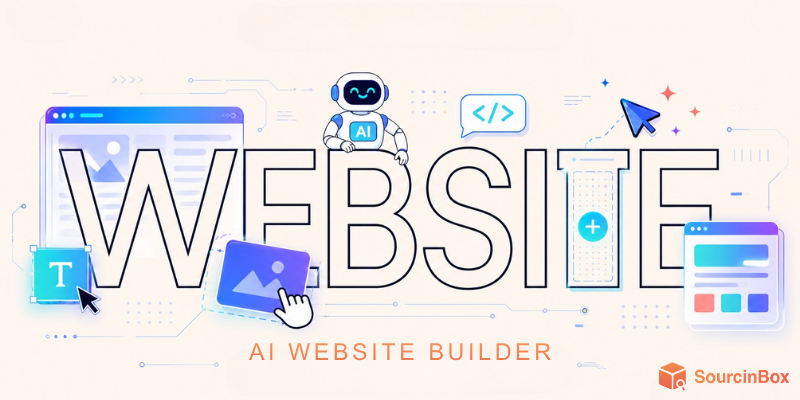
AI website builders can significantly shorten the store development process.
Building a store the traditional way often requires designers and developers. It also takes considerable time because of the back-and-forth communication and repeated revisions involved.
With an AI website builder, you only need to send clear instructions. It can then automatically generate high-converting designs, from homepage layouts to product detail pages.
Some AI website-building tools can also automatically integrate core ecommerce functions, including mobile optimization, payment systems, and product categories.
This process does not require coding or design experience, and there is no need to hire developers. Beginner sellers can usually build and launch a store within a short period of time.
The following AI website-building tools can help you quickly build a store and start dropshipping:
✦ Shopify
✦ Weblium
✦ Durable
✦ Wix ADI
✦ Hostinger
✦ Squarespace
Smarter Product Research and Market Trend Analysis
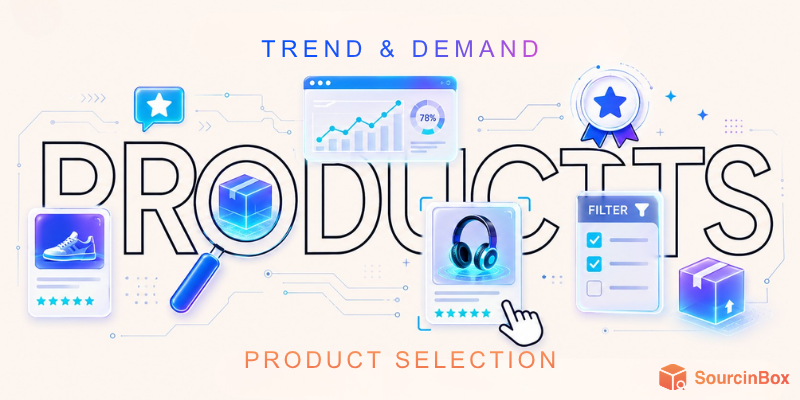
AI product research tools can help you find trending products that are suitable for dropshipping.
Air coolers and air conditioners are selling well in Europe, but large products like these are not necessarily suitable for dropshipping.
Meanwhile, lightweight and small products may have limited profit margins.
When facing this dilemma, AI can help recommend products that meet market demand while also being suitable for dropshipping.
AI can track trending products on social media platforms such as TikTok and Pinterest in real time.
It can also analyze data such as clicks and time spent on a page. This helps it estimate which products interest consumers and how likely they are to make a purchase.
In addition to discovering high-potential products, AI product research tools can also help you determine whether a product is suitable to sell.
They can analyze competitors’ sales trends, price ranges, customer reviews, negative-review keywords, and ad creative performance.
This helps you identify products that are already overly competitive. You can also find products that are still in the early stages of growth and target blue-ocean opportunities more accurately.
If you need trend monitoring, competitor store analysis, and advertising insights to support product research, the following tools are worth paying attention to:
✦ Google Trends
✦ Minea
✦ PPSpy
✦ Peeksta
AI Advertising and Social Media Management
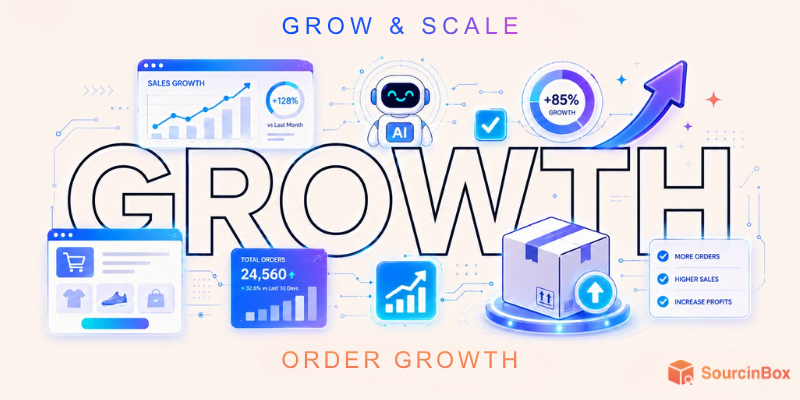
AI advertising tools can generate ad creatives efficiently.
For most sellers, the challenge is not only how long it takes to create ad creatives. The real question is whether those creatives can actually drive profitable sales.
AI advertising tools can create multiple images, videos, and other ad creatives for the same product. Each version can highlight a different selling point.
How can you decide which creatives are worth scaling?
AI can use historical data to evaluate the performance of different ad creatives. It can also suggest how to allocate your budget and help reduce unnecessary spending.
After an ad goes live, AI can monitor its click-through rate, conversion rate, and customer acquisition cost in real time. It can then provide suggestions for further optimization.
SourcinBox has selected 9 practical advertising tools with different strengths, together with advertising strategies to promote your AI dropshipping:
✦ Canca Magic Studio
✦ AdCreative.ai
✦ Flair AI
✦ Nano Banana
✦ Creatify
✦ HeyGen
✦ Copy.ai
✦ Pencil
✦ Triple Whale
As your store continues to grow and your social media advertising budget increases, how can you efficiently manage multiple social media accounts?
Managing several social media accounts manually can be overwhelming for dropshippers with larger stores. They need to schedule image and video ads, reply to comments, and handle inquiries sent through direct messages.
AI social media management tools can automate content scheduling and publish ads across multiple platforms. They can also monitor and analyze customer comments, helping sellers turn ad traffic into loyal customers.
The following AI social media management tools are worth considering for dropshippers operating medium-sized and large stores:
✦ Brand 24
✦ Brandwatch
✦ SocialBee
✦ Hootsuite
For larger stores, building customer trust and increasing average order value are also important. A partner that provides custom-branded packaging can help support further business growth.
Faster Customer Service and FAQ Responses
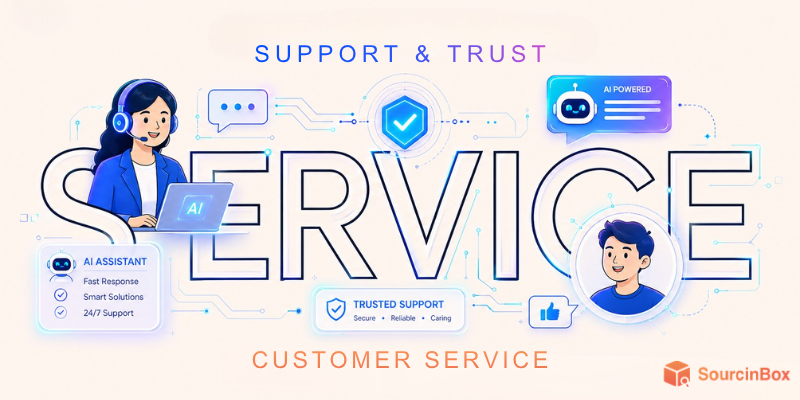
AI customer service tools can greatly reduce repetitive customer service questions and improve operational efficiency.
Dropshippers often receive the same questions about product sizes, shipment tracking, order status, and other FAQs. Although these questions are usually straightforward, answering them repeatedly can quickly become frustrating.
AI customer service tools can provide efficient 24/7 responses. Even customers in different time zones can receive timely and detailed service.
When a customer asks about the shipping status, AI can accurately check the tracking information and provide the estimated arrival time.
If a customer requests a return or refund, AI can acknowledge their concerns and guide them to the appropriate after-sales or human support process.
Another advantage of AI customer service is that it can combine users’ historical chat records, browsing behavior, and purchase history to provide personalized product recommendations.
This type of service can improve the shopping experience while also supporting conversions and increasing store sales.
We have carefully selected 8 AI customer service tools suitable for businesses of different sizes, together with detailed tutorials:
✦ Shopify Inbox & Shopify Magic
✦ Tidio
✦ Freshdesk
✦ Kommunicate
✦ Intercom
✦ Gorgias
✦ Zendesk
✦ Kustomer AI
Order Management and Workflow Automation
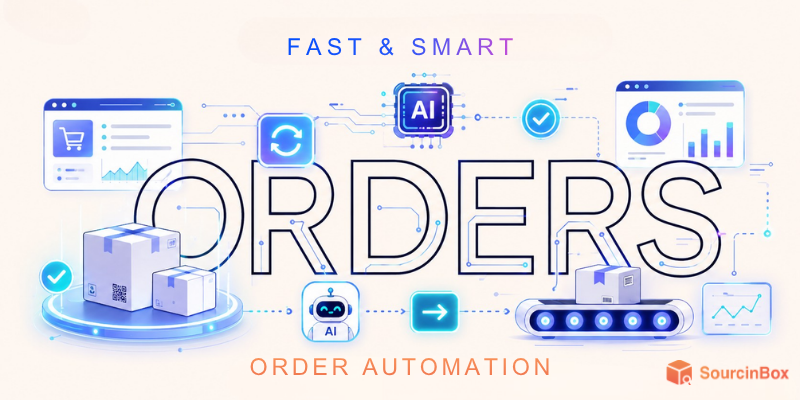
Order management and workflow automation play a decisive role in successful order fulfillment in AI dropshipping.
AI website-building tools help you launch your store. AI product research tools help you find suitable products. AI advertising tools help you attract customers. AI customer service tools provide consumers with a better shopping experience.
However, attracting customers is only the beginning. Once orders start coming in, customer satisfaction depends on how well those orders are fulfilled.
Order management, product sourcing, quality inspection, shipment tracking, and after-sales service all play a critical role.
Compared with dropshipping operation platforms such as Spocket, DSers, and Easync, which charge at least $20 per month, SourcinBox provides the following services for free:
✦ 1v1 customer manager
✦ Product research and supplier coordination
✦ Automated order processing
✦ Product quality control
✦ Product customization
✦ Branded packaging
✦ Global shipment tracking
✦ Order fulfillment and after-sales service
How to Automate Your Dropshipping Business?
Does using more tools automatically make your store more efficient?
Not necessarily.
A more effective approach is to set a clear goal and choose tools that support it. Test and refine your workflow until you find an automation method that works for your store. You also need to understand the limits of AI dropshipping and know which tasks still require human judgment.
1. Set Clear Goals and Choose the Right AI Tools
Dropshippers should set specific and practical goals based on their current business situation instead of blindly following technology trends.
For beginners, the main goal is to use AI website-building tools and product research tools to complete the basic dropshipping business process.
If you run a medium-sized store, the goal should be to use AI advertising and customer service tools to improve conversion rates.
Sellers operating large stores can choose AI data analysis tools to identify operational processes that can be optimized through data.
| Store Stage | Main Goal | Recommended AI Tools |
|---|---|---|
| Small Stores | Start quickly and test products | Shopify, Wix AI, Hostinger, Google Trends, Sell The Trend, Minea |
| Medium Stores | Improve marketing efficiency and customer conversion | Creatify, HeyGen, Copy.ai, Canva Magic Studio, AdCreative.ai, Tidio |
| Large Stores | Automate operations and scale efficiently | SocialBee, Hootsuite, Brandwatch, Zendesk, Intercom, Triple Whale |
No matter the size of your store, working with an experienced and reliable dropshipping agent helps a lot. It’s really responsible for order fulfillment.
2. Test and Optimize Your Automated Dropshipping Workflow
AI dropshipping does not completely replace people. Instead, it helps dropshippers reduce repetitive work.
Before applying AI tools to real workflows, dropshippers need to test and optimize them.
We have summarized the main areas you should test:
➢ Start by testing one specific process instead of the entire business workflow, such as product description generation, ad creative production, FAQ responses, or trending-product analysis…
➢ Set specific measurement indicators to determine whether AI has truly improved efficiency, such as actual store-building time, how much ad testing costs have been reduced, and customer response speed…
➢ During testing, manually review whether AI-generated content is accurate, including product information, marketing copy, and replies to customer questions…
➢ Continuously optimize the AI workflow based on test results by adjusting prompts, replacing unsuitable AI tools, and maintaining human review…
3. Make Sure What AI Can and Cannot Do for Dropshipping
A successful dropshipping business does not rely only on AI. Sellers must clearly understand the boundaries of AI and know what it can and cannot do.
What can AI help with in Dropshipping Automation?
The main value of AI dropshipping is that it can help sellers of all sizes. It improves efficiency across different parts of the business and reduces the cost of trial and error.
What AI Cannot do in the dropshipping workflow?
Although AI is powerful, it cannot completely replace several key parts of real business operations, including product sourcing, quality inspection, logistics, and after-sales service.
The right approach is to use AI to improve front-end marketing and attract customers. You then need a reliable order fulfillment partner to support back-end operations and turn traffic into actual orders and revenue.
What You Need Beyond AI: A Reliable Supply Chain Partner
Since AI has already become so powerful, what else does a dropshipper need?
AI can help you with front-end operations, including store building, trending product discovery, ad generation and optimization, and automated customer service.
However, AI cannot provide the physical products, suppliers, quality control, and order fulfillment required to complete a transaction.
Once products enter the actual sales stage, dropshippers still need reliable supply chain support.
| Dropshipping Need | AI Can Help With | Supply Chain Partners Can Help With |
|---|---|---|
| Store Building | Store layout ideas and product page structure | Product information, images, and customization support |
| Product Research | Trend discovery, competitor analysis, and product idea generation | Supplier sourcing, product verification, and sample checking |
| Advertising | Ad creatives, audience analysis, and campaign optimization | Real product details and marketing materials based on actual products |
| Customer Service | Chatbots, FAQ generation, and automated replies | Shipping updates, after-sales support, and customer issue handling |
| Order Fulfillment | Workflow automation and order data analysis | Order processing, quality inspection, packaging, and global shipping |
SourcinBox has extensive experience in supply chain support.
After AI helps with front-end operations, SourcinBox supports the back end of your business.
We help verify supplier qualifications, maintain product quality, synchronize orders, track shipments, and provide after-sales support. These are all critical to successful order fulfillment.
Frequently Asked Questions
What is AI dropshipping?
AI dropshipping refers to applying artificial intelligence technology to different parts of a dropshipping workflow. Store building, product research, advertising, customer service, and order automation are all areas where AI can play a role.
How does AI help in dropshipping automation?
AI can help dropshippers automatically complete many repetitive tasks, such as analyzing market trends, generating product descriptions, creating marketing content, answering FAQs, and organizing order-related information.
Can AI fully automate a dropshipping business?
AI can automate repetitive tasks and make daily operations more efficient, but it cannot completely replace human judgment. Supplier selection, product quality inspection, and the handling of complex after-sales issues still require professional partners.
What are the risks of using AI in dropshipping?
Relying too heavily on AI may lead to incorrect product information, inaccurate marketing content, and other problems. Sellers need to manually review AI-generated content to ensure that the information is accurate and complies with platform rules.
How should beginners start using AI for dropshipping?
Beginners should not try to automate the entire store at the beginning. Instead, they should start with one specific business process.
You can begin by using AI to generate product descriptions, create ad creatives, or handle common customer questions. Then, gradually expand the use of AI based on the how well it works in practice.
Do I still need a supplier for AI dropshipping?
AI can help sellers identify product opportunities, improve their marketing workflows, and run their stores more efficiently.
Supplier selection, product sourcing, quality inspection, packaging, inventory management, and logistics directly affect customer satisfaction and the long-term development of a store.
Share Article: