How to Find Winning Products for Dropshipping?

SIB Content Team
Finding winning products is one of the biggest challenges when running a dropshipping business. Some stores manage to scale quickly, while others struggle to generate consistent sales. In many cases, the difference starts with the products they choose to sell.
Even good store design, advertising, and customer service can only take you so far if the product itself has weak demand.
Quick Answer: How to Find Winning Products for Dropshipping
Finding winning products is not about chasing short-term trends on a single platform. A better approach is to discover potential items through multiple sources, including product research tools, social media, online marketplaces, competitor research, search trends, customer feedback, and sourcing channels.
When evaluating potential products, consider real demand, manageable competition, healthy profit margins, and whether sourcing, shipping, and fulfillment are feasible.
A trending product is only a candidate. Looking at signals from multiple channels gives you a more reliable basis for deciding whether a product has real potential.
This guide breaks down 5 key traits of a winning product, 7 practical ways to find promising products, and 5 common mistakes to avoid.
What Makes a Winning Dropshipping Product
Choosing winning products is not just about following social media trends. You also need to consider whether a product is truly suitable for dropshipping.
Here are some key characteristics to look for:
- It Has Real and Sustainable Market Demand
A winning product should have steady demand, including predictable seasonal or event-driven demand such as back-to-school or Halloween products.
- It Solves a Real Problem and Is Easy to Demonstrate
The best products solve a real problem and are easy to understand. Customers quickly see how the product works and why it is useful.
- It Targets a Clear Audience and Has Strong Selling Points
Products with clear target audiences and strong selling points are easier to market. Unique features, functions, or packaging can also help them stand out.
- It Has Healthy Profit Margins and Room to Scale
A winning product should leave enough profit to cover sourcing, shipping, and marketing costs, while also offering opportunities to increase order value through bundles.
- It Is Easy to Source, Ship, and Fulfill
Small, lightweight, and durable products are usually easier to ship and manage. Reliable sourcing and fulfillment also support long-term sales.
How to Find Winning Products for Dropshipping
So how can you find winning dropshipping products that meet the criteria above?
A product suddenly going viral on TikTok may be worth watching, but that alone does not make it a winning item.
The methods we summarize below can help you cross-check different signals and find products with stronger potential for long-term sales.
Use Product Research Tools to Find Potential Products
Compared with choosing products based on instinct, product research tools can help you spot market signals and quickly narrow down products worth further research.
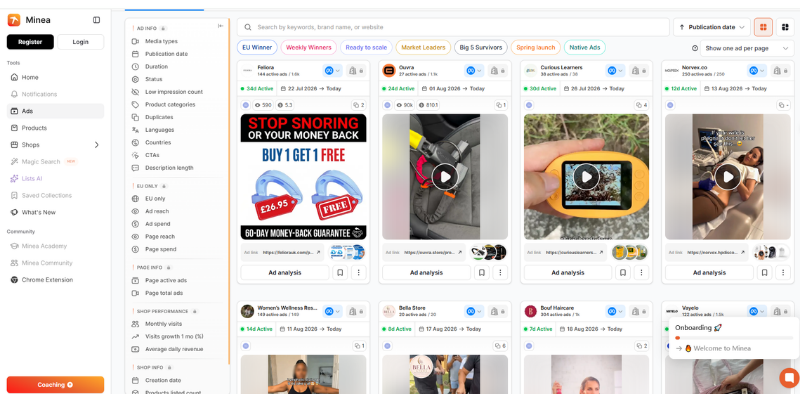
Tools such as Minea and PiPiADS can make dropshipping product research more efficient by showing which products are actively being advertised. They provide useful information about market competition.
Pay particular attention to these signals:
✦ Ad duration: Products with ads running consistently are usually worth more attention than those appearing only briefly.
✦ Number of advertisers: If several advertisers are promoting the same product, it may signal market interest and stronger competition.
Explore Product Trends on Social Media
If you want to discover trending products directly from consumer activity, social media is a useful place to start.

Different platforms are useful for different product types:
TikTok for visual, easy-to-demonstrate products, Instagram for beauty, fashion, and lifestyle items, Pinterest for home decor and DIY ideas, and YouTube for products that benefit from longer reviews or demonstrations, such as electronics and beauty devices.
Do not focus only on views. Look at likes, saves, shares, comments, and questions about price or where to buy. When the same product starts appearing across multiple accounts and social platforms, it can be a sign that market interest is growing.
Find Product Opportunities on Online Marketplaces
Large online marketplaces provide real purchasing data that can help you identify product opportunities.

Amazon, AliExpress, and eBay offer plenty of useful market information. Dropshippers can use trending product sections and best-seller lists to find products that are gaining traction. AliExpress can also help you compare price ranges, supply availability, and product variations.
Ratings and reviews are another useful source of information. They can show why customers buy a product and reveal common problems with existing options.
Research Competitors’ Best-Selling Products and Ads
Careful competitor research can help you identify gaps in the market and find ways to stand out.
If many sellers are already selling the same product with similar prices, product pages, and selling points, competition is likely to be high.
You can use Meta Ads Library to study competitors’ key selling points and marketing angles, then review their product pages, pricing, images, and customer feedback to spot gaps in the market.
The goal is not to copy the same product, but to find a different way to position or improve it.
Check Product Demand by Search Trends
Compared with short-term social media trends, search trends can give you a better view of ongoing consumer demand.
Google Trends is a free tool that shows whether search interest for a product keyword is rising, stable, seasonal, or driven by a short-term spike.
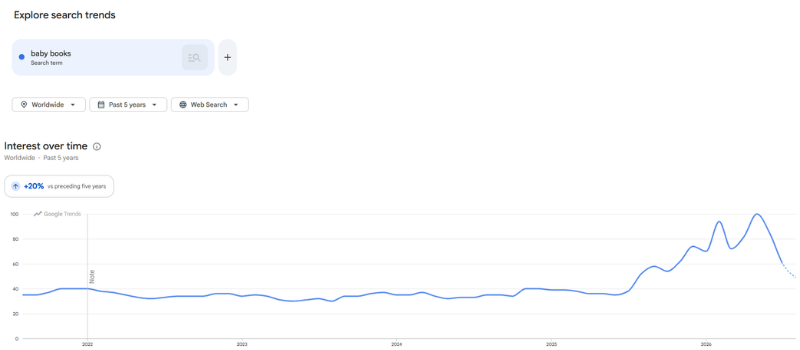
For example, if you are researching mom and baby products, you can compare search interest for a keyword such as “baby books” across different periods and regions.
The trend may show relatively steady demand without a clear off-season. Products with this kind of consistent interest can be useful starting points when looking for winning products.
If you are researching this category further, you can also check our best-selling mom and baby products for more product ideas.
Besides looking at a single keyword, you can use keyword research tools such as Google Keyword Planner and Semrush to compare search interest across several terms. This can help you understand which product types consumers are more interested in.
Find Customer Needs in Reviews and Online Communities
Instead of looking only at products that are already selling well, you can also find product opportunities in discussions on platforms such as Reddit and Facebook Groups.
These communities can reveal real customer problems and unmet needs.
For example, users in kitchen-related discussions may complain that standard measuring cups spill easily when pouring liquids, making it difficult to control the amount or flow. Others may point out that an electric cleaning brush has a handle that is too long, making it harder to control the pressure while cleaning.
These complaints do more than show dissatisfaction. They can also reveal ways existing products could be improved and help you find alternatives with better design or usability.
If you want to explore this category further, you can also check our best kitchen tools for dropshipping to see which products fit specific use cases and solve common customer pain points.
Get Product Ideas from Suppliers and Sourcing Channels
Suppliers and dropshipping agents work closely with new products and manufacturers, so they can also be useful sources of product ideas.
✦ SourcinBox Blog provides guides on dropshipping niches, winning products, and seasonal product opportunities.

✦ YouTube Channel shares dropshipping product ideas across different niches.
✦ TikTok & Instagram show product use cases and key selling points.

✦ LinkedIn covers seasonal sales opportunities and broader ecommerce trends.

Avoid Common Mistakes in Dropshipping Product Research
Some products may look promising at first, but that does not mean they are ready to scale. Watch out for 5 common mistakes during winning dropshipping product discovery.
Following Trends Without Checking Real Demand
A viral TikTok video or an Amazon Best Seller ranking can make a product worth watching, but neither proves long-term demand. Some products are driven by short-lived trends, while others may already be losing momentum.
Looking at Sales Without Calculating Profit and Costs
A product is only worth scaling if it still leaves a healthy profit after all major costs are deducted.
For example, a dropshipping store may generate $17,420.50 in sales, with $5,680 in ad spend, $4,850 in product and shipping costs, and $580 in payment and app fees. After these costs, the net profit is $6,310.50, or about 36.2%.
For dropshippers, high sales do not always mean high profits. You need to account for sourcing, shipping, advertising, payment fees, and after-sales costs.
Entering a Crowded Market Without a Clear Selling Angle
Strong demand does not guarantee an easy opportunity in a crowded market. If many sellers already offer the same product at similar prices with similar selling points, entering without clear differentiation can quickly lead to price competition.
Ignoring Shipping, Quality, and Supply Chain Risks
Some products may have strong demand and margins but still be unsuitable for dropshipping.
Large, fragile, liquid, battery-powered, copyrighted, or restricted products can lead to higher shipping, packaging, damage, and return costs. You should also check product quality, stock stability, and after-sales risks before selling.
Investing Too Much Too Early
Do not spend heavily on inventory, ads, or creatives before demand, margins, and supply conditions are clear.
A safer approach is to validate the basics first, then test with a small budget. Increase your investment only after the product shows real sales potential.
What to Do After Finding a Potential Winning Product
Once you find a potential winning product, the next step is to validate whether it is practical to sell. You should confirm sourcing costs, product quality, and shipping conditions, then use small-scale testing to see how the market responds.
SourcinBox can help you prepare the supply chain before and after product testing:
✧ Product sourcing: Find suitable suppliers and compare sourcing prices and product specifications.
✧ Supplier communication: Confirm MOQ, product details, stock, and production lead times.
✧ Quality inspection: Check products before shipping to identify obvious quality, specification, or packaging issues.
✧ Packaging support: Provide standard, custom, and branded packaging based on your product and sales needs.
✧ International shipping: Match suitable shipping options based on product type, destination, and delivery requirements.
✧ Warehousing and fulfillment: Support inventory management, packing, and order fulfillment based on your order needs.
With SourcinBox, you will be clearer about the real cost, quality, and fulfillment conditions before investing more in ads or inventory. Once both the market test and supply chain meet expectations, you can scale gradually.
Frequently Asked Questions
What is a winning product in dropshipping?
A winning product should have real market demand, clear selling points, healthy profit margins, and practical sourcing, shipping, and fulfillment conditions. Ideally, it should also have the potential for long-term sales and growth.
How do I find winning products for dropshipping?
Use multiple sources to find potential products. Product research tools can highlight promising products, while social media and search trends reveal consumer interest. Marketplace data shows real sales activity. Competitor research, reviews, and online communities can help you spot gaps and opportunities.
How do I know if a dropshipping product is too saturated?
A market may be highly competitive if many sellers offer the same product. Check the number of competitors, their ads, pricing, and customer reviews. A product may still have potential if you can target a different audience or find a different marketing angle.
Do I need paid product research tools to find winning products?
Paid tools can make it faster to collect ad data and market signals, but they are not essential. You can also use free sources such as social media, online marketplaces, search trends, and online communities to compare demand and competition.

Share Article: