Ecommerce Advertising Strategies: 9 AI Tools for Dropshippers in 2026

SIB Content Team
In 2026, compared with traditional advertising platforms such as Facebook, TikTok, and Google, AI is becoming both a new entry point for online shopping and an emerging traffic source for ecommerce advertising.
➢ In Q1 2026, AI-referred traffic to U.S. retail websites increased by 393% year over year.
➢ AI-referred visitors had a 42% higher conversion rate than visitors from non-AI sources.
➢53% of businesses have already started allocating budget to conversational AI advertising.
➢ The latest version of Shopify is connecting the product data to the AI channels, giving products more opportunities to be discovered and recommended by AI.
For dropshippers, these trends bring both opportunities and challenges.
This guide will walk you through the latest ecommerce advertising trends in 2026 and help you find 5 practical advertising strategies for dropshippers. It will also introduce 9 useful AI advertising tools to help you create ad creatives, test product selling points, and improve ad performance.
Keep reading to learn how to generate ad creatives more efficiently, test product selling points, and optimize ad performance.
Quick Answer: What Is the Best E-commerce Advertising Strategy for Dropshippers in 2026?
In 2026, the best advertising strategy for dropshippers is to take advantage of AI as an emerging traffic opportunity. Dropshippers should not limit themselves to traditional search engine ads and social media advertising. Instead, they need to explore emerging advertising opportunities in Google AI Overviews, ChatGPT, and AI shopping assistants.
To capture the traffic opportunities brought by AI advertising, dropshippers first need to prepare clear product data so that AI systems and advertising platforms can better understand their products. Next, they should choose the right AI tools to generate multiple ad variations and use small-budget tests to identify creatives with stronger conversion potential.
Before scaling campaigns, dropshippers should manually review ad content to make sure it is truthful, accurate, and compliant. Finally, they also need to ensure that product sourcing, product quality, and order fulfillment can support the traffic generated by advertising.
What Is AI Advertising?
AI advertising refers to the use of artificial intelligence to generate ad creatives, optimize ad campaigns, and improve advertising performance.
The value of AI in ecommerce advertising lies in its ability to quickly generate different types of ad creatives based on product information, target audience, platform characteristics, and campaign goals.
AI advertising tools can also help sellers test different selling points, visual styles, and marketing angles to identify high-potential ad creatives. After campaigns go live, AI can further optimize performance by adjusting creatives, audience targeting, or budget allocation based on real-time data.
With the right AI advertising strategies, dropshippers can test product ads faster and understand their target audience more clearly. This helps them focus their budget on the creatives and channels that are more likely to drive conversions.
Why Do Dropshippers Need AI Advertising Strategies?
As AI becomes a new shopping entry point, dropshippers need to rethink their advertising strategies.
✧ Is using AI to generate ad creatives more efficient? Can AI-generated ad creatives boost clicks and conversions?
✧ Can AI monitoring and analyzing ad data make my campaigns more precise?
✧ As consumers increasingly prefer asking AI for shopping advice, can I advertise on platforms like Google AI Overview, ChatGPT, or AI shopping experiences connected to Shopify?
Consumer shopping habits are changing, and AI-generated ad creatives are becoming easier and faster to produce. Together, these shifts make AI advertising a new growth opportunity for dropshippers.
We’ll explore 4 key trends to help dropshippers adjust their advertising strategies.
Smarter AI Advertising: Faster Product Testing and More Precise Audience Reach
AI helps dropshippers test product ads more efficiently and reach target customers with greater accuracy.
Traditional product ad testing is time-consuming, costly, and heavily reliant on experience. AI makes advertising faster, more objective, and more precise:
✦ Quickly generating ad creatives: AI can produce multiple ad variations for the same product, allowing sellers to test more creative ideas in a short time.
✦ Predicting ad performance: Based on historical ad data and past platform performance, AI can predict which ad ideas are more worth testing.
✦ Precise ad targeting: Using user behavior data, AI helps match product features with users who have higher purchase intent.
✦ Real-time data monitoring: AI quickly identifies which creatives, audiences, or channels perform best and detects ads that waste budget without driving effective conversions.
These advantages show how AI advertising strategies can help dropshippers validate products faster, lower ad testing costs, and improve sales conversions.
It’s important to note that AI-generated ad creatives cannot fully replace human aesthetic judgment. Currently, AI-generated images and copy can still look generic or template-like. To truly engage your target customers, you need to understand what content resonates with your audience.
Additionally, always review AI-generated ad creatives before using them in live campaigns. This prevents AI hallucinations, exaggerated claims, or inaccurate product descriptions. Sellers must verify content to ensure compliance with platform policies before going live.
Rising ecommerce Competition: Smarter Ad Decisions With AI Data
AI data analysis can help sellers manage ad campaigns more efficiently and more accurately, giving them an advantage in an increasingly competitive ecommerce market.
Ethnotek is a Shopify accessories brand. By analyzing Reddit user behavior data and connecting its Shopify product catalog with Reddit’s advertising system, the brand was able to identify high-intent shoppers and dynamically display relevant product ads.
As a result, Ethnotek increased its return on ad spend (ROAS) to 4x its previous level and reduced its cost per acquisition (CPA) by 40% compared with the benchmark.
As ecommerce competition becomes more intense, dropshippers should make better use of AI advertising tools to identify user interests faster and serve more relevant product ads.
This allows them to focus their budget on audiences with higher conversion potential and gain an edge amid rising ad costs and increasingly similar product offerings.
AI Is Reshaping Advertising: From Tech Giants to Ecommerce Sellers
Tech giants and ecommerce sellers are both changing their advertising strategies and accelerating their move into AI-powered ecommerce advertising.
✦ OpenAI has introduced updated advertising policies for ChatGPT.
✦ Google has started testing ads on a small scale in AI Mode and allows users to choose their preferred information sources.
✦ RedBalloon, an Australian experience gift ecommerce platform, used the AI digital marketing platform Albert to optimize its ad campaigns. Its return on ad spend (ROAS) once reached as high as 3000%, while its overall customer acquisition cost decreased by about 25%.
These cases show that tech giants are extending advertising into AI-powered search and shopping experiences, while ecommerce sellers are already using AI to improve ad conversion performance.
As more consumers use AI tools to discover products, compare options, and make purchase decisions, AI advertising is becoming an emerging traffic channel for dropshipping sellers. To stay visible, dropshippers need better advertising strategies that help their stores and products appear in AI-powered shopping experiences.
Changing Shopping Habits: From Keyword Search to AI Shopping Conversations
Compared with traditional keyword search, AI is changing the way consumers shop.
According to research from Boston Consulting Group, the use of generative AI for shopping-related activities increased by 35% from February 2025 to November 2025.
This growth shows that consumers are gradually becoming more willing to trust AI for direct, objective, and personalized shopping recommendations.
Whether they are buying high-value consumer electronics or everyday groceries, consumers are starting to use AI to discover products, compare options, and support purchase decisions.
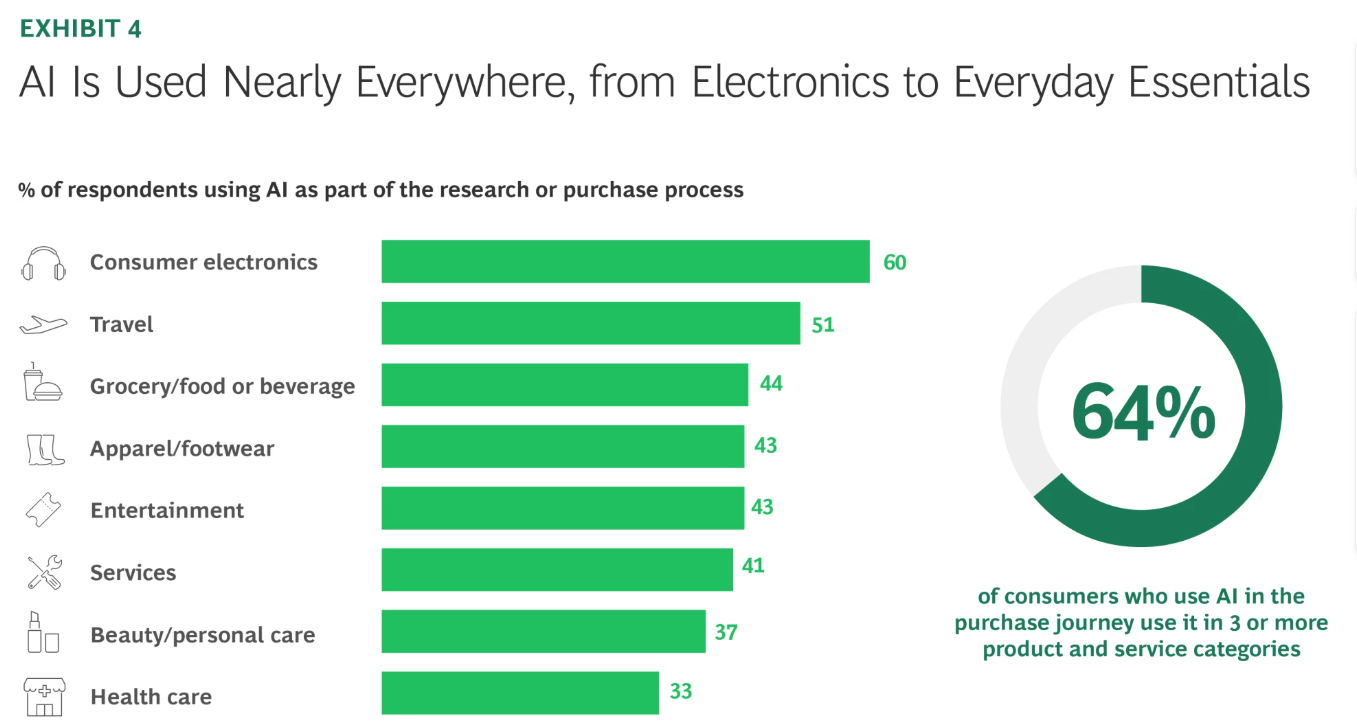
Source: BCG CCI GenAI Consumer Usage survey, November 2025
This means that consumer shopping entry points are no longer limited to traditional keyword-based search result pages. They are gradually expanding into AI Overviews in search engines (Google AI Overviews), native AI assistants (ChatGPT), and AI shopping assistants inside ecommerce platforms (Amazon Rufus).
For dropshippers, advertising should not remain limited to traditional search channels such as Google and Bing, or traditional social platforms such as TikTok and Instagram.
Instead, they need to adapt to the shift in shopping entry points and pay attention to advertising opportunities in AI shopping scenarios, including ChatGPT, Google AI Overviews, and AI shopping assistants.
What ecommerce Advertising Strategies Can Dropshippers Use?
To capture the opportunities brought by AI advertising, dropshippers need the right ecommerce advertising strategies. These strategies can help their stores and products appear in AI recommendations and AI Overviews.
The following 5 strategies can help you take advantage of AI advertising opportunities and grow your dropshipping business.
Explore Emerging AI Advertising Channels
In addition to common advertising channels such as Google Search, Bing, and Meta, dropshippers should also pay attention to new customer acquisition channels such as AI search, AI shopping assistants, and AI modes in search engines.
Shopify’s latest Spring Edition uses Shopify Catalog and the Universal Commerce Protocol to distribute product information across different AI channels. This means consumers may be able to see product information through AI conversations, such as ChatGPT and Google AI Overviews, and then click through directly to shop from a Shopify store.
For dropshippers, this means product information and key selling points need to be further optimized. When products are easier for AI to discover, understand, and recommend, it becomes easier to guide high-intent shoppers back to your store and turn them into customers.
OpenAI has also opened up advertising opportunities. Dropshippers can create ads through OpenAI Ads Manager Beta. This means your products may have the chance to appear directly in ChatGPT conversations.
Build a Strong Product Data Foundation
Before using AI advertising tools, dropshippers need to prepare clear and complete product information.
In the AI shopping era, the consumer shopping journey is shifting from keyword search to AI recommendations, AI-powered Q&A, and AI shopping conversations. AI advertising is becoming a new customer acquisition channel, but it is also creating new competition for product visibility.
To help AI understand your products more accurately and better identify who your products should be recommended to, dropshippers should optimize the key content on their product pages in advance:
✦ Product titles
✦ Product descriptions
✦ Product images
✦ Key selling points
✦ Real customer reviews
✦ Shipping information
✦ Return and exchange policies
✦ FAQ
Choose AI Tools Based on Your Current Needs
When choosing AI advertising tools, dropshippers should first identify the problem they need to solve most urgently.
Different tools are suitable for different stages of the advertising process
For beginners with limited budgets, it is better to start with only 1–2 tools. Choose tools that can directly improve ad testing efficiency, such as tools for basic ad images, product image optimization, or ad copy generation. Avoid subscribing to multiple platforms at the same time.
| Current Need | Recommended Tools | Reason |
|---|---|---|
| Quickly create basic ad images and social media creatives | Canva Magic Studio | Easy to use, suitable for beginners and later-stage image editing |
| Optimize product images and generate lifestyle backgrounds | Flair.ai | Suitable for batch product image background editing |
| Nano Banana | Cost-effective, suitable for turning standard product images into ad creatives | |
| Generate ad creative variations in bulk | AdCreative.ai | Suitable for quickly generating ad creatives from different angles |
| Create short video ads and AI video ads | Creatify | Suitable for quickly generating short video ads in different styles |
| Create product explainer videos or AI spokesperson videos | HeyGen | Suitable for product testing, brand introductions, and multilingual videos |
| Generate ad copy and marketing content | Copy.ai | Suitable for quickly generating ad headlines, body copy, CTAs, product descriptions, and social media copy |
| Predict ad performance in bulk | Pencil | Suitable for testing ad performance before large-scale ad spending |
| Analyze ad data and profit performance | Triple Whale | Suitable for teams with stable order volume and advertising budgets across multiple channels |
Test Different Marketing Angles Before Scaling Your Ads
Before scaling ad campaigns, dropshippers should first test different marketing angles with a smaller budget.
The advantage of AI advertising tools is that they can significantly shorten the time needed to generate ads. Sellers no longer have to rely on a single ad creative. Instead, they can generate different versions of ad creatives for the same product from multiple angles:
✦ Market pain points
✦ Use cases
✦ Real customer reviews
✦ Promotional offers
✦ Holiday and seasonal marketing
After running small-scale tests from these angles, dropshippers can observe which types of copy, visual styles, opening hooks, and product selling points are more likely to drive clicks and conversions.
At the same time, ad performance prediction, competitor analysis, and data tracking tools can also help sellers learn from historical ad data and competitor ad directions. This allows them to continuously optimize ad content and improve ROAS.
Create Drafts by AI, Refine Them by Hand
AI is better suited for creating drafts, not final versions that can be published directly.
Many experienced users of AI advertising tools have mentioned the same problem. One of the most common beginner mistakes is expecting AI to generate a perfect, ready-to-publish ad in one attempt.
AI can quickly generate ad images, copy, scripts, and video drafts. However, before publishing them, dropshippers should manually check the following points:
✦ Whether the product images match the actual product
✦ Whether customer reviews and advertising claims are truthful
✦ Whether the video pacing, tone, and wording feel natural
✦ Whether the ad content complies with policy requirements, especially in the U.S. and the EU
Exaggerated product effects, inaccurate product images, and unclear shipping information can all lead to customer complaints, refunds, or even risks to the ad account.
Dropshippers should let AI handle repetitive creative generation tasks, while humans take responsibility for the final quality review.
9 Best AI Tools to Create, Test, and Optimize Dropshipping Ads
How can dropshippers choose the right AI tools and use AI advertising to stand out from competitors?
Some AI tools can quickly generate ad creatives such as images, videos, and copy. Some can create AI spokesperson videos. Others can predict ad performance, analyze advertising data, and more. There are now many tools available on the market.
AI tools can help dropshippers generate ad images, videos, and copy faster, reducing the time spent on manual creative production. As the number of ad creatives increases, AI ad prediction and data analysis tools can help sellers decide which creatives are worth scaling.
However, different AI tools have their own strengths and limitations. Sellers should choose the right tools based on their advertising goals and budget.
SourcinBox has listed 9 common and practical AI advertising tools for dropshippers.
Dropshippers can choose the right tools based on their current advertising goals, budget, and each tool’s main focus. In this way, AI can better support their ecommerce advertising strategies.
| Platform | Best for | Pricing Level |
|---|---|---|
| Canva Magic Studio | Basic ad creatives and quick image editing | Low |
| AdCreative.ai | Bulk ad creative variations and fast ad testing | Medium |
| Flair AI | Bulk product image and lifestyle background editing | Low–Medium |
| Nano Banana | Cost-effective static ads and product image optimization | Low |
| Creatify | Short video ad testing in multiple styles | Medium |
| HeyGen | Product explainers, brand videos, and multilingual videos | Medium |
| Copy.ai | Multiple versions of ad copy and marketing content | Low–Medium |
| Pencil | Ad creative testing before scaling | Medium |
| Triple Whale | Multi-channel ad data and profit analysis | Medium–High |
Canva Magic Studio
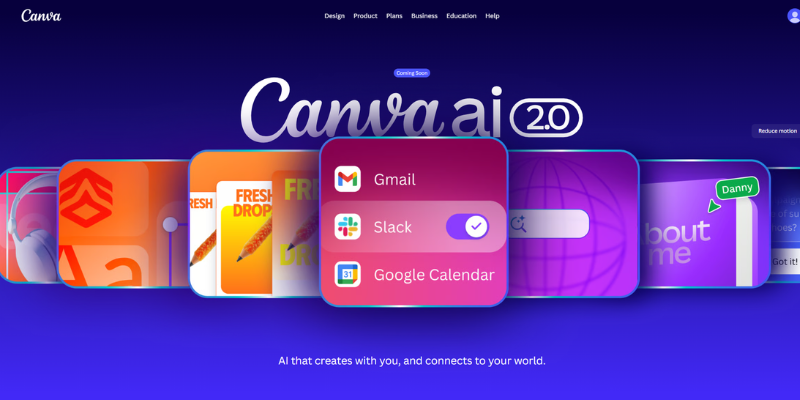
Canva Magic Studio is suitable for small dropshipping teams that need to quickly create simple social media ads, product banners, and short video creatives.
With Canva Magic Studio’s templates, AI generation features, and drag-and-drop editor, users can quickly create basic ad creatives. It is a practical tool for simple ads creative production.
Key Features:
➤ Low learning curve: Users can create ad creatives with simple operations. Even without professional design experience, they can quickly produce basic ad images.
➤ Better brand consistency: Canva supports Brand Kit, allowing sellers to set up brand logos, colors, fonts, and visual styles in advance. This helps keep the store’s brand image consistent and professional when creating different ad creatives.
➤ Multi-platform ad resizing: The Magic Resize can quickly adjust the same set of ad creatives into the sizes required by different platforms such as Instagram, Facebook, and TikTok. This makes it easier to test and run ads across multiple channels.
Pricing:
Canva offers a free plan for individuals. It uses tiered pricing, with the individual premium plan starting at $144/year. A free trial is available.
Pros & Cons From Users:
Canva Magic Studio is a good entry-level choice for sellers with limited budgets and a useful tool for later-stage image editing, but it is not a main ad generation tool. Many users say the Magic Eraser feature is very practical because it can remove unnecessary elements while keeping the background as natural as possible.
However, sellers who need to generate high-converting ad creatives in bulk may still need to use it together with more professional ad creative tools.
AdCreative.ai
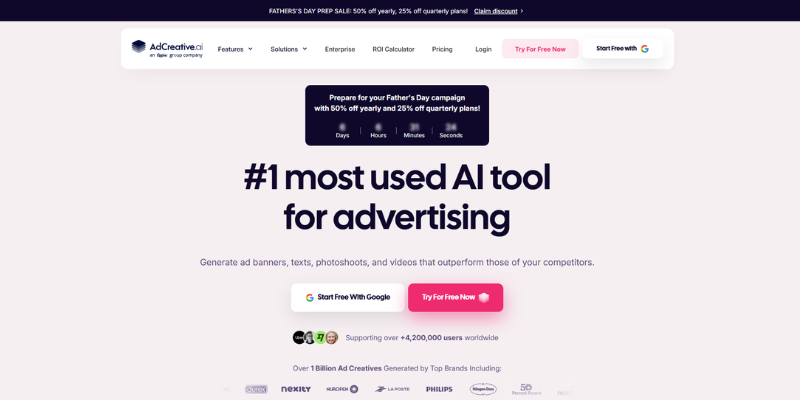
AdCreative.ai is suitable for ecommerce teams that need to quickly generate ad creatives in bulk. Based on product information, brand assets, and campaign goals, AdCreative.ai can quickly generate different ad images, videos, headlines, and copy. This helps sellers reduce the time needed from creative planning to ad production.
Key Features:
➤ Fast ad creative generation: After users upload product images and brand assets, AdCreative.ai can quickly generate multiple versions of static ads. For sellers who need many ad creative variations, this tool can greatly improve efficiency.
➤ Competitor insights: AdCreative.ai can collect competitors’ best-performing ad creatives from the past 90 days and analyze their visual patterns.
➤ Strong product photo feature: Standard white-background product images can be turned into multiple lifestyle scenes with one click, helping sellers reduce the cost of studio photography.
Pricing:
AdCreative.ai offers a free trial and supports monthly, quarterly, and annual billing. The basic monthly plan starts at $39/month.
Pros & Cons From Users:
Experienced users say AdCreative.ai is useful for generating ad creative variations in bulk, but the customization options after generation are limited. Dropshippers may need to use other tools for further editing.
In addition, AdCreative.ai credits do not roll over to the next month, and some users mention the risk of automatic billing without email reminders.
Flair AI
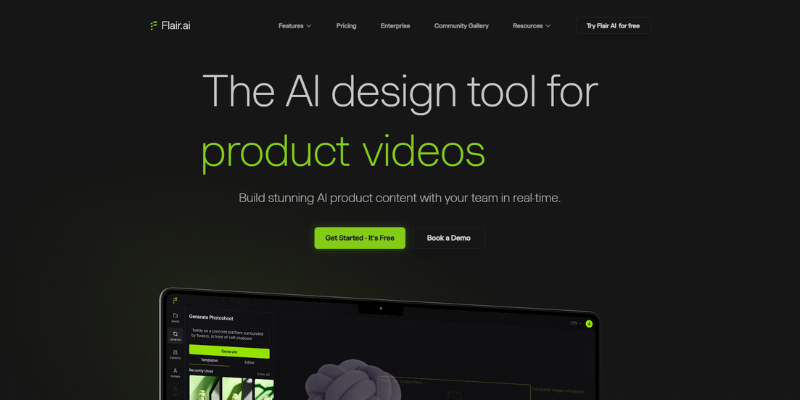
Flair.ai is more suitable for small and medium-sized ecommerce teams that need to replace product backgrounds in bulk.
Flair.ai is an AI product photography and ad visual generation tool. It mainly helps sellers turn ordinary product images into high-quality ad creatives that show products in lifestyle scenes or studio-quality settings
Key Features:
➤ AI product ad scene images: Flair.ai can place ordinary product images into different backgrounds and scenes, making product images more suitable for ads and social media display. This helps reduce the cost of reshooting product photos.
➤ Personalized background adjustments: Sellers can adjust visual styles based on different products and ad themes, including backgrounds, lighting, product placement, and the overall atmosphere.
➤ AI virtual models: Flair.ai offers an on-model photography feature, which can generate product images that look closer to real model or try-on displays. This is suitable for visual product categories such as fashion, beauty, and home products.
Pricing:
Flair.ai offers a free plan. Paid plans start at $10/month.
Pros & Cons From Users:
Based on real user feedback, Flair.ai’s strengths are its relatively user-friendly operation, fast generation speed, and flexible control over backgrounds, composition, and visual style. It can quickly produce a wide range of product scene images.
Some users mention that credits can be consumed quickly, and there is sometimes a gap between pricing and actual use value. During deeper use, users have also found that Flair.ai still has limitations in product consistency, complex texture handling, and output reliability.
Nano Banana
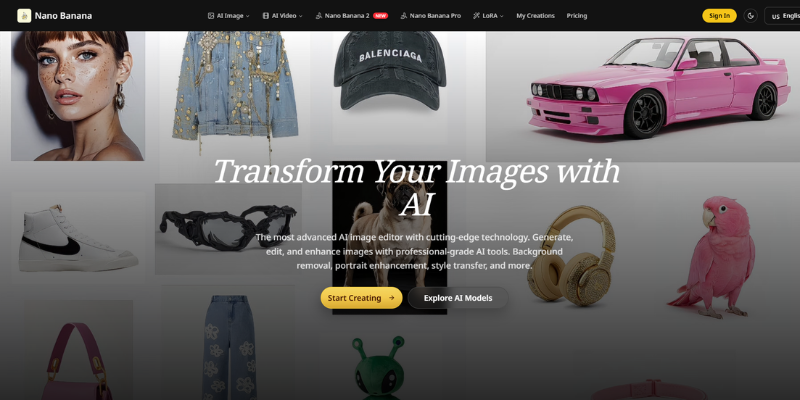
Nano Banana is suitable for small and medium-sized sellers who need to optimize product images.
It is an AI image generation and editing tool that can be used for product image editing, ad scene image generation, and visual creative exploration. It helps sellers turn ordinary product images into creatives that are more suitable for social media and advertising.
Key Features:
➤ Text-to-image ad creatives: With the text-to-image capability of Google Gemini, Nano Banana allows sellers to quickly generate visual creatives for testing by describing the product, scene, style, and ad atmosphere.
➤ AI product image editing: Nano Banana can edit existing product images, such as changing backgrounds, adjusting lighting, modifying the visual style, adding usage scenes, or improving composition.
➤ Cost-effective: It offers credit-based purchase packages, and the credit consumption rate is relatively moderate.
Pricing:
Nano Banana supports credit purchases, annual billing, and monthly billing. The basic monthly plan starts at $14.9/month.
Pros & Cons From Users:
Nano Banana is one of the image ad generation tools commonly used by ecommerce sellers in their advertising strategies. It is especially useful for creating lifestyle scene images, product display images, and ad creatives with text labels.
Users generally think it has a low image generation cost and offers good value for money. This makes it suitable for dropshippers who need to quickly generate multiple versions of static ad images during the product testing stage.
However, its video generation performance is relatively limited, and the videos can look somewhat template-like.
Creatify
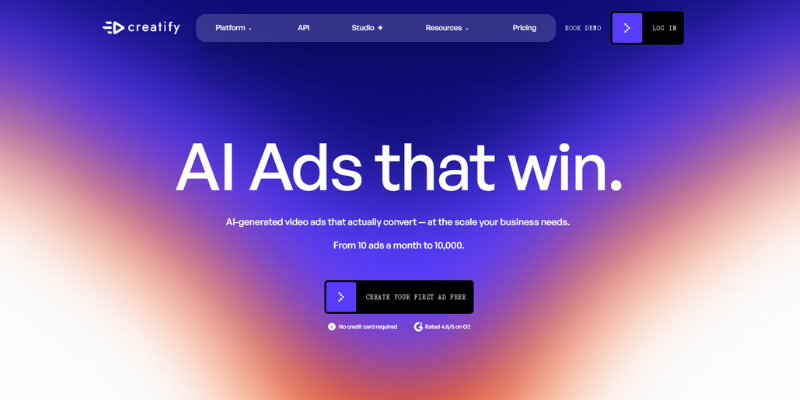
Creatify is an AI video ad generator suitable for small and medium-sized ecommerce sellers. This tool can quickly produce video ads for social media advertising, such as product video ads, UGC-style ads, AI avatar videos, and short video ad creatives.
Key Features:
➤ Generate video ads from product links: Creatify can turn a product page URL into a video ad. Sellers only need to enter the product link, and the AI can analyze the product information and generate the corresponding video creative.
➤ UGC-style ads: Creatify supports ad content that looks like real user recommendations, product reviews, and short-form social media videos. Sellers can use AI characters, automated scripts, and voiceovers without appearing on camera, recording audio, or editing videos themselves.
➤ Suitable for multi-platform short video ad production: Creatify’s video ads can be used on platforms such as Meta, TikTok, and YouTube. This makes it suitable for sellers who want to test different video creatives for the same product across multiple channels.
Pricing:
Creatify uses tiered pricing, with the basic plan starting at $39/month.
Pros & Cons From Users:
Creatify is a frequently mentioned AI tool in the video advertising space and is often used as an AI video ad generator. Its core strengths are URL-to-video generation and bulk generation of AI avatar ad variations.
Some users report that the quality of AI avatars is not always stable, and the usable output rate can be limited. Overall, its performance is still slightly below real human videos.
A common way to use Creatify is to first test multiple video directions quickly. After identifying the better-performing creative angles, sellers can then work with real creators or further refine the videos into final ad creatives.
HeyGen
HeyGen is suitable for small and medium-sized dropshipping teams that need to create AI avatar videos. Its core features include AI avatars, digital twins, voice cloning, and video translation, helping users quickly produce talking-head videos.

Key Features:
➤ AI avatar videos: Users only need to enter a script, choose an avatar, and select a language to generate videos that look like a real person explaining a product. This is suitable for product introductions, brand explanations, ad voiceovers, and tutorial content.
➤ Custom digital twins: HeyGen allows sellers to create custom digital twins. Sellers can record a calibration video to create an AI avatar that closely matches their appearance and voice style. This can be used for long-term brand videos or multilingual marketing videos.
➤ Video translation and lip-sync: HeyGen’s video translation feature supports 175 languages. It can help preserve the original speaker’s voice characteristics and lip-sync as much as possible.
Pricing:
HeyGen offers a free plan. Paid plans start at $29/month.
Pros & Cons From Users:
HeyGen is suitable for explanatory content such as product review videos and brand introduction videos. Users generally find that its videos look realistic and professional, while the production cost of each video is relatively manageable. This makes it useful for paid social media ads and product page videos.
However, for UGC-style promotional videos that require strong hooks, a fast pace, and a native social media feel, HeyGen can sometimes look too formal. It may not always be the best choice for short video ads designed purely to grab attention.
Copy.ai
After preparing image and video creatives, you may still need marketing copy in different styles. Copy.aiis a suitable choice for this.
Whether you need ad copy for social media platforms such as Facebook, Instagram, and TikTok, or product descriptions for Shopify and independent online stores, it can help you generate copy quickly.
If you are also running email marketing campaigns, repetitive email copywriting tasks can also be handled by Copy.ai.
Key Features:
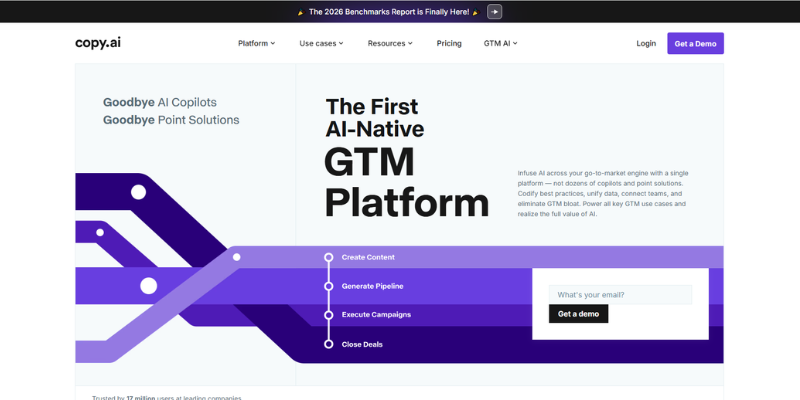
➤ Fast ad copy generation: Based on product information, target audience, and campaign goals, Copy.ai can generate multiple versions of ad copy, including headlines, body copy, CTAs, selling point descriptions, and opening hooks in different styles.
➤ Consistent tone and content: Brand Voice and Infobase features help teams store brand tone, product information, and commonly used content materials. This makes it easier to keep generated copy consistent and build a more professional brand image.
➤ Automation for repetitive workflows: Copy.ai’s automated workflows can reduce repetitive tasks, such as generating marketing content for multiple platforms and writing emails.
Pricing:
The individual plan starts at $29/month. Enterprise plans are also available.
Pros & Cons From Users:
Copy.ai has certain advantages in maintaining brand voice consistency, and it can generate copy quickly, saving time for sellers.
A common issue with AI copywriting tools is that the output may not always sound natural. When dropshippers use this type of tool in their ecommerce advertising strategies, manual editing and review are still necessary.
Pencil
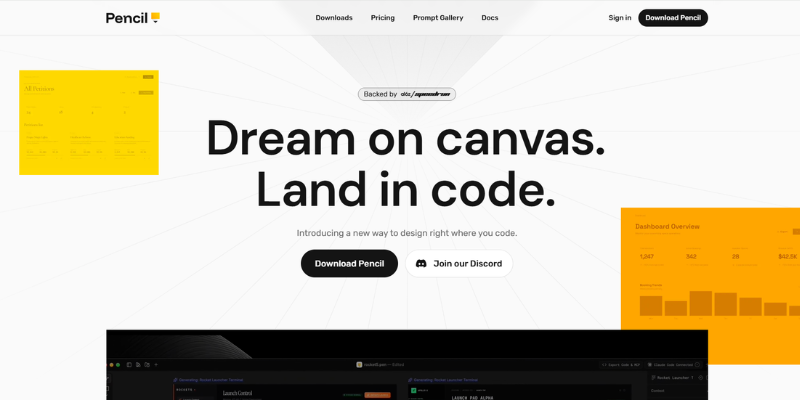
How can you judge the performance of AI-generated ad creatives? Pencil can help. Pencil is designed to help sellers test ad creatives quickly.
It is good at using an AI predictive scoring system to evaluate which creatives are more likely to drive clicks and conversions. This type of AI advertising tool can help reduce ad testing costs to some extent.
Key Features:
➤ Predicting ad performance: With AI data analysis, Pencil evaluates the potential performance of different ad creatives. The results can help sellers judge which creatives are more likely to drive clicks and conversions before launching campaigns.
➤ Reducing the cost of blind ad testing: By evaluating the potential of ad creatives in advance, sellers can avoid spreading their budget evenly across many low-quality ads and make their ad spending more targeted.
➤ Real-time data monitoring: Pencil can help sellers monitor ad creative performance in real time. Based on data feedback, sellers can optimize future ad content and make the ad testing process clearer and more adjustable.
Pricing:
Pencil offers a free plan and uses tiered pricing.
Pros & Cons From Users:
Users say Pencil is suitable for small teams and can quickly generate multiple versions of product images or videos. Some users also mention that downloading creatives from the website can sometimes be slow or laggy, requiring them to contact the Pencil team.
At the same time, Pencil’s product ad generation depends heavily on the original materials. High-quality input assets are needed to generate high-quality ads.
Triple Whale
If a large amount of advertising data gives you a headache, you may need an AI data analysis assistant.
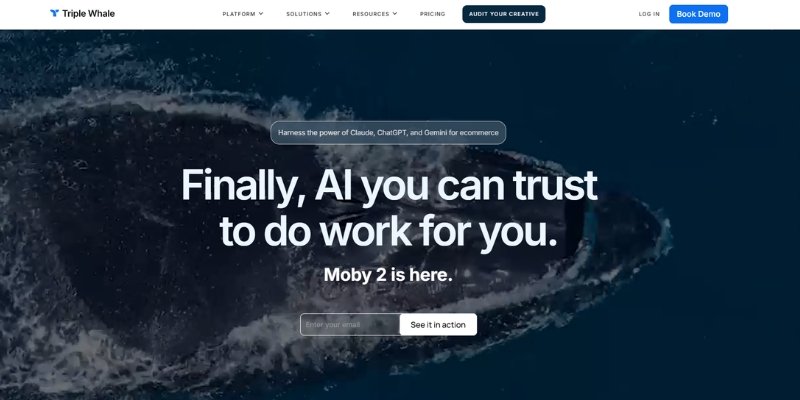
Triple Whale is a tool designed for ecommerce brands to analyze advertising data and track profit performance. It helps sellers clearly understand which advertising channels are driving profit.
This AI advertising data analysis tool is more suitable for medium and large teams with a certain advertising budget.
Key Features:
➤ Ad attribution analysis: Triple Whale helps sellers understand which advertising channels and campaigns are actually driving orders.
➤ Real-time data analysis: Triple Whale’s Moby AI can provide real-time insights based on brand data, customer behavior, and ad performance. This helps teams identify data anomalies, advertising opportunities, and optimization directions.
➤ Optimizing ad budget allocation: Triple Whale brings ad performance, attribution results, and profit data from different channels into one place. This helps sellers decide which campaigns deserve more budget and which channels should be paused or retested.
Pricing:
Triple Whale offers a free plan. Paid plans are priced based on store sales volume and required feature modules, and sellers need to contact the Triple Whale team for details.
Pros & Cons From Users:
The main value of Triple Whale lies in its ability to integrate data from multiple platforms, including Shopify, Meta, Google, and TikTok, into one dashboard. This helps sellers analyze advertising performance, sales data, and profit more efficiently.
For teams that already have a certain order volume and multi-channel advertising needs, this kind of unified data analysis capability can play an important role in ecommerce advertising strategies and support better ad management for online sellers.
At the same time, some users think Triple Whale is relatively expensive and does not always offer the best value for money. This is especially true for smaller stores with limited advertising budgets. For these stores, Triple Whale may not be necessary in the short term.
SourcinBox Helps You Turn Advertising Success into Smooth Order Fulfillment
Choosing the right AI advertising strategies is only the first step.
Once your ads start bringing in customers, you still need to manage product sourcing, quality inspection, packaging, shipping, and after-sales support. If your supply chain is unstable, the customer experience can easily suffer, and your early advertising efforts may go to waste.
SourcinBox is willing to be your product sourcing and logistics partner:
➤ Product sourcing: After a product passes your ad testing, SourcinBox can help dropshippers quickly find stable suppliers with reasonable prices and reliable product quality.
➤ Quality inspection: Ads can bring in orders, but product quality determines whether customers are satisfied. SourcinBox provides quality inspection services to help sellers check product quality before shipping.
➤ Custom packaging: SourcinBox supports custom packaging, helping sellers create a more consistent brand image through details such as custom parcels, brand stickers, and thank-you cards. This can improve customer trust and encourage repeat purchases.
➤ Global fulfillment: Once your ads start scaling, order processing speed and logistics stability directly affect the customer experience. SourcinBox can help sellers handle order fulfillment, allowing dropshippers to focus more on ad optimization and store growth.
Frequently Asked Questions
Is it legal to use AI ads for ecommerce?
Ecommerce sellers can use AI to generate ad images, copy, or videos, but the ad content must be truthful, transparent, and compliant with the advertising requirements of the target market.
Currently, many countries and regions are strengthening regulations around AI-generated content. The EU and the U.S., in particular, have introduced clearer requirements for AI-generated content, deepfakes, AI virtual characters, and synthetic content disclosure.
Can AI advertising strategies guarantee higher clicks and conversions?
AI advertising strategies can help improve clicks and conversions, but they cannot guarantee results.
They can help dropshippers quickly generate a large number of ad creatives, test different selling points faster, analyze ad performance, and focus their budget on ads with stronger potential. This can increase the chances of improving clicks and conversions.
Ad performance still depends on factors such as the product itself, target audience, pricing, logistics, and after-sales support. If the product has no real market demand, it will be difficult to achieve stable conversions. The same is true if the ad content is exaggerated or misleading. Even with AI tools, weak supply chain support or poor fulfillment can still hurt your ad results.
What is the biggest mistake dropshippers need to avoid when using AI ads?
The biggest mistake is treating AI-generated content as final ad content and publishing it directly. AI can help generate draft images, copy, and videos, but key details still need human review. Otherwise, sellers may risk misleading claims, customer complaints, or even ad account issues.
What are the best AI advertising tools for dropshippers?
The best tool depends on your specific needs.
For ad images, you can choose Canva Magic Studio, Flair.ai, Nano Banana, or AdCreative.ai. For video ads, Creatify and HeyGen are good options. For ad copy, Copy.ai is suitable. For ad data and profit analysis, Triple Whale can be useful. Pencil is suitable for testing ad creatives before scaling.
Can AI advertising tools help dropshippers reduce ad costs?
These tools do not directly make ad placements cheaper. Instead, they help reduce costs by improving testing efficiency.
AI tools can quickly generate multiple ad versions, predict creative performance, and optimize copy and visuals. This helps sellers identify underperforming ads earlier and focus their budget on ad creatives with stronger potential.
How do AI advertising tools help products stay visible in the AI shopping era?
AI advertising tools can help sellers create clearer product information, richer ad creatives, and more targeted marketing content. This makes products easier for AI systems to understand, recommend, and display. However, the product page itself must first include complete product information so that AI can accurately recognize the product’s value.

Share Article: