How to Start Dropshipping in Canada: 2026 Step-by-Step Guide

SIB Content Team
Canada is a market worth considering for dropshippers. Online shopping is already well established, yet many sellers entering North America focus on the United States first. That leaves room for both Canadian and overseas sellers to test the Canadian market.
Running a dropshipping business in Canada involves more than simply selling products to Canadian customers. Taxes, import charges, supplier reliability, shipping distance, and fulfillment costs can all affect customer experience and profit margins. Many sellers know they can sell to Canada, but fewer understand the practical issues they need to solve once they start operating.
This guide takes a practical look at the Canadian market. It covers the opportunity, tax and compliance requirements, and the steps for building a dropshipping business for Canadian customers—from product research and supplier selection to store setup, shipping, pricing, and marketing. It also explains how SourcinBox can support sourcing, quality inspection, packaging, inventory planning, and order fulfillment.
Why Canada Is a Promising Market for Dropshipping
Canada is worth a closer look for more than its place in the North American market. Online shopping is already well established, and e-commerce sales are still growing. A few recent figures help show why the market deserves attention:
- Canada's e-commerce market is still growing. According to Statistics Canada, retail e-commerce operating revenue reached CAD 73.7 billion in 2024, up 9.0% year over year. Overall retail operating revenue grew by about 3.0% over the same period, so online retail continued to grow faster than the retail market as a whole.
- Online shopping is already a mainstream habit. The Statistics Canada Canadian Internet Use Survey found that 79% of Canadian internet users bought goods or services online in 2022. Among people aged 35–44, the figure reached 89%. For e-commerce sellers, that points to a well-established base of online shoppers.
- Canada's e-commerce market is relatively fragmented. The market is not dominated by only a handful of companies. Trade.gov notes that the top five companies account for about 40% of the market. Canadian shoppers buy through a mix of retailers and channels, which leaves room for sellers focused on specific audiences or product categories.
Canada already has a mature online shopping base, and the market is still expanding. For dropshippers, the opportunity is not simply that Canadians shop online. The real question is whether you can find products that fit local demand and support them with a supply chain and fulfillment setup that can turn that demand into consistent sales.
What Is Dropshipping and How Does It Work in Canada?
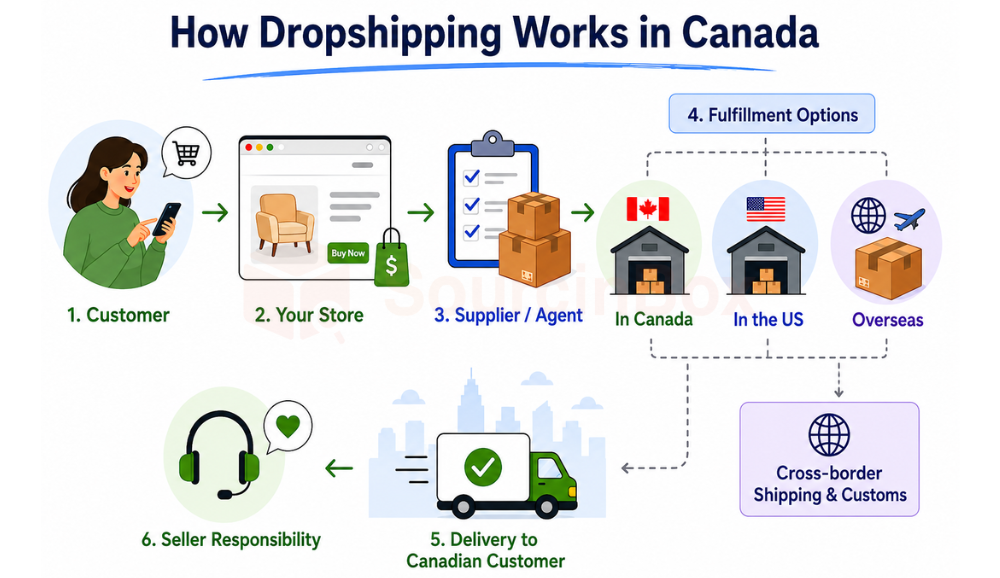
Dropshipping is a retail fulfillment model where you sell products online without buying or storing inventory upfront. When a customer places an order, the supplier or dropshipping agent prepares and ships the product directly to the customer.
How Does Dropshipping Work in Canada
When a Canadian customer places an order in your store, you handle the product listing, pricing, payment collection, marketing, and customer service. The supplier or dropshipping agent then takes care of sourcing, packing, and shipping. Depending on your supply chain setup, the order may ship from inventory in Canada, a US warehouse, a supplier in China, or another overseas location.
Where the order ships from affects delivery time, shipping cost, tracking, and how imports are handled. Orders sent to Canada from overseas may also involve customs clearance and import charges. So it is not enough to find a supplier that can simply ship to Canada. You also need to know how the route performs in practice and what the full order cost looks like. No matter who ships the product, you are still responsible for the customer-facing experience, including product quality, delivery promises, refunds, and after-sales support.
What Makes Dropshipping Different in Canada?
One of the biggest differences in Canadian dropshipping is geography. Canada covers a vast area, while much of the population is concentrated in specific cities and metropolitan regions. Shipping costs and delivery times can vary significantly by destination. Orders may ship from inventory in Canada, a US warehouse, or an overseas location such as China, and each route comes with different transit times, costs, and tracking performance. Cross-border orders may also involve customs clearance and import charges.
Cross-border sellers also need to account for Canada-specific issues such as GST/HST requirements, pricing in CAD, and French-language requirements in Quebec. Each of these can affect the final cost of the product and the customer experience.
It also matters whether you operate from within Canada or sell to Canadian customers from abroad. Both models can work for dropshipping, but business registration, tax obligations, inventory location, and fulfillment arrangements may differ.
Is Dropshipping Legal in Canada?
Yes, dropshipping is legal in Canada. The dropshipping model itself is not prohibited.
Dropshipping is still an e-commerce retail business, so the usual compliance obligations still apply. Before launching, sellers should understand the basics around business registration, income tax and sales tax, cross-border import charges, product-specific compliance, and the accuracy of product pages and marketing claims. The exact requirements depend on factors such as where the seller operates, what is being sold, where inventory is stored, the sales channel, and how orders are fulfilled.
Your compliance obligations depend on how the business is actually set up. Canadian-based sellers, non-resident sellers, businesses using inventory stored in Canada, and sellers shipping directly from overseas may fall under different rules. The following sections highlight the main issues to check and are not legal or tax advice.
Business Registration Requirements
There is no single business registration rule that applies to every seller running a dropshipping business in Canada. According to the Government of Canada, registration requirements vary by business type and jurisdiction. Sellers should check the federal, provincial, or territorial rules that apply to their business structure, primary place of business, and the regions where they operate.
For overseas sellers, selling to Canadian customers does not automatically mean you must establish a company in Canada. At the same time, non-resident sellers should not assume they have no registration obligations. If your business operates across multiple provinces or you are unsure whether your structure triggers registration requirements, check the relevant jurisdictional rules and seek advice from a Canadian accountant or legal professional when needed.
Taxes for Dropshipping in Canada
For Canadian dropshipping, the two main tax areas to consider are income tax on business profits and GST/HST or provincial sales taxes that may apply when you sell goods. Customs duties and import charges that arise when goods enter Canada are covered separately in the next section.
★ Income tax
Profits from a dropshipping business may need to be reported for income tax based on the seller's business structure and location. Filing requirements differ for sole proprietors, corporations, and non-residents, so there is no single tax rate that applies to every seller.
★ Sales tax
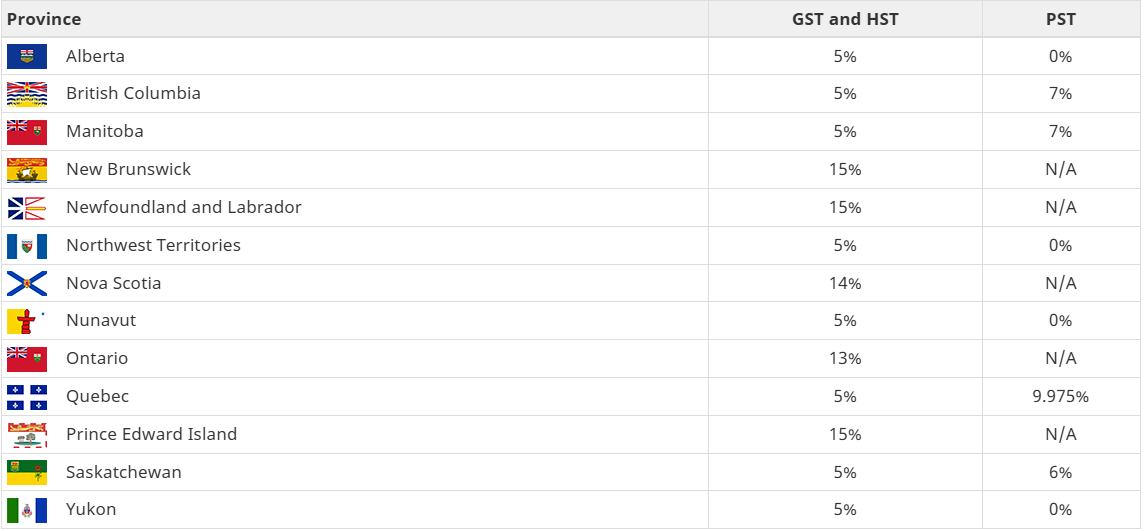
Canada's sales tax system includes GST/HST, along with PST, RST, or QST in certain provinces. Whether you need to register and collect these taxes depends on more than sales volume. Seller status, the customer's province, the location of the goods, and the sales channel can all matter.
💡 CAD 30,000 is not a universal GST/HST registration threshold for every seller.
Different rules may apply to Canadian-based sellers, non-resident sellers, goods stored in Canada, and sales where a platform collects tax. When checking your tax obligations, look at where the goods are physically located, who you are selling to, and which channel the sale goes through.
★ Canadian-based sellers
For many businesses, CAD 30,000 is an important GST/HST registration threshold under the CRA's small supplier rules. If you stay below the CRA threshold, registration is generally not mandatory. If you exceed it within a single calendar quarter or under the calculation based on four consecutive calendar quarters, the timing of registration and when you must begin charging tax depends on the specific circumstances.
Some provinces also charge PST, RST, or QST in addition to GST/HST. These provincial taxes have their own registration rules and do not necessarily use the same CAD 30,000 threshold. Once GST/HST applies, the applicable rate also depends on Canada's place-of-supply rules.
★ Non-resident sellers
Overseas sellers should not automatically apply the small supplier rules used for Canadian-based businesses. Under CRA RC4027, factors used to determine whether a non-resident is carrying on business in Canada can include the place of delivery, place of payment, location of inventory, location of employees or agents, and contractual arrangements.
If goods are stored in a Canadian fulfillment warehouse or shipped to Canadian customers from within Canada, the special rules for qualifying goods may apply. A qualifying non-resident vendor whose relevant sales exceed CAD 30,000 over any 12 months may need to register for GST/HST. For some sales made through a registered distribution platform, the platform may be responsible for collecting GST/HST.
If products are shipped directly to Canadian customers from China, the United States, or another country, you cannot determine your tax obligations from the CAD 30,000 figure alone. The answer depends on how your business and fulfillment setup actually work.
Customs and Import Duties
Sales tax and import charges are two separate issues. Sales tax refers to GST/HST, PST, or QST that may be collected when a product is sold. Import charges can arise when goods enter Canada from abroad and may include customs duties, import taxes, and customs clearance or brokerage fees.
Whether import charges apply depends on more than the shipping origin or order value. Once an order exceeds the relevant low-value threshold, actual duties can also depend on the product category, country of origin, declared value, and applicable tariff rules. Shipping country and order value alone are not enough to estimate the final import cost.
For low-value shipments, the CBSA uses different reference thresholds:
- Imports by mail: Goods imported from any country with a value of CAD 20 or less are generally free of duties and taxes.
- Courier imports from countries other than the United States or Mexico: The general reference threshold is also CAD 20.
- Courier imports from the United States or Mexico: Shipments worth CAD 40 or less are generally free of duties and taxes. Above CAD 40 and up to CAD 150, duties are generally waived, although taxes may still apply.
💡 Here, mail means an international parcel handled through the postal system—for example, a package sent by USPS and delivered in Canada by Canada Post. Courier refers to commercial express carriers such as DHL, FedEx, or UPS.
These thresholds do not apply to every product. Sellers should still check the rules for the specific product category and shipping route, and confirm whether the shipping quote includes applicable taxes, duties, and customs clearance fees.
Before listing a product, dropshipping sellers should confirm three things:
- Whether the import may trigger additional charges;
- Who is responsible for customs clearance;
- Who ultimately pays the duties, import taxes, and customs clearance fees.
If the customer will have to pay these charges on delivery, disclose that clearly on the product page, at checkout, or in the shipping policy. If the seller covers them, include them in the full fulfillment cost.
Product Compliance and Consumer Protection
Having the supplier ship the order does not remove the seller's responsibility for product compliance. Before listing a product in Canada, first identify which product category it falls into and then check the relevant requirements. Certificates and test reports from the supplier are only part of that review.
★ Not every product sold in Canada is governed by the same rules.
Many everyday consumer products fall under the Canada Consumer Product Safety Act (CCPSA), while food, cosmetics, drugs, medical devices, and natural health products are subject to separate requirements. During product research, dropshippers should identify the product category first rather than relying on the same set of supplier documents for every item.
★ Regulated or specialized product categories require an additional check against Canadian rules.
For example, cosmetics must meet ingredient and labelling requirements, most food imported commercially must comply with CFIA food import requirements, and natural health products generally need a product licence before they can be legally sold in Canada, with an NPN or DIN-HM shown on the label. CE, FDA, or other market-specific test documents from a supplier can be useful references, but they should not be treated as proof that the product meets Canadian requirements.
★ Your product pages and marketing should also match the product you actually sell.
Health Canada's guidance for online sellers recommends providing accurate descriptions, labels, instructions, warnings, and certification information where relevant. The Competition Bureau also sets requirements around performance claims and ordinary price claims. Avoid exaggerated product claims or misleading reference prices and discounts simply to drive conversions.
If you are unfamiliar with Canadian product compliance, an experienced dropshipping agent can help collect supplier documents, confirm product specifications and packaging information, and communicate document requirements with suppliers. The final compliance check, however, still needs to be based on the Canadian rules that apply to the specific product.
How to Start Dropshipping in Canada Step by Step
The basic process for starting a dropshipping business in Canada is similar to other markets, but product research, supplier selection, and shipping all need to be checked against Canadian market conditions. Let's dive in.
Step 1: Research Products for the Canadian Market
Start product research with two questions:
- Is there real demand from Canadian consumers?
- Is the product practical to fulfill to Canada through dropshipping?
You need both. Demand alone can lead you toward products that are expensive to ship, difficult to return, or risky from a compliance standpoint. Focusing only on the purchase price can leave you with a cheap product that Canadian customers do not actually want.
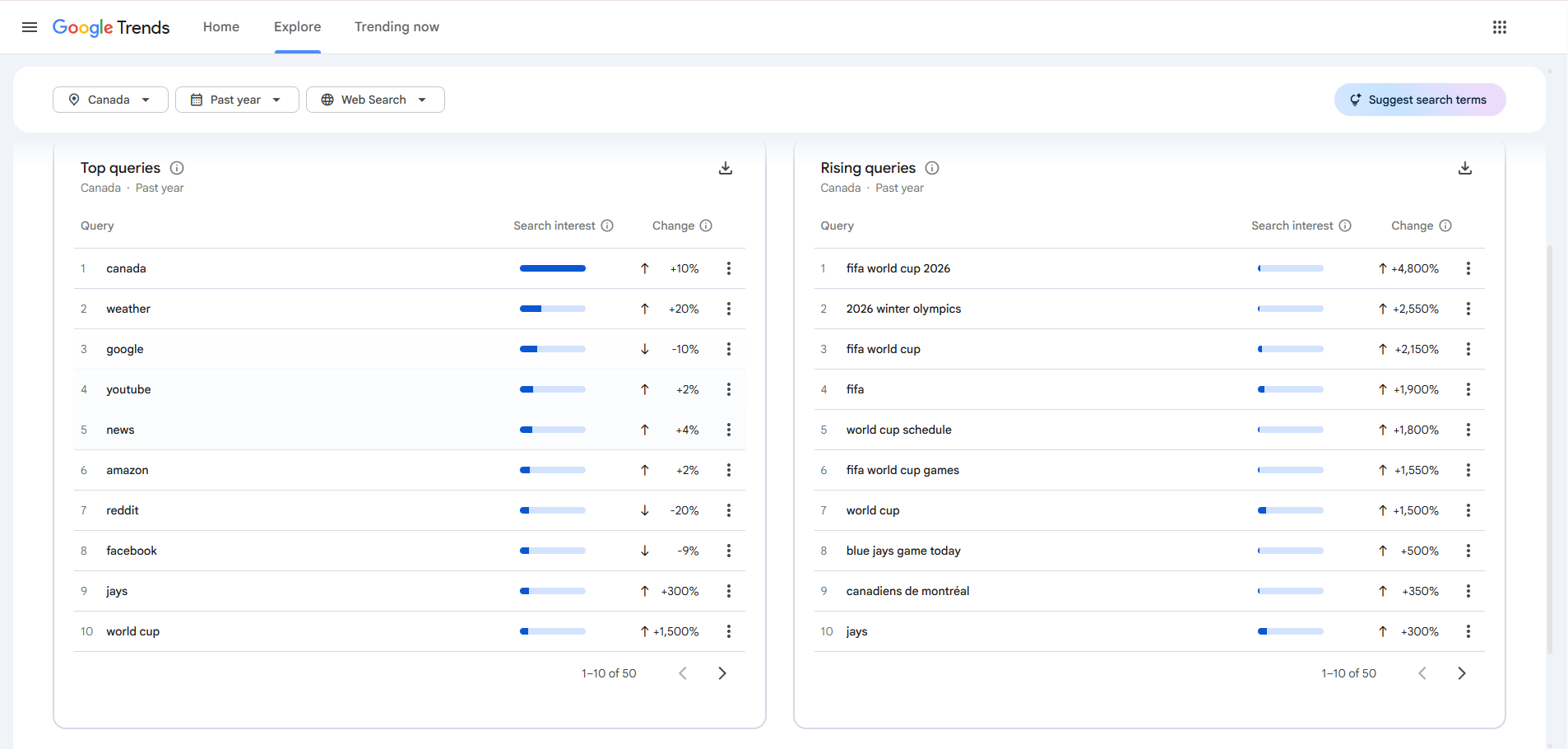
Validate demand in Canada first. Check best-selling trends on marketplaces such as Amazon.ca and eBay Canada, and set the location to Canada in Google Trends. Do not assume US or global trends will translate directly to the Canadian market. Shopping behavior can also vary by region. Winter demand, the outdoor season, back-to-school, holiday gifting, and language preferences in Quebec can all affect product pages, ad creative, and sales timing.
Then check how practical the product is to fulfill. Bulky or fragile items, complicated sizing, batteries or liquids, higher compliance risk, or unreliable tracking can all raise shipping and after-sales costs for Canadian orders. As you evaluate a product, ask four simple questions:
- Why would a customer need it now?
- Why would they buy it from your store instead of a local retailer?
- Is it small and light enough to ship efficiently?
- Can you differentiate it through packaging, bundles, or content?
At the beginning, test a small group of products aimed at the same audience or use case. Before moving on to supplier validation, make sure each candidate has demand in Canada, manageable fulfillment risk, and enough margin after the main costs are deducted. The goal is a shortlist worth validating further—not a random batch of products to upload.
Step 2: Find a Reliable Dropshipping Supplier
Once you have a product shortlist, the next step is finding suppliers. Canadian orders may be fulfilled by local suppliers or shipped cross-border from the United States, China, or other countries.
Different sourcing options come with different product ranges, purchasing costs, and fulfillment setups. Choose the sourcing option that fits the product and your current stage, then check whether the supplier can provide reliable shipping to Canada, clear tracking, and defined procedures for damaged, lost, or other problem orders.
Common supplier sources fall into three main groups:
| Supplier Source | Example | Best for | Main Advantage | What to Check |
|---|---|---|---|---|
| Dropshipping Platforms | SourcinBox ↗ | Beginners and sellers in the testing stage | Products, orders, and fulfillment are managed in a more connected workflow | Confirm reliable shipping to Canada and consistent tracking |
| Supplier Marketplaces | Alibaba.com | Sellers with sourcing experience | Wide product selection and direct supplier contact | You need to verify quality, MOQ, shipping capability, and after-sales policies yourself |
| Direct Suppliers | Manufacturer | Sellers with stable sales or customization needs | More room to negotiate pricing and build a long-term relationship | Higher upfront communication, quality-control, and order-management workload |
Do not choose a supplier on purchase price alone. A cheaper supplier can quickly become expensive if inventory is unreliable, orders are processed slowly, or tracking is unclear. For Canadian orders, check product quality, stock stability, response time, after-sales policies, and whether the supplier has real experience shipping to Canada.
Before scaling, order a sample and place a test order. Use the sample to confirm product quality, specifications, and whether the item matches the listing. Use the test order to check packaging, order processing, tracking updates, and basic delivery performance. You do not need to test every destination in Canada at this stage, but you should verify that the supplier's delivery claims hold up in practice.
| Check | Questions to Ask | Warning Signs |
|---|---|---|
| Product Quality | Can the supplier provide samples, real product photos, and basic specifications? | The sample does not match the product actually shipped to customers |
| Inventory Stability | How often is inventory updated? How are stockouts communicated? | The supplier can only give verbal assurances and cannot explain restock timing |
| Experience with Canadian Orders | Have they shipped to Canada before? Can they provide tracking examples? | They say they can ship to Canada but cannot explain the actual route or process |
| Response Time | How quickly do they respond to new orders, address changes, and order inquiries? | Fast before the sale, but slow once a problem occurs |
| After-sales Policy | How are wrong items, damage, lost parcels, and returns handled? | No clear policy, with responsibility pushed back to the seller |
If you do not want to contact suppliers one by one, compare quotes, verify specifications, and inspect samples yourself, SourcinBox can assist with sourcing, supplier communication, sample inspection, and order setup and preparation, making the transition into fulfillment easier to manage.
Step 3: Choose a Platform and Build Your Store
Once your product and supplier are in place, you can choose where to sell. Shopify, Amazon.ca, and eBay Canada can all reach Canadian customers, but they suit different business models.
Common options include:
- Independent stores built with Shopify, WooCommerce, and similar tools: A better fit for sellers who want control over branding, content, advertising, pricing, and customer data.
- Marketplaces such as Amazon.ca and eBay Canada: You can tap into existing traffic and buyer trust, but you also need to follow marketplace rules and account for platform fees.
For a new seller, it is usually easier to get one channel working well before adding more. Once you choose a platform, complete the basic settings needed for Canadian customers.
Before launch, check at least the following:
- Pricing in CAD;
- Canada shipping zones;
- Payment methods;
- Shipping and refund policies;
- Privacy information and contact details;
- Tax settings that match your actual registration status.
If you run an independent store, test the checkout with a Canadian address. Make sure you can complete the order, shipping rates display correctly, and payment methods such as credit cards, PayPal, Shop Pay, and Apple Pay work as expected. If you accept payments in multiple currencies, check the foreign exchange fees as well.
Product pages should also be adapted for the Canadian market. Supplier titles and descriptions can be a starting point, but recheck CAD pricing, delivery estimates, measurement units, return information, and any applicable French-language content. Do not copy unverified performance or marketing claims from the supplier page.
By the end of this step, your store should be ready to accept Canadian orders.
Step 4: Set Up Shipping and Fulfillment for Canadian Customers
Once the supplier is confirmed, choose from the shipping options the supplier can actually provide. Many suppliers and dropshipping platforms provide more than one route, with differences in shipping cost, delivery time, tracking, and surcharges.
When comparing shipping options, focus on:
- Shipping cost and any remote-area surcharges
- Processing time and estimated delivery time
- Tracking coverage and how quickly the first update appears
- Whether the route supports the product type, such as batteries, liquids, or oversized items
- How customs clearance and import charges are handled
The cheapest route is not always the best one to use long term. If a slightly cheaper option takes much longer or provides inconsistent tracking, the savings can be offset by more support tickets and refunds. Choose a route that makes sense for your product margin and the delivery time your customers are willing to accept.
Before publishing your shipping information, compare the supplier's estimates with the results of your test order. The processing time, estimated delivery time, and tracking information in your shipping policy should match the route you actually use. Remote areas and northern postal codes in Canada may have different delivery times or extra fees, so check these in advance.
If your supplier or fulfillment partner offers warehousing in different regions, you can also adjust where inventory is stored as sales grow.
| Check | Questions to Ask | Warning Signs |
|---|---|---|
| Product Quality | Can the supplier provide samples, real product photos, and basic specifications? | The sample does not match the product actually shipped to customers. |
| Inventory Stability | How often is inventory updated? How are stockouts communicated? | The supplier can only give verbal assurances and cannot explain restock timing. |
| Experience with Canadian Orders | Have they shipped to Canada before? Can they provide tracking examples? | They say they can ship to Canada but cannot explain the actual route or process. |
| Response Time | How quickly do they respond to new orders, address changes, and order inquiries? | Fast before the sale, but slow once a problem occurs. |
| After-sales Policy | How are wrong items, damage, lost parcels, and returns handled? | No clear policy, with responsibility pushed back to the seller. |
Which warehouse options are actually available depends on where the product is stocked and what the supplier can support. During product testing, direct shipping can keep inventory commitments low. Once orders become more stable, compare shipping costs and delivery performance before deciding whether to move stock closer to customers.
SourcinBox customers can work with a dedicated customer manager to check the shipping options available for a product and compare routes based on destination, product characteristics, delivery time, and budget. For products with stable sales, SourcinBox can also support overseas warehousing, packaging, inventory management, and order fulfillment.
Step 5: Set Your Pricing and Check Profit Margins
Once the product, supplier, and shipping plan are set, use the actual costs to set your selling price and check whether each order still leaves enough margin.
When setting your price, include more than the product cost:
- Packaging costs;
- Shipping and fulfillment costs;
- Platform and payment fees;
- Duties or other import charges paid by the seller;
- Expected costs from refunds, replacements, and other after-sales issues.
💡 Use a simple per-order calculation to check your margin: Profit per order = Selling price - Product cost - Shipping & fulfillment - Platform/payment fees - Other seller-paid costs
If your store is priced in CAD while product or shipping costs are paid in USD, CNY, or another currency, leave room for exchange-rate movements and conversion fees.
Once you start running ads, add your actual customer acquisition cost, refund rate, and other selling costs to the calculation. If the remaining margin is too thin, revisit the selling price, sourcing cost, or shipping route before scaling further.
Step 6: Validate Your Store Before Launch
Before spending on ads, place a complete test order using a Canadian address. Make sure the entire flow works—from the product page and checkout to order sync, fulfillment, and tracking updates.
During the test, check:
- Product pages, CAD pricing, and discounts display correctly;
- Canada shipping zones, shipping rates, and taxes are calculated correctly;
- Customers can complete payment successfully;
- The order syncs correctly to the supplier or dropshipping platform;
- The SKU, quantity, and shipping address are accurate;
- Tracking information syncs back correctly;
- Order status and customer notifications update as expected.
If you find incorrect shipping charges, failed payments, missing order syncs, or tracking that does not update, fix the store settings or fulfillment workflow before you start driving paid or organic traffic.
How to Market a Dropshipping Store in Canada
Once the product, supplier, store, and fulfillment process are ready, you can start driving traffic. Choose advertising, search, and social channels that fit the product, then adapt the marketing for Canadian shoppers—their shopping habits, language, and delivery expectations all matter.
Choose Your Main Marketing Channels
Do not launch on every marketing channel at once. Start with one or two that fit the product best—for example, Meta or TikTok ads, Google Search/Shopping, or organic social content. Once you have your first orders and customer data, email marketing can help with repeat purchases and promotions.
Match the channel to the product. Products that sell well through visual demonstrations or short-form video may be a good fit for Meta, Instagram, or TikTok. Products with clear search demand may perform better through Google. Early on, focus on finding a channel that can consistently generate clicks, add-to-carts, and orders before increasing the budget.
Localize Your Marketing for Canadian Customers
For the Canadian market, your ads and landing pages should match the buying experience customers will actually get. Show prices in CAD, make Canadian shipping coverage and delivery estimates clear, and adapt your product focus and ad creative to local seasons and use cases.
Canada's size also matters for marketing. Shipping performance and acquisition costs can vary by region. At the beginning, it can make sense to focus on areas where demand is concentrated and shipping has already been validated, then expand based on real order data.
If Quebec is a major target market, check the French-language requirements separately. The OQLF states that businesses operating in Quebec must use French in commercial publications and that consumers have the right to access a complete French version of a business website. The exact requirements should be confirmed for your specific business situation.
Build Trust Before Scaling Your Ads
Once ads start bringing visitors, the product page and shipping information can make or break the conversion. Pricing, product descriptions, shipping times, tracking, refund policies, and customer service information should match what your fulfillment setup can actually deliver. Do not promise fast delivery or local warehouse fulfillment if you cannot provide it.
Once orders start coming in, use conversion rates, refund reasons, delivery performance, and customer feedback to decide which products and marketing channels deserve more budget.
If you use email or SMS for promotions, you also need to account for CASL. For commercial electronic messages sent to Canadian users, the CRTC's core requirements include obtaining the appropriate consent, identifying the sender, and providing a working unsubscribe mechanism.
Is Dropshipping Worth It in Canada in 2026?
Yes. Canada is still a market worth testing for dropshipping in 2026. Canadian consumers are already comfortable shopping online, e-commerce continues to develop, and sellers can reach the market through independent stores as well as established marketplaces.
Running a dropshipping business in Canada still requires solid product research, reliable suppliers, workable shipping, sensible pricing, and attention to tax and product compliance. These are simply part of running an e-commerce business in Canada. Dropshipping still lets sellers test demand without committing heavily to inventory upfront.
For sellers entering Canada for the first time, dropshipping makes it possible to test products and demand on a small scale without committing heavily to inventory upfront. As orders become more consistent, you can adjust shipping routes, inventory location, and fulfillment based on actual sales.
If you are planning to sell to Canadian customers, SourcinBox can support product sourcing, quality inspection, packaging, warehousing, and order fulfillment, helping you adjust your supply chain as products and order volume grow.
FAQs
1. How to Start Dropshipping in Canada for Free?
Starting completely free is not realistic. Dropshipping lets you avoid buying large amounts of inventory upfront, but you may still pay for a domain, store-building tools, samples, and marketing tests. Free trials and low-cost tools can keep the initial budget down, but do not skip product testing or shipping validation just to save money.
2. Is Dropshipping Profitable in Canada?
Yes, dropshipping can be profitable in Canada, but profitability depends on your selling price and the full cost per order. Include shipping, platform and payment fees, advertising costs, seller-paid import charges, refunds, replacements, and other after-sales costs—not just the product cost. Once you start selling, keep checking per-order profit against real order data.
3. Do I Need a Business License for Dropshipping in Canada?
Canada does not have a single business licence specifically for dropshipping. Whether you need to register a business or obtain another licence depends on where you operate, your business structure, the province or municipality involved, and the type of products you sell. Overseas sellers do not automatically need to form a Canadian company simply because they sell to Canadian customers, but they still need to check the tax and product compliance rules that apply to their setup.
4. Do I Need a Canadian Supplier to Dropship in Canada?
No. Your supplier can be based in Canada, China, the United States, or another country. What matters more is whether the supplier can reliably supply and fulfill orders for Canadian customers. Compare product cost, shipping time, tracking, product quality, and after-sales support. Once sales are stable, you can also consider overseas warehousing or other fulfillment options.
5. Is Dropshipping Legal in Canada?
Yes. Dropshipping is legal in Canada, but sellers still need to follow the tax, consumer protection, product safety, and advertising rules that apply to e-commerce businesses. The exact requirements depend on where the seller operates, what products are sold, and how orders are fulfilled.
Share Article: