How Does AI Help with Dropshipping Product Research?

SIB Content Team
Struggling to come up with product ideas for your dropshipping store? Not sure where to find reliable information for product research?
You may have saved dozens of products and ads but still have no idea which ones are worth testing.
There's no shortage of information available to dropshippers. The challenge is making sense of it all and using it to decide which products are worth selling.
Beyond traditional methods to find potential winning products, AI can also be a valuable part of the research process.
So, how does artificial intelligence help with dropshipping product research? We'll walk through a real-world example using ChatGPT and reusable prompts, covering both its benefits and limitations.
How to Use AI for Dropshipping Product Research: A Step-by-Step Guide
Instead of simply asking ChatGPT which dropshipping products to sell, break your research into manageable tasks and have AI analyze real data and information at each stage.
The process starts with defining your target market and exploring product opportunities, followed by evaluating demand, competition, and profitability.
To show you how this works, we'll use a real-life scenario: the challenges dog owners face when walking their pets on rainy winter days.
With reusable prompts, you'll learn how AI helps with dropshipping product research.
Step 1. Prepare Your Research Context and Set AI Guidelines
Start by giving ChatGPT a clear picture of your business and what you're looking for in a product.
✦ Target market and audience: Where do you plan to sell, and who are your target customers?
✦ Budget and pricing: What's your budget, and do you have a target retail price range?
✦ Product selection criteria: What specific requirements should your products meet?
✦ Initial product ideas: Do you already have a product category or niche in mind?
Use your answers to establish your business context, target market, and customer profile. Your budget and product criteria will also help ChatGPT suggest products that fit your business in Step 2.
You should also set clear rules for how AI handles research data and uncertain information. This helps reduce the risk of fabricated facts or unsupported assumptions influencing your product decisions.
For example, we'll focus on pet-owning households and explore product opportunities based on everyday challenges.
We'll assume the following business setup: the United States as our target market, with Shopify, TikTok, and Instagram as sales channels. Our target retail price is $15-50, with a target gross margin of 40%–50%. We're looking for dropshipping products that are easy to ship and have the potential for long-term sales.
Here's how to include these details in your ChatGPT prompt:
My Business Background:
- Target Market: [United States]
Show Full Prompt ↓
- Sales Channels: [Shopify, TikTok, Instagram]
- Business Model: Dropshipping
- Expected Selling Price: [15-50]
- Target Gross Margin: [40%–50%; to be verified using sourcing and US fulfillment costs in Step 6]
- Product Preferences: [Lightweight, easy to ship]
- Product Restrictions: [Fragile products, complex electronics]
- Other Requirements: [Year-round demand preferred]
Please complete the following tasks:
1. Organize my business information into a concise Product Research Brief.
2. Categorize my product selection criteria into:
- Must-have requirements
- Adjustable preferences
- Assumptions that need verification
3. Identify missing information that could affect product selection. Do not invent answers or make decisions on my behalf.
4. Establish the following rules for our future research:
- Distinguish verified facts, assumptions, and unverified information.
- Never invent sales figures, market data, supplier information, costs, or shipping details.
- Identify the source and date of any external data provided.
- Clearly explain when available information is insufficient to support a conclusion.
5. Summarize the information and criteria that should be used in the next stages of product research.
Do not recommend products yet. Focus only on understanding my business and establishing research criteria.
💡 SourcinBox Tips: You can reuse the tasks and research rules in the prompt above. If you haven't decided on a specific detail, such as your target retail price, simply enter [unknown]. This helps ChatGPT identify gaps that may affect later research rather than filling them with made-up figures.
After submitting the product research prompt and completing two rounds of conversation, ChatGPT generated a product research brief, product selection criteria, missing information that could affect product selection, rules for future research, and details to confirm before product discovery.
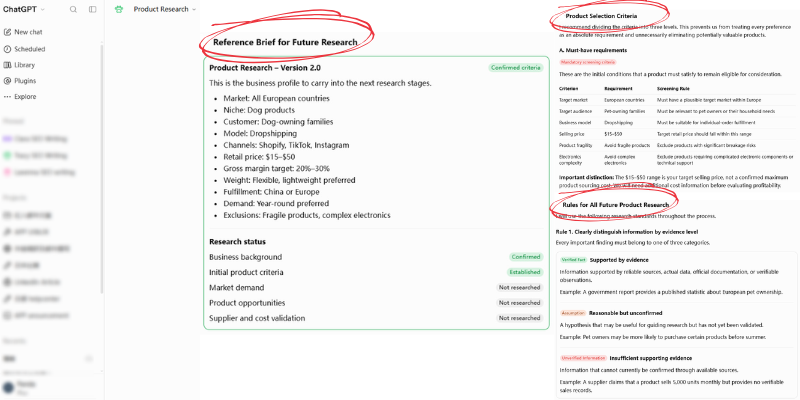
The resulting brief and selection criteria will serve as the reference for the next stage of product research.
Step 2. Discover Product Ideas Based on Customer Needs and Pain Points
With the Product Research Brief from Step 1, ChatGPT now has a clear understanding of your target market and product requirements. The next step is to uncover customer pain points in real-life situations.
For our example of US dog-owning households facing winter rain and snow, you can gather customer feedback from relevant forums, social media comments, and product reviews on Amazon.com.
When researching discussions on Reddit or other forums, check where the users are located. Comments from users in unspecified locations may inspire product ideas, but shouldn't be treated as direct evidence of demand in the US market.
We collected real discussions from Reddit and several pet forums. Copy the text or share screenshots with ChatGPT and ask it to identify recurring problems and group similar customer needs.

After analyzing the Reddit discussions, ChatGPT identified several ways dog owners deal with winter walks:
♦ Some dogs are comfortable in cold, wet weather and enjoy playing outside.
♦ Others are sensitive to the cold and reluctant to go out when it's windy or rainy.
♦ Some owners make small adjustments so they can continue walking their dogs outdoors.
♦ Others turn to indoor products as alternatives to outdoor walks.
Different dogs need different solutions. Assuming they all need winter clothing or protective boots could limit your research.
ChatGPT identified 4 customer needs from the discussions:
- Protect dogs' paws from rainwater, ice, snow, and road salt.
- Keep dogs warm and dry during winter outdoor activities.
- Find protective dog boots that fit comfortably and securely.
- Manage indoor potty and exercise needs when outdoor activities are limited.
ChatGPT then matched these needs with our Step 1 selection criteria to generate the following 6 product ideas:
| Customer Pain Point | Supporting Evidence or Hypothesis | Relevant Product Ideas | How the Product Addresses the Problem | Fit with My Product Criteria |
|---|---|---|---|---|
| Paw irritation from road salt, snow, and ice | Multiple owners mention paw washing, balm, Vaseline, and salt accumulation. | Dog Paw Balm / Paw Wax | Helps condition paw pads and provides a convenient post-walk care option. | High. Dog-specific, lightweight, non-fragile, no electronics. Could be bundled in the 15–50 range. |
| Dirty or wet paws after outdoor walks | Owners describe washing paws after walks and the time involved. | Silicone Paw Cleaner, Microfiber Paw Towel, Pet Paw Cleaning Kit | Makes it easier to remove mud, dirt, and other outdoor debris after walks. | High. Lightweight options, easy to ship, non-fragile, year-round use. |
| Dogs become uncomfortable in cold or rainy weather | Multiple owners use sweaters, fleece, raincoats, and winter jackets. | Waterproof Dog Raincoat, Fleece Dog Sweater, Insulated Dog Jacket | Keeps dogs covered and more comfortable in different weather conditions. | High. Strong audience fit and no electronics. Some garments may fit the price range. Sizing and seasonal demand are concerns. |
Show All 6 Customer Pain Points ↓
| Dogs refuse to wear conventional boots | Several owners describe dogs refusing shoes or walking awkwardly in them. | Adjustable Dog Booties, Anti-Slip Dog Socks, Protective Paw Shoes | Aims to protect paws while improving fit, comfort, and ease of use. | Medium. Lightweight, easy to ship, non-fragile. Seasonal demand and sizing complexity reduce the fit. |
| Outdoor exercise becomes difficult in bad weather | Owners describe using indoor fetch, tug games, and other activities. | Snuffle Mats, Interactive Puzzle Toys, Indoor Tug Toys, Treat-Dispensing Toys | Provides indoor stimulation and activity when outdoor exercise is limited. | High. Lightweight options, year-round demand potential, no complex electronics, suitable for video demonstrations. |
| Poor visibility during evening walks | Owners mention wearing illuminated or bright clothing and choosing well-lit routes. Hypothesis: Dogs may also benefit from reflective equipment. | Reflective Dog Vest, Reflective Harness, Reflective Leash | Improves a dog's visibility during low-light walks. | Medium. Lightweight, non-fragile, easy to ship, no electronics required. |
Based on our product selection criteria from Step 1, ChatGPT recommended prioritizing 3 product categories:

➤ Dog Paw Care and Cleaning Kit
Many dog owners in the Reddit discussions mentioned how inconvenient it is to clean mud, water, and snow off their dogs' paws after walks.
This suggests potential demand for silicone paw cleaners, paw cleaning solutions, microfiber towels, and dog paw balm. Dropshippers could also bundle these products into cleaning kits to increase average order value.
➤ Waterproof Dog Coats and Jackets
Many owners choose dog clothing based on the weather and how well their pets tolerate the cold. Waterproof dog raincoats can sell beyond winter, while fleece sweaters and adjustable jackets serve dogs with different needs for warmth and fit.
These products also have clear, relatable use cases that dropshippers can demonstrate through videos on TikTok and Instagram.
➤ Indoor Dog Enrichment Toys
Some dogs are reluctant to go outside in rain or snow, but staying indoors can leave them with plenty of energy to burn. Snuffle mats, treat-dispensing puzzle toys, and indoor tug toys can help keep them occupied and active.
For dropshippers, these products have less seasonal demand variation and are suitable for year-round sales.
Use the Product Research Brief and selection criteria established in our previous step. Do not redefine them unless new information requires an update.
My Current Research Materials:
Show Full Prompt ↓
- Social Media Feedback: [Paste comments or Unknown]
- Forum Discussions: [Paste relevant discussions or Unknown]
- Survey Data: [Paste available results or Unknown]
- Existing Product Ideas: [List products or Unknown]
- Specific Usage Scenarios: [Describe relevant situations or Unknown]
Please complete the following tasks:
1. Identify recurring customer problems, unmet needs, and the situations in which they occur.
2. Separate pain points supported by actual customer evidence from potential needs that are only hypotheses.
3. Based on these problems, suggest relevant product categories and specific product ideas.
4. Evaluate each product idea against the Product Research Criteria established in my Product Research Brief.
5. Organize the results into a table containing:
- Customer Pain Point
- Supporting Evidence or Hypothesis
- Relevant Product Ideas
- How the Product Addresses the Problem
- Fit with My Product Criteria
- Information That Still Needs Verification
6. Prioritize the product ideas that best match my business requirements and explain why.
Do not claim that a product has proven market demand or sales potential based only on customer complaints or AI-generated ideas.
If I have not provided customer feedback or existing product ideas, help me explore potential customer problems based on the target audience and usage scenarios. Clearly label these as hypotheses and suggest what evidence I should collect to verify them.
Do not perform detailed market trend, competitor, supplier, or profitability analysis yet. These will be covered in later research stages.
Step 3. Analyze Product Demand and Market Trends
Our initial product research identified 3 categories: dog paw care and cleaning kits, waterproof dog coats and jackets, and indoor dog enrichment toys.
But which specific products show consistent demand and potential for long-term sales? In Step 3, we'll begin product demand analysis with AI.
We collected Google Trends search data for all three categories, Amazon purchase indicators, and sales and advertising data from free product research tools, including FindNiche and PiPiAds.
💡 SourcinBox Tips: Google Trends provides search interest data directly from Google, making it a useful source for identifying changes in consumer interest. Amazon is one of the world's largest online marketplaces, and its purchase indicators can offer additional insight into buying activity. Comparing search trends with marketplace data helps you assess product demand from different angles rather than relying on a single signal.
For research targeting the US market, set Google Trends to the United States and use data from Amazon. Check the geographic coverage and reporting period of any third-party research tools. If the location of the original data is unclear, verify it or collect new data rather than assuming the findings apply to US consumers.
Once you've gathered the data, upload the screenshots to ChatGPT for analysis.

After examining Google Trends search patterns and changes in related queries, ChatGPT recommended taking a closer look at 12 specific products:
✦ Dog paw care and cleaning: dog paw cleaner, dog paw washer, dog paw wipes, dog paw balm
✦ Indoor Dog Enrichment: dog puzzle toy, snuffle mat for dogs, lick mat for dogs, interactive dog toy
✦ Waterproof dog coats and Jackets: waterproof dog coat, dog raincoat, dog winter jacket, fleece dog coat
Use the Product Research Brief and Initial Product Idea List established in the previous steps. Do not redefine my business requirements or generate unrelated product ideas.
My Current Research Materials:
Show Full Prompt ↓
- Target Market: [United States]
- Google Trends Data: [Paste data, screenshots, or exported reports]
- Marketplace Data: [Paste available sales estimates, product performance data, and review information]
- Social Media Data: [Paste relevant posts, engagement metrics, and publication dates]
- Industry Reports: [Paste relevant market data, if available]
- Research Period: [Specify the time range]
- Data Sources: [Provide source links and collection dates]
Please complete the following tasks:
1. Analyze the search interest and historical trends for each candidate product.
- Identify growth, stability, decline, or seasonal patterns.
- Use United States data as the market baseline; compare US regions or states where data is available. Flag non-US data or data with an unknown geographic scope rather than treating it as US market evidence.
- Distinguish long-term trends from short-term spikes.
2. Examine recent market signals.
- Analyze available marketplace sales estimates and recent performance.
- Identify relevant social media activity and engagement patterns.
- Separate search interest, social engagement, estimated sales, and verified transaction data.
3. Compare demand signals across different sources.
- Identify where the data supports consistent conclusions.
- Highlight conflicting signals and missing information.
- Explain what the available evidence can and cannot establish.
4. Evaluate each candidate product and classify it into:
- Continue Research: Demand signals justify further investigation.
- Monitor: Potential demand exists, but more evidence is needed.
- Hold: Current evidence is weak or shows declining interest.
5. Present the findings in a comparison table containing:
- Product
- Search Trend
- Recent Market Signals
- Seasonality
- Supporting Evidence
- Missing Information
- Recommended Next Step
Use only the information provided. Do not invent search volumes, sales figures, market sizes, or growth rates.
Do not analyze competitor positioning, supplier reliability, shipping costs, or profit margins yet. These will be covered in later steps.
Next, we provided ChatGPT with additional Google Trends and Amazon data for all 12 products. It organized the findings into a statistical chart, helping us narrow the list to 7 products for further research in Step 4.

Search trends and Amazon purchase indicators pointed to different strengths across the shortlisted products.:
Manual paw cleaners, paw balm, and interactive dog toys showed strong search interest, suggesting considerable consumer interest in these products.
Meanwhile, puzzle toys, snuffle mats, paw wipes, and paw balm had relatively high recent Amazon purchase indicators, providing additional evidence of buying activity. Dog raincoats also showed both search interest and purchase signals.
All seven products appear to fit the product categories and use cases outlined in Step 1. However, we still need to determine whether they can meet our target gross margin of 40%–50%. We'll evaluate this in Step 6 using US retail prices and actual sourcing and fulfillment costs.
Why did ChatGPT give the other five products a lower priority?
It provided specific reasons based on our target retail price from Step 1, the stability of search interest, and shipping considerations.
| Product | Google Trends Evidence | Amazon Evidence | Main Concern | Decision |
|---|---|---|---|---|
| Lick Mats | Average interest: 5 | LUKITO: 6K+ bought/month | Most observed products cost below $15 | Monitor |
| Waterproof Dog Coats | Average interest: 15 | Kuoser: 300+ bought/month | Search spike followed by a substantial decline; overlaps with raincoats and winter coats | Monitor |
| Dog Winter Jackets | Average interest: 14 | Some listings: 200+–500+ bought/month | Strong seasonality; some declining related queries | Monitor |
| Fleece Dog Coats | Average interest: 6 | Leading listings: 50+–100+ bought/month | Weak search interest and seasonal demand | Monitor |
| Automatic Dog Paw Cleaners | Related queries are growing | Rechargeable cleaner: 100+ bought/month | Electronic components and weaker marketplace evidence than manual cleaners | Hold |
After two rounds of analysis, ChatGPT helped us narrow the 3 broad product categories into a more focused shortlist:
- Continue to Step 4 (7 products): Manual paw cleaners, paw balm, interactive dog toys, puzzle toys, snuffle mats, paw wipes, and dog raincoats.
- Monitor (4 products): Lick mats, waterproof dog coats, dog winter jackets, and fleece dog coats.
- Hold (1 product): Automatic dog paw cleaners.
I have collected additional product-specific demand data for the US market. Analyze the new materials and update only the findings affected by the new evidence.
Tasks:
Show Full Prompt ↓
2. Distinguish sustained interest, seasonality, isolated spikes, and insufficient data.
3. Reconcile new observations with the previous report, identifying any changes in conclusions.
4. Identify the most promising specific product types for further competitor research.
5. Classify each product type as Continue to Step 4, Monitor, or Hold, and explain the supporting evidence.
6. Produce a concise updated shortlist with product type, key supporting evidence, limitations, and next action.
Preserve the original business criteria. Do not invent missing data, treat Amazon purchase indicators as verified orders, or analyze supplier costs and profit margins yet.
Explore more products in the SourcinBox Marketplace.
Step 4: Find Market Gaps through Competitor and Review Analysis
With 7 products shortlisted, the next step is to determine whether there's room for new sellers to compete in these markets.
To make that decision, we need to examine existing competitors through a complete competitor analysis with AI. Meanwhile, dropshippers need to understand what customers like and dislike about their products, and identify needs that aren't being fully met.
Start by finding competing products on Amazon. Make sure these products are available to US customers and record their prices. Share product links and screenshots with ChatGPT, then ask it to compare product descriptions, prices, specifications, and selling points.
You can also make a product review analysis with ChatGPT to identify recurring praise and complaints, uncover potential product improvements, and assess opportunities for differentiation.
Use the existing Product Research Brief, Initial Product Idea List, and the latest Updated Step 3 Demand Validation Report.
I have completed demand validation and collected competitor product pages, specifications, prices, and customer reviews for the seven shortlisted product types in the US market.
Show Full Prompt ↓
1. Manual Dog Paw Cleaner
2. Dog Paw Balm
3. Dog Puzzle Feeder / Puzzle Toy
4. Dog Raincoat
5. Snuffle Mat
6. Multipurpose Dog Wipes
7. Simple Interactive Dog Balls
Analyze only the competitor materials I provide. Do not invent additional competitors.
TASK 1: ORGANIZE COMPETITOR EVIDENCE
- Analyze each product type separately.
- Match every product's specifications, prices, and reviews to the correct competitor.
- Preserve source links and review dates where available.
- Identify missing or inaccessible information.
TASK 2: COMPARE COMPETING PRODUCTS
- Compare prices, materials, key features, specifications, target customers, and selling points.
- Identify common features and meaningful differences.
- Distinguish marketing claims from customer-confirmed experiences.
TASK 3: ANALYZE CUSTOMER REVIEWS
- Group recurring positive feedback and complaints.
- Identify usage scenarios and features associated with each theme.
- Cite supporting reviews and the corresponding competitors.
- Report complaint frequency only if the supplied sample supports it.
- Do not assume selected reviews represent the entire market.
TASK 4: IDENTIFY POTENTIAL MARKET GAPS
- Compare existing products with the customer needs identified in Step 2.
- Identify problems that competitors appear to address poorly.
- Suggest possible product improvements or differentiation opportunities.
- Separate evidence-supported opportunities from unverified hypotheses.
- Explain what further validation is needed.
TASK 5: EVALUATE COMPETITIVE OPPORTUNITIES
- Assess observed competitive intensity and differentiation potential.
- Identify advantages held by established competitors.
- Evaluate fit with my existing Product Research Criteria.
- Do not infer market-wide competition levels from a small sample without qualification.
TASK 6: UPDATE THE PRODUCT SHORTLIST
Classify each product type as:
- Continue to Step 5: Enough competitor evidence and at least one plausible, evidence-supported way to compete.
- Research Further: Potential opportunity exists, but critical information is missing.
- Hold: Significant competitive or product-fit concerns make it a lower priority.
Do not automatically reject a product because competition exists.
REQUIRED OUTPUTS
A. Competitor Comparison Table
Product | Competitors | Price Range | Common Features | Key Differences | Competitive Observations
B. Customer Review Analysis
Product | Positive Feedback | Recurring Complaints | Supporting Evidence | Data Limitations
C. Potential Market Gaps
Product | Unmet Need | Competitor Evidence | Possible Differentiation | Uncertainty | Validation Needed
D. Updated Step 4 Shortlist
Product | Main Findings | Differentiation Potential | Limitations | Decision | Next Action
E. Executive Summary
- Most promising competitive opportunities
- Main barriers for new sellers
- Changes from Step 3 priorities
- Information needed before Step 5
RESEARCH RULES
Use the latest Step 3 results as the demand baseline. Do not repeat demand validation.
Do not invent competitor details, prices, reviews, or product performance.
Do not treat isolated complaints as proven market gaps.
Do not assume that proposed product improvements can be sourced or manufactured without verification.
Do not calculate procurement costs, shipping expenses, or profit margins. These belong to Step 5.
Keep all findings evidence-based and traceable to the supplied materials.
After analyzing the competitor listings and customer reviews, ChatGPT recommended moving 5 products to Step 5:
➤ Manual Dog Paw Cleaner
Cleaning the cleaner itself turned out to be a common frustration. Buyers reported that dirty water and debris were difficult to remove after use. This creates an opportunity to look for designs that are easier to rinse, or bundle the product with cleaning accessories.
➤ Dog Paw Balm
For dog paw balm, the main complaints centered on application, strong fragrances, and a greasy texture. Some buyers also felt that the product ran out too quickly.
Possible improvements include easier-to-use packaging, larger sizes, and formula adjustments discussed with suppliers. Any changes to the formula, labeling, or product claims would need to meet applicable US requirements.
➤ Dog Puzzle Toy
Dog puzzle toys presented a different challenge: finding the right difficulty level. Some dogs solved the puzzles too quickly, while others struggled with sliding mechanisms. Reports of broken parts also raised concerns about accidental ingestion.
Sellers could explore toys with different difficulty levels and sturdier construction, subject to supplier verification.
➤ Dog Raincoat
Poor fit, inadequate waterproofing, and difficult fasteners appeared repeatedly in reviews of competing dog raincoats.
These issues point to several possible improvements: more size options, clearer measurements, better waterproof fabrics, and easier fastening systems. Dropshippers should order samples to check performance and discuss design options with suppliers.
➤ Multi-purpose dog wipes
Packaging was the main concern for multipurpose dog wipes. Customers reported that the wipes dried out too quickly or were difficult to remove individually. Better seals and easier-to-use dispensers are potential improvements worth discussing with suppliers.
Among the 5 products, dog raincoats and puzzle toys showed the clearest opportunities for differentiation compared with paw balm, multipurpose dog wipes, and manual paw cleaners.
ChatGPT identified specific customer complaints that dropshippers could address through product selection or improvements, providing a potential way to stand out from existing competitors.
Step 5: Evaluate Sourcing and Fulfillment
After completing the first four steps, you still need to answer 3 important questions with AI's help:
- Can you find reliable suppliers that meet your product differentiation requirements at reasonable prices?
- Are shipping costs and delivery times reasonable for your target destinations in the United States?
- Can the products achieve your target gross margin of 40%–50% after sourcing and fulfillment costs? Will there still be enough contribution profit after platform fees, payment processing fees, advertising costs, and other variable expenses?
Start by asking ChatGPT to organize the sourcing requirements for the five products shortlisted in Step 4. You can use the following prompt for product sourcing:
Use my existing business requirements: Target Market: United States; Target Retail Price: 15–50 USD; Target Gross Margin: 40%–50%.
Please organize the sourcing requirements into:
Show Full Prompt ↓
2. Preferred Improvements: Features that could improve competitiveness but are not mandatory.
3. Product Specifications: Materials, dimensions, weight, colors, sizes, functions, and packaging requirements where known.
4. Customization Requirements: Potential OEM, ODM, logo, and packaging options.
5. Cost Expectations: Estimate a target sourcing budget using the 15–50 USD retail price range and 40%–50% target gross margin. Under this research model, total product and fulfillment cost should equal 50%–60% of selling price to fall within that margin range. Deduct packaging, handling, US shipping, and any applicable import costs borne by the seller from this cost budget to estimate the sourcing allowance. Clearly label assumptions; if costs are missing, provide a formula rather than inventing a sourcing quote.
6. Supplier Questions: A list of questions to ask SourcinBox when requesting product sourcing.
Do not invent specifications or claim that suppliers can provide these features. Separate confirmed requirements from ideas that need validation. Present the result as a concise sourcing brief that can be sent to a sourcing agent.
ChatGPT will organize your requirements into a sourcing brief that you can use when contacting suppliers. You can then search for potential suppliers on platforms such as 1688 and AliExpress, or explore how to find reliable dropshipping suppliers and sourcing agents.

When contacting suppliers, confirm whether their products meet your differentiation requirements. Ask about pricing for different specifications, minimum order quantities (MOQs), production lead times, stock availability, and quality inspection reports.
Ask suppliers for product weights and packaged dimensions. Then confirm storage fees, shipping options, estimated delivery times, and quotes for your target US destinations. Check whether applicable import costs are included.
Check the estimated delivery times and whether the quotes include any applicable import costs. Feed the collected quotes and shipping details into ChatGPT to compare suppliers against your sourcing requirements.
If managing multiple suppliers and shipping providers sounds time-consuming, SourcinBox can help simplify the process.
You can use your Product Sourcing Brief to search for suitable products in the SourcinBox Marketplace. Most products have no minimum order quantity, and you can order samples to check product quality before selling. If you need help finding products that meet your specific requirements, your dedicated 1-on-1 customer manager can assist with sourcing.

SourcinBox also works with established logistics partners and offers multiple shipping options. You can check estimated shipping costs directly in the SourcinBox app, saving time when comparing sourcing and fulfillment options.

Step 6: Evaluate Profitability and Build Your Product Shortlist
With supplier and shipping quotes in hand, you're ready to calculate whether each product meets your profit targets.
Ask AI to calculate gross profit, gross margin, contribution profit, and contribution margin for each product. Compare the results against your 40%–50% target gross margin to see which products offer better profit potential and which may be too costly to sell.
Business Requirements:
- Target Market: United States
Show Full Prompt ↓
- Target Gross Margin: 40%–50%
Please complete the following tasks:
1. Calculate the total product and fulfillment cost per order in USD, including sourcing, packaging, handling, shipping to the US customer, and any applicable import costs borne by the seller. Identify what is already included in supplier quotes to avoid double counting.
2. Calculate gross profit and gross margin for each product at different selling prices within the 15–50 USD target range. Use Gross Profit = Selling Price − Total Product and Fulfillment Cost, and Gross Margin = Gross Profit / Selling Price × 100%.
3. Calculate contribution profit and contribution margin when platform fees, payment fees, advertising costs, and other variable expenses are available.
4. Compare all products against the 40%–50% target gross margin. Classify results as Below Target (under 40%), Within Target (40%–50%), Above Target (over 50%), or Insufficient Cost Data. Do not reject a product solely because its gross margin exceeds 50%; verify the selling price and cost assumptions.
5. Rank the products by profitability and recommend which ones should remain on my final product shortlist.
Present the results in a comparison table showing:
- Product
- Selling Price
- Total Cost per Order
- Gross Profit
- Gross Margin
- Contribution Profit (if available)
- Final Recommendation
Use actual cost data wherever available. Clearly label estimates and assumptions. Do not invent missing costs. Keep gross margin and contribution margin separate.
With these results, AI can help you compare the products based on market demand, competition, sourcing feasibility, shipping costs, and profitability. You'll have a clearer picture of which products are worth testing and which need further research or monitoring.
The Limitations of AI Product Research
AI product research can help you understand customer needs, compare competitors, and shortlist promising products. But does an AI recommendation mean a product is ready to sell?
Before using AI to help with dropshipping product research, you need to understand where AI falls short in data analysis, demand assessment, and supplier evaluation.
AI Insights Depend on Data Quality, Freshness, and Access
The reliability of AI product research depends on the quality of the data it receives. Outdated product prices, incomplete customer review samples, or trend data from outside your target market can lead to misleading conclusions.
You also need to check whether AI has actually accessed the information you provided. If a product page is inaccessible or a screenshot leaves out important details, AI may not have enough reliable evidence to support its analysis.
Search Interest and Social Media Hype Do Not Prove Buying Demand
Search interest, TikTok views, and engagement don't necessarily translate into purchases. Someone might enjoy watching a pet toy video without having any intention of buying the product.
For example, our earlier research found strong search interest in manual dog paw cleaners and interactive dog toys. These signals make the products worth investigating, but they don't guarantee consistent sales in your store.
Showing interest in a product, buying it from a competitor, and choosing to buy it from your store are three different things.
AI Predictions Don’t Guarantee Profits
AI can't accurately predict your actual conversion rate, customer acquisition cost, or return rate before you start selling.
It can estimate and compare profit margins based on the data you provide. However, if supplier prices, shipping fees, advertising costs, or discounts change, you'll need to update those calculations.
Supplier Reliability Requires Real-World Checks
AI can't verify product quality or a supplier's actual fulfillment capabilities from product listings, images, and basic company information alone.
Products that look nearly identical may use different materials, while advertised stock levels and delivery times don't guarantee consistent performance across orders.
To find out whether a product actually solves a customer problem, you need to order samples and test them yourself. Shipping performance to the United States also needs to be checked through trial shipments and ongoing monitoring.
AI can help identify potential sourcing risks. With a trusted supplier network, a professional quality inspection team, and reliable logistics partners, SourcinBox helps you manage product sourcing and order fulfillment with greater confidence.
How to Validate Your AI Product Research Findings
Before testing a shortlisted product, check the evidence behind AI's recommendations. Focus on real market data, product samples, sourcing costs, and customer feedback.
Cross-Check Demand Signals Across Multiple Sources
Even if ChatGPT has analyzed data from Google Trends, Amazon, and social media, you should still review the original sources behind its conclusions.
Pay particular attention to products AI identifies as fast-growing. Check whether the data comes from your target market and whether the reporting periods are comparable.
In our earlier pet supplies research, some products showed low search interest on Google Trends but relatively strong recent purchase indicators on Amazon.
When you encounter conflicting signals like these, take a closer look at the specific search terms, recent purchase activity, and social media engagement. See whether the different sources support the same conclusion. If the evidence remains inconsistent, collect more data before deciding the product has sales potential.
Contact Suppliers and Order Product Samples
AI can't physically verify whether a product meets your sourcing requirements or solves the problems identified in competitor reviews.
Once you've shortlisted your products, contact suppliers to confirm specifications, stock availability, production lead times, and available quality inspection reports. Order samples to check product quality and performance firsthand.
For example, our competitor research found recurring complaints about poor sizing, inadequate waterproofing, and inconvenient fasteners on some dog raincoats.
When testing samples, focus on accurate sizing, waterproof performance, fastener durability, and how comfortably the raincoat fits a dog. If a sample doesn't meet your expectations, discuss possible improvements with the supplier or look for a more suitable product.
Verify Your Costs, Margins, and Break-Even Customer Acquisition Cost
AI's profit calculations are only as accurate as the supplier quotes, shipping costs, and selling prices you provide.
Before launching a product, reconfirm your costs and check for missing or double-counted expenses. Consider how discounts, payment processing fees, refunds, and returns could affect your profit per order.
If you use paid advertising, calculate your break-even customer acquisition cost (break-even CAC). It tells you how much you can spend to acquire a customer before the first order becomes unprofitable, excluding fixed costs.
Run Small-Scale Product Tests
After completing these checks, sellers can start with a few shortlisted products and run small-scale sales tests to see whether customers are willing to buy.
Monitor product page conversion rates, actual customer acquisition costs, add-to-cart and checkout behavior, refund reasons, and customer feedback. As orders come in, track actual fulfillment times and any after-sales issues.
Compare these results with AI's earlier estimates before deciding whether to scale up, continue testing, or put the product on hold.
Frequently Asked Questions
Can AI Accurately Predict Demand for Dropshipping Products?
AI can analyze search trends, customer feedback, and purchase data to assess potential demand, but it can't reliably predict future sales. Search interest doesn't always translate into purchases. Cross-check demand signals from multiple sources and run small-scale tests before committing to a product.
Can AI Help Me Find Profitable Dropshipping Products Faster?
AI can speed up market research, competitor analysis, and product shortlisting. It can also estimate profit margins using supplier quotes and shipping costs. However, actual profitability depends on selling prices, customer acquisition costs, conversion rates, and returns. AI makes product research more efficient, but it can't guarantee profits.
What Information Should I Give AI for Product Research?
Start with your target market, audience, sales channels, target retail price, profit goals, and product selection criteria.
If you already have potential products, share Google Trends data, competitor listings, customer reviews, supplier quotes, and shipping costs. Include source links and collection dates where possible, and mark missing information as Unknown to help AI distinguish confirmed facts from assumptions.
Can AI Replace Traditional Dropshipping Product Research Tools?
AI is useful for organizing market data, identifying customer needs, comparing competitors, and shortlisting products. However, it can't reliably access accurate, real-time sales and market data on its own. Use dedicated product research tools to collect relevant data, then let AI help you analyze the findings and make better-informed product decisions.
Start Your AI Product Research for Dropshipping with SourcinBox
AI can help you discover promising dropshipping products, assess market demand, analyze competitors, and identify opportunities for differentiation. But turning those ideas into products you can sell still requires supplier communication, quality control, and reliable order fulfillment.
SourcinBox simplifies sourcing and fulfillment, giving you more time to focus on product research and growing your business.
✦ Reliable supplier network: SourcinBox works with established suppliers to help you find products that meet your requirements, saving you the trouble of contacting and screening suppliers one by one.
✦ Dedicated sourcing support: Your 1-on-1 customer manager assists with product quotations, specification confirmation, customization requests, and supplier communication.
✦ Professional quality inspection: Our quality inspection team checks products to help reduce defects, customer complaints, and returns.
✦ Flexible shipping and fulfillment: We work with reliable logistics partners and offer multiple shipping options, helping you balance shipping costs and delivery times for your target markets.
Let AI help you discover your next promising product. SourcinBox will take care of sourcing, quality inspection, and global fulfillment.


Share Article: