Temu Dropshipping in 2026: Is It Possible and Profitable?

SIB Content Team
You must have heard of Temu, one of the most discussed shopping platforms in 2023. The most attractive aspect of Temu for consumers is its super-cheap products. However, consumers have different experiences when it comes to Temu’s product quality and delivery service. Despite this, its low price and popularity are attracting more and more entrepreneurs to turn their attention to Temu dropshipping.
So, can you dropship from Temu? Is it possible and profitable? What are the challenges of Temu dropshipping? Let's figure them out in this article!
What is Temu?
Temu, an e-commerce marketplace that PDD (Pinduoduo) launched in September 2022, is one of the most downloaded shopping apps in the US. As of 2025, it has gained over 416.5 million active users. It is known for its wide selection of affordably priced products across more than 29 categories, making it an attractive source of products for dropshipping businesses.
How does Temu work?
Temu operates as a traditional e-commerce marketplace, connecting consumers with sellers, mostly from China. The platform offers products across multiple categories, including electronics, fashion, home goods, beauty, health, and more.
What sets Temu apart is its aggressive pricing model and frequent promotions, which attract bargain-conscious shoppers. Customers can browse products, read reviews, and purchase items directly through Temu’s website or mobile app.
Notably, Temu handles logistics and shipping for sellers, which ensures products are delivered directly to customers, usually with Temu-branded packaging.
Is Temu a Dropshipping Company?
Temu is not a dropshipping company. Unlike platforms designed specifically for dropshipping—such as AliExpress or SourcinBox —Temu does not provide a built-in system for sellers to automatically ship products to customers under a reseller’s brand.
Like other marketplaces such as AliExpress, Shopee, and Shein, Temu is actually not a dropshipping company. But can you dropship from Temu like AliExpress dropshipping?
Can You Dropship from Temu?
As Temu gains popularity among consumers, many dropshippers naturally ask whether they can use it as a direct supplier for their stores. While Temu offers extremely competitive prices and a wide product range, dropshipping directly from Temu comes with some limitations.
Let’s dive into its policies and the practical approach if you still want to leverage Temu for dropshipping purposes. To understand what is possible, it's important to distinguish Temu's official policy from the ways some sellers attempt to fulfill orders manually.
Temu’s Policy
Officially, Temu does not support dropshipping. The platform is designed as a direct-to-consumer marketplace, meaning sellers and suppliers ship products directly to buyers through Temu’s logistics system.
Its consumer-facing services are intended strictly for personal, non-commercial use, and its terms of service prohibit purchasing on behalf of third parties. Furthermore, Temu does not offer an official dropshipping integration for independent store owners to source items and automate order fulfillment.
While Shopify currently features an official Temu sales channel, it is designed for merchants to sell on Temu rather than source products from Temu for their Shopify stores.
In short, although sellers can manually place orders, Temu does not officially allow dropshipping or reselling through its consumer marketplace.
How to Dropship with Temu
Although Temu does not officially support dropshipping, some sellers still use it for product research or attempt to fulfill customer orders manually. Here are two approaches to consider:
- Market Testing and Product Validation
Use Temu to identify trending products, top-selling items, and highly-rated products. Check customer reviews, compare prices, and look for products with consistent buyer interest. However, popularity on Temu alone does not guarantee demand in your store, so it is important to validate potential products through other channels before adding them to your inventory.
- Manual Fulfillment Approach
Some sellers attempt to fulfill orders by purchasing items from Temu and entering their customers' shipping addresses directly. They must then track shipments manually and provide delivery updates to customers. However, this manual approach is not an officially supported dropshipping method and may violate Temu’s terms of use. Sellers also face limited control over packaging, shipping times, and after-sales service.
Therefore, while Temu can be valuable for product research, relying on it as a direct dropshipping supplier is not recommended for sustainable business growth.
Want to learn more about Temu? Check out our other articles for tips and insights.
- What is Temu? What Impact Does Temu Have on Dropshipping?
- Can You Do Dropshipping from Sites Like Temu in 2025? Or Is There a Better Way?
What are The Challenges of Dropshipping from Temu?
You can find people talking about the possibility of dropshipping from Temu, but few people have really tried this way, because we can easily foresee a lot of challenges and risks it may bring.
Temu Packaging
One challenge of dropshipping from Temu is the limited control sellers have over packaging. While some orders arrive in Temu's distinctive orange packaging, others may come in plain packaging depending on the individual seller or fulfillment method. Since Temu does not officially support dropshipping, merchants cannot request unbranded or custom-branded packaging when placing standard consumer orders.

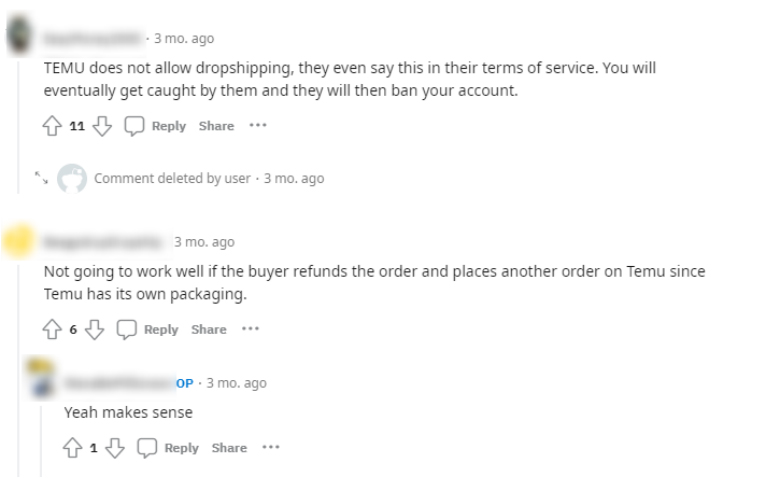
If customers recognize the packaging or discover that their items came directly from Temu, they may question the price markup or the credibility of your store. This can easily lead to customer complaints, refund requests, and a loss of brand trust.
Inconsistent Product Quality
While consumers seem to benefit from low prices, a bad result is that higher-quality, slightly more expensive products are being phased out, leaving only the cheapest, subpar products. Many cheap products on the platform are made from low-quality materials and might even contain harmful substances.
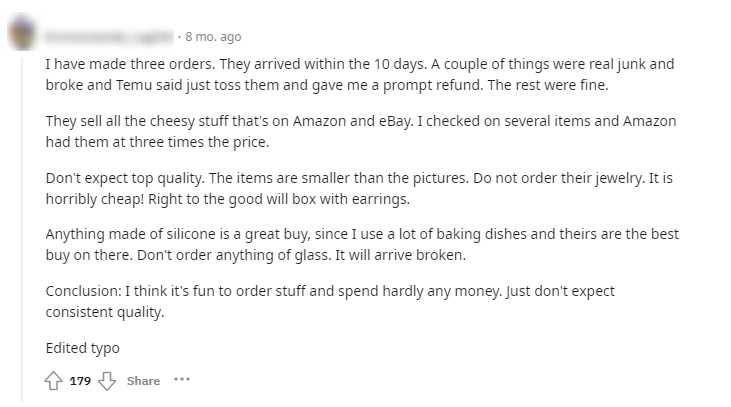
Moreover, some suppliers use false photos, resulting in customers receiving products that don't match the displayed images. Temu is more like a one-time shopping platform, and most purchased products end up broken and thrown in the trash. This can lead to serious quality issues for dropshippers.
Risk of Lost Packages
Like other online marketplaces, Temu orders may occasionally experience shipping delays or lost packages. When using Temu for order fulfillment, dropshippers have limited control over carriers and delivery timelines. If a package is lost or delayed, resolving the issue requires coordination between Temu and the end buyer, which can negatively impact customer satisfaction.

No Scalability
Furthermore, using Temu for dropshipping can hinder scalability. If you purchase products on Temu and ship them to multiple customers, your account may be at risk of being banned due to adding different recipients and using multiple shipping addresses. Alternatively, you could create multiple accounts to ship to different regions, but this approach is time-consuming and limits the growth potential of your business.
Privacy Risks
Lastly, privacy concerns arise due to Temu's parent company, PDD, previously being removed from the Google Play Store for containing malware. The data collection practices of Temu may be bad for privacy because it stores a large amount of information about users’ browsing habits and devices.
Is Temu Killing the Dropshipping World?
With Temu offering a wide range of low-priced items, shoppers can easily compare prices across different online stores. This intensifies competition for dropshippers selling similar, widely available products.
However, price is not the only factor driving purchasing decisions. Offering products with distinctive designs, practical features, or a clear niche focus gives customers a compelling reason to choose your store over cheaper alternatives.
For example, print-on-demand allows sellers to offer customized, personalized products that cannot be easily compared to mass-produced items.
Some retailers even develop new products with unique functions or features to differentiate themselves from what already exists in the marketplace. Ultimately, establishing a strong brand builds buyer trust and encourages long-term customer loyalty over quick price hunting.
Temu may drive down prices across generic goods, but it does not diminish the value of dropshipping. Merchants who focus on curated niches, quality presentation, and unique customer value will continue to find sustainable success.
Temu vs Amazon vs SourcinBox
While Temu and Amazon primarily operate as online marketplaces, SourcinBox specializes in product sourcing and dropshipping fulfillment. Here's how they compare across key features.
| Feature | Temu | Amazon | SourcinBox |
|---|---|---|---|
| Platform Type | B2C e-commerce marketplace | B2C / B2B e-commerce marketplace | Dedicated sourcing & dropshipping fulfillment platform |
| Dropshipping Support | No official support | Allowed for Amazon sellers under specific conditions; not a direct dropshipping supplier | Fully supported with automated order syncing & fulfillment |
| Product Range | Extensive selection of consumer goods | Vast marketplace catalog across multiple categories | Wide product network with custom sourcing on demand |
| Pricing | Low retail prices; frequent promotions and price changes | Varies by third-party seller and product category | Competitive sourcing quotes based on product requirements and order quantities |
| Product Quality | Varies by merchant and manufacturer | Varies by seller and product | Supplier-dependent, with pre-shipment quality inspection |
| Shipping & Delivery | Delivery times vary by seller and destination | Multiple options (e.g., FBA); delivery depends on location | Multiple international shipping options; delivery times vary by destination |
| Branding & Customization | Not supported for standard consumer purchases | Limited; depends on direct supplier cooperation | Full customization supported (custom packaging, private labeling, insert cards) |
| Automation Support | No official dropshipping integration for external stores | Seller APIs available; no built-in retail-to-dropshipping integration for external stores | Automated store order syncing, tracking updates, and bulk fulfillment |
| Returns & Refunds | Most items returnable within 90 days; first return per order free (exceptions apply) | Generally 30-day returns for eligible items; exceptions apply | Reshipment or refund for eligible damaged, defective, or lost orders (per policy) |
How to Leverage Temu for Your Dropshipping Business
While Temu does not officially support dropshipping for independent online stores, it can still be a useful source of product ideas. Sellers can research popular products and consumer preferences on Temu before sourcing them through dedicated suppliers.
Step 1: Use Temu to Discover Trending Products
- Explore Popular Products: Browse Temu's best-selling, highly rated, and newly listed products for inspiration.
- Analyze Consumer Demand: Look for problem-solving products with steady buyer interest and strong recent feedback.
- Validate Market Demand: Cross-check potential products on Google Trends, social media platforms (such as TikTok or Instagram), or competing storefronts to assess demand beyond Temu.
Step 2: Find Reliable Sourcing and Fulfillment Partners
- Find B2B Suppliers: Look for reliable dropshipping suppliers or sourcing agents that can provide the same or similar products. Services like SourcinBox can help you find suitable suppliers, obtain quotes, and arrange product sourcing.
- Request Product Samples: Order samples first to evaluate product quality, packaging, and delivery times before selling.
- Calculate Profit Margins: Factor in product costs, international shipping fees, payment processing fees, advertising costs, and potential returns to estimate your profit margins.
Step 3: Build Your Brand Through Customization
- Add Custom Branding: Differentiate your storefront from generic marketplace listings by adding branded packaging, logos, or personalized thank-you cards.
- Offer Niche Product Variations: Consider different colors, product bundles, or customized features to distinguish your offerings from similar products on Temu.
- Verify Minimum Order Quantities (MOQs): Confirm your supplier's MOQ requirements and upfront fees for packaging customization before launching campaigns.
Step 4: Automate Order Fulfillment
- Connect Your Store: Connect your e-commerce store to SourcinBox to sync orders and simplify order processing across supported platforms such as Shopify and WooCommerce.
- Streamline Operations: Automated workflows reduce manual data entry and order processing errors, making it easier to manage growing order volumes.
- Set Clear Logistics Expectations: Compare available shipping methods, costs, and estimated delivery times to choose suitable options and set realistic delivery expectations for your customers.
Try SourcinBox Dropshipping to Grow Your Business
While Temu attracts shoppers with low prices, it does not officially support dropshipping for independent online stores. For sellers planning to scale, a dedicated sourcing and fulfillment partner can make product procurement and order management easier.
SourcinBox combines product sourcing, customization, free warehousing, and order fulfillment services, supported by an app that simplifies order management. Here is how we support your store’s growth:
High-quality Product Sourcing
Product quality is an important way to differentiate your store from competitors selling similar low-cost products. SourcinBox works with a network of manufacturers and suppliers across China. Our dedicated sourcing team helps you find suitable suppliers, compare quotations, and negotiate pricing based on your product specifications, quality requirements, and order quantities.
Custom Product Development
If you spot a promising product idea on Temu but want to make it stand out, SourcinBox can help you customize its design, materials, and functional features. We work with manufacturers to explore customization options and develop products tailored to your target market.
Private Label & Branding Services
Branded packaging and presentation can help your products stand out and make your store more memorable. Our private labeling services include:
- Custom logo printing on products and packaging
- Personalized thank-you cards and branded inserts
- Custom kitting and product bundling
- Free Warehousing: Pre-purchase inventory and store it in our warehouse at no additional storage cost, with inventory management support.
Automated Order Fulfillment
Connect your online store to SourcinBox and manage orders from supported e-commerce platforms, including Shopify, WooCommerce, Etsy, and Shoplazza. Once connected:
- Eligible store orders automatically sync to the SourcinBox App.
- You can review and pay for orders individually or in bulk.
- Our team handles procurement, quality control (QC) inspection, packaging, and dispatch.
- Tracking numbers and fulfillment updates are synced back to your connected store after shipment.
Flexible International Shipping & Delivery
We work with international logistics partners to offer shipping options for different destinations, delivery needs, and budgets.
- Cost-Effective & Express Options: Choose between economy lines and premium express shipping depending on your customer expectations.
- Shipping Rates & Estimates: Compare available shipping methods, rates, and estimated delivery times in the SourcinBox App.
- After-Sales Support: Our dedicated support team assists with logistics inquiries and provides refunds or reshipments for eligible lost, damaged, or defective orders in accordance with our after-sales policy.
FAQs
1. Can I Use Temu for Dropshipping?
Temu does not officially support dropshipping. Some sellers manually place Temu orders using their customers' shipping addresses, but this approach may conflict with Temu's terms of use and offers no dedicated dropshipping automation. Temu is better suited for product research than as a long-term dropshipping supplier.
2. Can I Resell Products Purchased on Temu?
Temu is primarily designed for consumer shopping, not wholesale sourcing. Its terms of use vary by market and may restrict purchases for resale. Check the applicable terms before buying products for your business.
3. Where Is Temu Located?
Temu's U.S. operating company is based in Boston, Massachusetts, while its parent company, PDD Holdings, has its principal executive offices in Dublin, Ireland. Temu operates internationally, with shipping origins varying by seller and fulfillment method.
4. Can I Connect Temu to Shopify for Dropshipping?
Shopify offers an official Temu sales channel that allows merchants to sell their Shopify products on Temu. However, it does not allow merchants to import products from Temu to fulfill orders placed on Shopify. To fulfill Shopify orders this way, you'll need a dedicated dropshipping supplier or fulfillment service.
Final Thoughts
Temu can be useful for finding product ideas and comparing retail prices, but it does not officially support dropshipping. Limited control over packaging and order fulfillment also makes it difficult to rely on Temu for long-term sourcing.
Rather than competing with Temu on price alone, dropshippers can focus on a specific, profitable niche and differentiate their products through customization or branding. A reliable sourcing and fulfillment partner can also help with quality checks and manage orders more efficiently as sales grow.
Share your product requirements with SourcinBox to get one-on-one sourcing assistance.
Related Reading
- How to work with SourcinBox
- 10 Best Dropshipping Suppliers and Platforms
- How to Brand Your Dropshipping Store with SourcinBox
- Everything You Should Know About Private Label Business

Share Article: