How to Start a Supplement Dropshipping Business in 2026

SIB Content Team
Whenever I talk to independent store owners about product sourcing, one niche keeps coming up: supplements.
And that makes sense. Global consumer interest in health management, nutritional supplements, sleep support, immunity, workout recovery, and stress support continues to rise. In the U.S. alone, consumers spend around $60 billion a year on dietary supplements, covering everything from multivitamins and digestive support to sports nutrition and healthy aging products.
For Shopify and independent store owners, the mainstream supplement market is already highly competitive. But there are still plenty of opportunities in niche supplements that focus on specific functions, target audiences, or unique formulas.
Compared with many one-time-purchase products, supplements often have stronger repeat-purchase potential. They are easier to build into a long-term DTC brand through content marketing, packaging, and customer trust.
That said, supplement dropshipping is not a niche market where you can simply upload products and run ads. It involves more complex product compliance, labeling requirements, supplier screening, fulfillment, and brand positioning.
Whether you are a beginner preparing to enter the supplement market or an experienced dropshipper looking to expand into health and wellness products, you need to understand the key rules and steps before you start.
In this guide, we will break down how to start a supplement dropshipping business, including:
- What is supplement dropshipping
- Is it legal to dropship dietary supplements
- White label vs. private label: which one is better for you
- 5 profitable supplement niches to break into in 2026
- How to start a supplement dropshipping business step by step
- How to Choose a Reliable Supplement Dropshipping Fulfillment Agent
What is Supplement Dropshipping?
Supplement dropshipping is an e-commerce business model where you sell supplements through your online store without holding large amounts of inventory upfront. When a customer places an order, your supplier or dropshipping agent ships the product directly to your customer under your brand or store name.
Further reading: If you are not familiar with dropshipping yet, we recommend reading our beginner's guide: What is Dropshipping? A Beginner’s Guide for Independent Store Owners, before coming back to this article. It will help you better understand how supplement dropshipping works.
In short, the main advantage of dropshipping is that you can test products and enter the market without taking on heavy inventory risk. Instead of managing stock, you can focus more on marketing, brand building, and customer relationships.
However, supplements are different from ordinary daily-use products. They are directly tied to health and trust. Customers are usually more cautious before buying, and they pay more attention to ingredients, labels, brand background, reviews, and product descriptions.
We will cover these challenges and common beginner mistakes in supplement dropshipping later in this guide. Stick around.
Is It Legal to Dropship Dietary Supplements?
Yes, dropshipping dietary supplements is legal.
However, the legality does not depend only on the act of selling supplements. It also depends on whether the product ingredients are compliant, whether the labels and marketing claims follow regulations, whether your supplier has the right qualifications, and whether your target market allows the product to be imported and sold.
In markets such as the United States, the European Union, the United Kingdom, Canada, and Australia, dropshippers can generally sell dietary supplements through a dropshipping model, as long as the products and marketing materials comply with local regulations.
Using the U.S. market as an example, here are several key points you need to pay attention to.
Follow FDA Requirements
In the US, dietary supplements are regulated by the FDA and are subject to the Dietary Supplement Health and Education Act of 1994, also known as DSHEA.
Your product label must be transparent and clearly list all ingredients, dosage information, directions for use, warnings, and other required product information. It must not contain false or misleading statements.
Avoid Medical Claims
Dietary supplements cannot claim to “cure,” “treat,” “prevent,” or “diagnose” any disease. This means you should not use drug-like claims on your product pages, ad copy, email campaigns, or social media content.
For example, avoid claims such as "treats high blood pressure," “cures colds," and “prevents cancer."
If you want to describe how your supplement product supports health, a safer approach is to use structure claims, such as "helps support joint health" and “supports immune system function.”
In the US, structure claims also need to include the following disclaimer on the product label: "This statement has not been evaluated by the Food and Drug Administration." This product is not intended to diagnose, treat, cure, or prevent any disease.
For more details, refer to the official Dietary Supplement Health and Education Act of 1994.
Work with Qualified Suppliers
Your supplier should follow GMP. This is a basic quality standard that shows the factory’s production process meets important safety and quality requirements for dietary supplements.
In addition, your supplier should also be able to provide clear third-party testing reports and COAs, so you can verify the ingredients, purity, and safety of each batch.
Lastly, ingredients should be traceable, and products should have batch numbers. If a quality complaint ever arises, you can quickly isolate the specific batch, protecting both your customers and your brand's reputation.
Regulations Vary by Country
Supplement regulations differ widely across countries and regions. If you sell across the US, Europe, Canada, Australia, Japan, or other markets, you need to research each market’s ingredient restrictions and labeling requirements separately.
Some ingredients, such as melatonin or certain botanical extracts, may be strictly regulated in specific countries.
If you work with a dropshipping fulfillment agent like SourcinBox, make sure to clearly communicate your target market. A professional dropshipping fulfillment agent can help you screen suppliers that already meet basic compliance expectations for your target market, which can significantly reduce compliance risk.
White Label vs Private Label Supplements: Which One is Better for You
Once you understand the basic business model and legal boundaries of supplement dropshipping, the next key question is:
Where do the products come from, and how should you brand them?
In the supplement industry, suppliers usually offer two common brand models: white label and private label. White labeling means putting your brand on a pre-existing, factory-standard formula. Private labeling involves manufacturing a custom, proprietary formula unique to your brand.
You may be wondering, "Which one should I choose?"
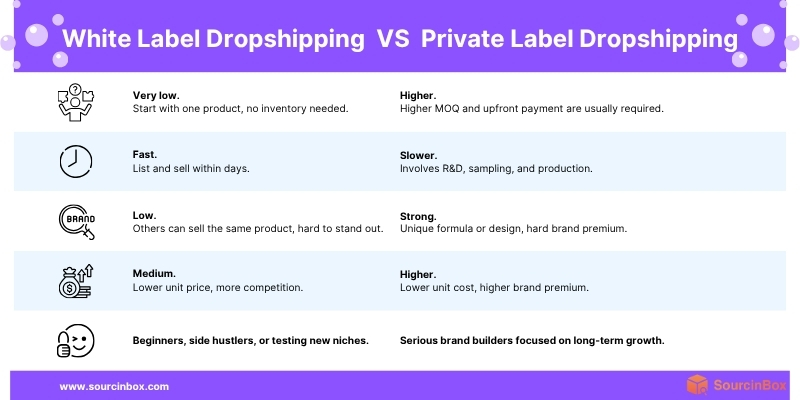
Both models are common in the supplement industry, and there is no one-size-fits-all answer. They differ in startup cost, brand control, operational difficulty, development timeline, and long-term profit potential.
Let’s break down the pros and cons so you can decide which model fits your current stage.
White Label Supplements Dropshipping
White-label supplements are products in which the supplier already has ready-made formulas. The same formula may be offered to multiple brands. You simply choose the product, design your packaging, add your brand label, and launch it faster.
For example, you can choose a ready-made probiotic from a supplier’s product catalog, redesign the bottle label, and sell it under your own brand name.
Most white label supplement suppliers have lower MOQs. Some may even support small test batches of 50 to 100 bottles, making white-label a practical option for beginners entering the supplement dropshipping industry.
The biggest advantage of white label is the lower startup cost. You do not need to spend heavily on formula development. Instead, you can start with a mature product that the supplier already produces. This also reduces inventory pressure and supply chain complexity.
However, the main downside of white label is weaker differentiation. Since many dropshippers may be selling similar formulas, competition often comes down to pricing, ad performance, packaging design, content marketing, and brand positioning.
So if you choose white label, your focus should not just be “selling the same product.” You need to create differentiation through audience positioning, educational content, packaging experience, and brand trust.
Private Label Supplements Dropshipping
Unlike white label supplements, private label supplements are more customized. You may have your own formula requirements, and the manufacturer develops and produces the product for your brand. This gives your product stronger differentiation in the market and makes it harder for competitors to copy.
As a result, you usually have more control over pricing and profit margins. For dropshippers with an existing customer base, private label can also help increase customer loyalty and long-term repeat purchases.
Of course, the barriers to entry for private label are much higher.
It usually involves formula communication, sample testing, packaging design, label review, bulk production, and higher MOQs. The development cycle may take several weeks or even months.
Private label is also more complex from a compliance perspective. Dropshippers need to pay closer attention to ingredient safety, label requirements, target market regulations, and marketing claims.
If you are interested in private label but are not sure where to start, you can first speak with a dropshipping fulfillment agent like SourcinBox. SourcinBox has product development experience and has helped clients turn custom product ideas into real products. You can read SourcinBox’s product development stories to see how sellers bring ideas from concept to shelf-ready products.
[Click here to view SourcinBox’s product development story.]
As a professional dropshipping fulfillment agent, SourcinBox generally recommends that most beginners start with white label. You can use white label to test the market at a lower cost, validate your product, operations, and marketing workflow, and then gradually move into private label once you have more data and experience.
For experienced dropshippers who already understand the supplement industry and have a well-researched formula idea, private label supplement dropshipping can be a strong long-term strategy.
5 Most Profitable Supplement Categories for Dropshipping
Before discussing specific product categories, it helps to understand common supplement formats. Beyond traditional capsules and tablets, more suppliers now offer gummies, powders, liquid supplements, functional drinks, sprays, and other formats.
Different formats affect the customer experience, packaging cost, shipping method, and brand positioning. After choosing your supplement category, independent store owners can further research the most common formats in the target market or ask suppliers for recommendations before deciding which dosage form or packaging format to sell.
The supplement market has strong demand, but not every supplement product is suitable for dropshipping.
A supplement category that works well for dropshipping usually has several characteristics: stable demand, repeat purchase potential, lightweight and easy-to-ship products, room for higher average order value, and strong potential to build a brand around a specific audience.
Here are the top high-performing niches that check all these boxes for independent store owners:
Joint Health Supplements
As older consumers pay more attention to joint care and mobility, and younger consumers become more proactive about sports recovery and daily maintenance, the audience for this category continues to expand.
The global bone and joint health supplements market was estimated at $14.17 billion in 2024 and is projected to reach $27.16 billion by 2033. According to market reports, North America holds the largest market share at 35.3%, and the U.S. bone and joint health supplement market is expected to continue growing strongly.
Common products include glucosamine and chondroitin, curcumin, collagen (hydrolyzed peptides), and fish oil, or omega-3 fatty acids. These products are usually not one-time purchases. Customers often need to use them consistently over time, which gives the category good repeat purchase potential.
For independent store owners, joint health products can be positioned around healthy aging, daily mobility, post-workout joint support, and everyday joint care. Instead of simply selling a product, this category is better suited for building trust through educational content, usage scenarios, and audience pain points.
|Compliance reminder: Avoid medicalized claims such as “treats arthritis” or “cures pain.” Safer wording includes “supports joint health” and “daily joint care.”
Stress Relief and Sleep Aid Supplement
Sleep and stress relief products are another strong direction for dropshipping. Modern consumers often deal with work stress, poor sleep quality, and emotional tension, which creates a consistent demand for sleep support, relaxation, and stress management products.
According to a CDC report, one in eight U.S. adults regularly uses some type of sleep aid, including supplements or over-the-counter products, to help them fall asleep or stay asleep. In 2023, the U.S. sleep supplement market was valued at $1.02 billion and is projected to reach $1.45 billion by 2029.
Common dietary supplements used to support sleep quality include nitrates, melatonin, magnesium glycinate or magnesium threonate, zinc, vitamin D, and L-theanine. Stress relief supplements may include ashwagandha, chamomile, lavender, melatonin, rhodiola, and L-theanine.
This category is especially suitable for building a lifestyle brand. You can create content around evening relaxation, bedtime routines, workplace stress management, and natural sleep support. The customer pain point is clear, and there is plenty of room for content creation. Sharing sleep tips, stress-management tips, and evening routines via blogs, short-form video, and email newsletters will organically drive store conversions.
|Compliance reminder:Do not claim that the product can “treat insomnia” or “relieve anxiety disorder.” Better wording includes “supports relaxation,” “helps maintain a healthy sleep cycle,” and “fits into a nighttime relaxation routine.”
Immunity Health Supplements
After COVID-19, consumer interest in immune system health, daily nutrition, and seasonal wellness management increased significantly. Many consumers are more willing to buy dietary supplements that support immune function and general wellness.
Market data shows that the global immune health supplements market was estimated at $35.35 billion in 2024 and is projected to reach $76.23 billion by 2033, growing at a CAGR of 9.06% from 2025 to 2033. This growth is heavily driven by an increasing awareness of health.
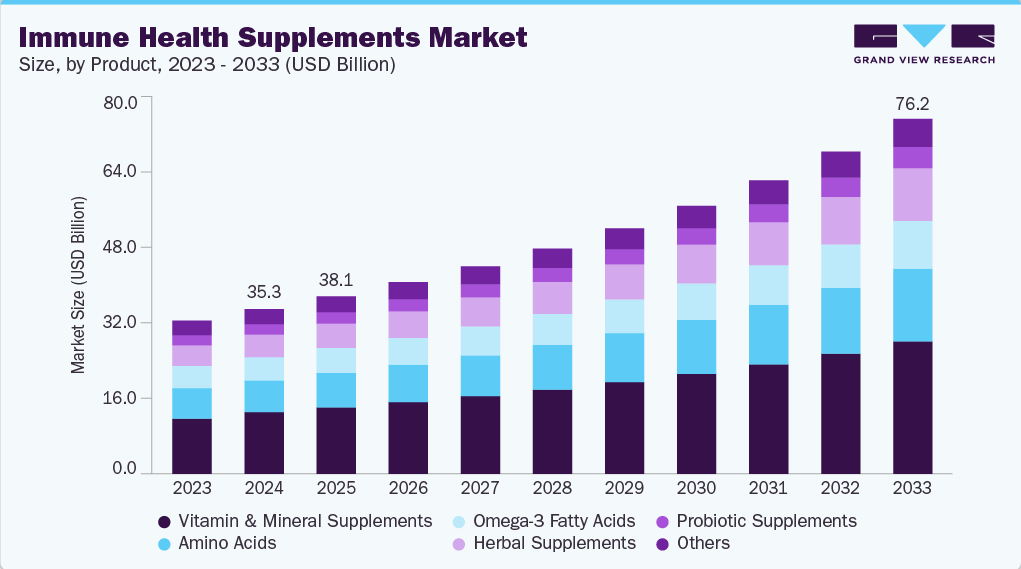
Common immune support ingredients include vitamin C, vitamin D, vitamin B, zinc, selenium, multivitamins, and minerals. Herbal supplements, such as echinacea and elderberry, have also become important growth drivers in this segment because of their broad consumer awareness and availability.
The main advantage of immune health products is a relatively stable demand. Demand can also spike during seasonal changes, winter, and flu season.
For beginners in supplement dropshipping, immune support products have another advantage: consumers already understand many of the core ingredients, so the education cost is lower.
However, competition is intense, so it is usually not enough to simply sell basic vitamin C or zinc.
|Compliance reminder: Avoid claims such as “prevents colds,” “reduces infection risk,” “antiviral,” or “boosts immunity to prevent disease.” Safer wording includes “supports immune system health,” “helps maintain daily nutritional balance,” and “suitable for seasonal wellness management.”
Brain Health Supplement
Brain health supplements have gained more attention in recent years. The audience is no longer limited to older adults. Students, professionals, entrepreneurs, and high-performance workers are also interested in memory, focus, mental clarity, and long-term cognitive wellness.
According to a 2021 AARP survey, about one in five adults over age 50 use vitamins or supplements specifically to support brain functions such as memory, attention, or focus.
Common ingredients include curcumin, coenzyme Q10, omega-3 fatty acids, L-theanine, choline, resveratrol, ashwagandha, and lion’s mane.
Compared with basic vitamins, brain health supplements are easier to differentiate. They can be connected to specific scenarios such as study performance, workplace productivity, and healthy aging. You can use content marketing to build authority and trust.
For example, you can create SEO content around topics such as the following:
- How to stay focused
- Nutritional support for high-intensity work
- Daily brain health habits for students and professionals
|Compliance reminder: Brain health products are easy to overstate. Avoid claims such as “raises IQ” or “treats” any condition. Better wording includes “supports cognitive function,” “helps maintain focus and mental clarity,” and “supports brain health.”
Fitness and Recovery Supplements
Fitness and recovery supplements have a strong and growing demand. In 2024, the U.S. sports nutrition supplement market was estimated at $43.16 billion and is projected to reach $86.74 billion by 2033.
Fitness and recovery supplements are a mature market with strong buyer intent. As fitness, running, strength training, and active lifestyles continue to grow, more consumers are willing to pay for products that support performance, muscle recovery, energy replenishment, and electrolyte balance.
Common products include protein, creatine, BCAAs, omega-3 fatty acids, vitamin D, electrolytes, and magnesium. The advantage of this category is that the target audience is clear, usage scenarios are easy to understand, and both average order value and repeat purchase potential can be strong.
For independent store owners, this category can be easier to start if you already have fitness content channels, influencer resources, a community, or short-form video traffic. It works well for niche brand positioning, such as women’s fitness, running recovery, strength training, outdoor sports hydration, or a low-sugar, high-protein lifestyle.
However, this category is also highly competitive, especially for protein powder and creatine. If you are a beginner, it is not ideal to compete head-to-head with major brands from the start. A better strategy is to choose a more specific use case or audience and enter the market with clearer positioning.
|Compliance reminder: Avoid exaggerated claims such as “rapid muscle gain,” “guaranteed fat loss,” or “treats sports injuries.” Better wording includes “supports post-workout recovery,” “helps supplement daily protein intake,” and “suitable for post-training nutrition.”
When choosing a supplement category for dropshipping, do not get blinded by a single product’s high margin. Ask yourself:
- Is the demand real?
- Can repeat purchases work?
- Are shipping costs reasonable?
- Can you create brand differentiation?
- Is the supplier reliable?
- Are there hidden compliance risks?
For beginners, SourcinBox recommends starting with a clear niche and a well-defined audience. Validate your target customers, product positioning, and supply chain capabilities first, then gradually expand your product line.
That is how you build a supplement dropshipping business that can scale long-term, instead of relying only on short-lived winning products.
How to Start a Supplement Dropshipping Business Step by Step
Once you’ve selected your supplement category, the next step is not to immediately upload products to your store. Instead, you need to confirm whether the category actually fits your target market, whether the supply chain is stable, and whether your product and marketing content are compliant.
A complete supplement dropshipping startup process usually includes the following steps:
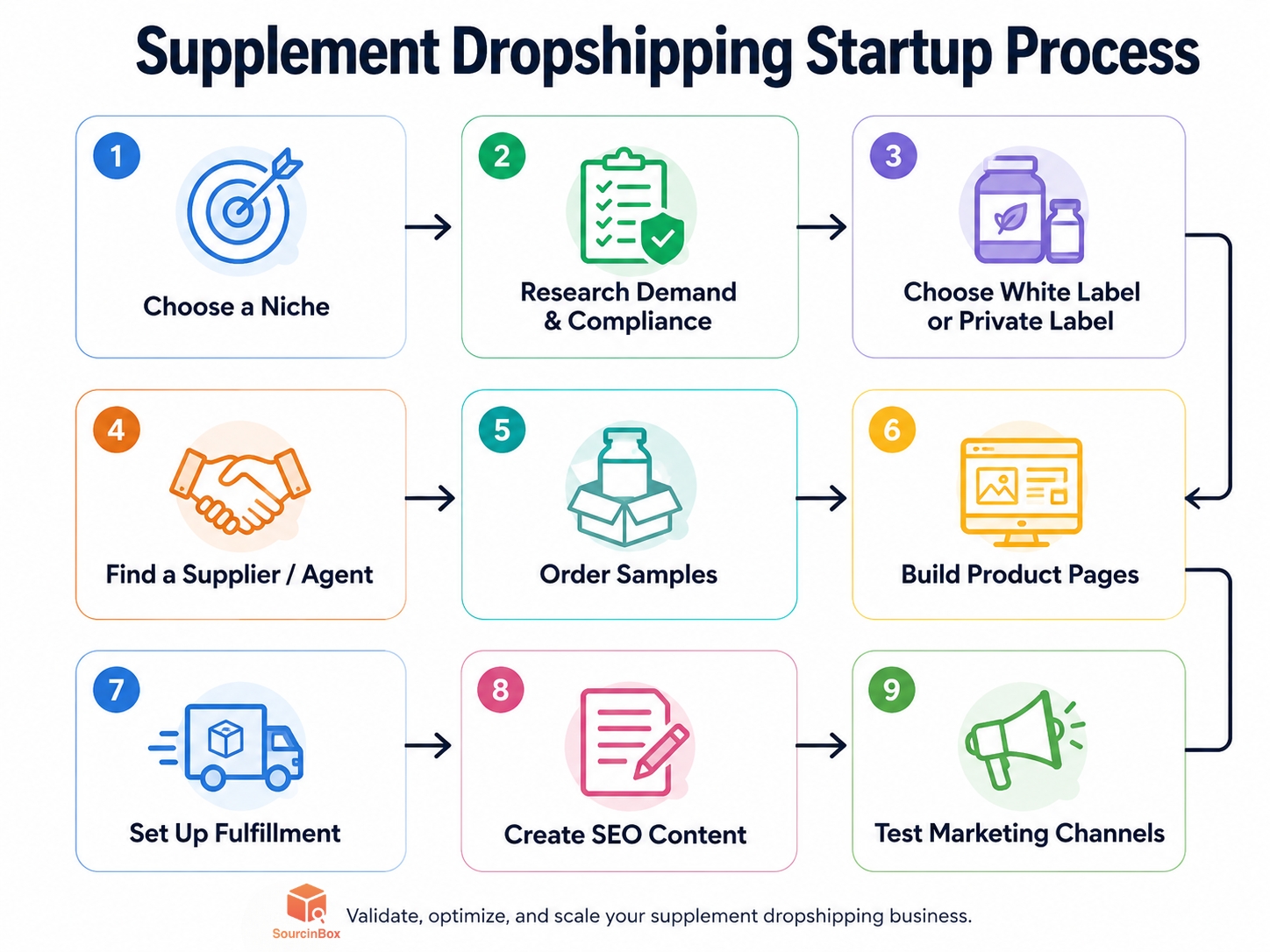
1. Choose a Clear Niche: Start by choosing one supplement niche, such as sleep support, joint health, immune support, or workout recovery.
2. Conduct Market & Compliance Research: Analyze demand in your target market and understand local regulations for supplement products.
3. Decide Your Product Model: Decide whether a low-MOQ White Label approach or a proprietary Private Label model fits your budget and timeline.
4. Partner with a Reliable Fulfillment Agent: Contact suppliers or supplement dropshipping fulfillment agents, request samples, and ask for basic compliance documents.
5. Build Product Pages and Set Up Shipping Policies: Create complete product pages and set clear shipping, delivery, and return policies.
6. Launch Initial Marketing: Use SEO, content marketing, and small-budget ad testing to get your first orders.
In this process, the key is not to “launch as fast as possible.” The key is to confirm whether the product fits your target market, whether the supplier is reliable, whether the labels and copy are compliant, and whether the fulfillment workflow is stable.
Only after these core foundations are validated does your supplement dropshipping business become ready to scale.
Next, let’s look at how independent store owners can choose a truly reliable supplement dropshipping fulfillment agent.
How to Choose a Reliable Supplement Dropshipping Fulfillment Agent
Supplement dropshipping depends more heavily on supply chain stability and basic compliance capabilities than generic dropshipping products. Product ingredients, label information, ad claims, customs clearance, inventory management, and after-sales support can all affect the long-term performance of your store.
After you have chosen your target niche and mapped out your startup process, the next step is to evaluate whether your back-end partner truly understands the supplement industry and can support stable fulfillment, product inspection, packaging customization, order processing, and basic compliance needs.
Compliance and Product Quality
Supplements are a trust-driven category. Customers are not just buying capsules or powder. They are buying health, safety, and brand professionalism.
When screening suppliers, you need to confirm whether they can provide:
- GMP certification
- Third-party testing reports
- COA, or Certificate of Analysis
- Ingredient sourcing information
- Label and ingredient information required by your target market
If a supplier cannot provide these basic documents, or if they give vague answers about ingredients, testing, and labels, you should be cautious.
In supplement dropshipping, a lower price does not always mean higher profit. It may lead to compliance risks, customer complaints, and long-term brand damage.
Branding and Packaging Capability
If you want to build a long-term supplement dropshipping business, you should not stay stuck in generic, unbranded dropshipping.
Supplements depend heavily on trust. Brand packaging, label design, and product information can directly affect whether customers feel confident enough to place an order.
You should check whether the supplier supports:
- White label
- Private label
- Custom labels
- Custom packaging
- Marketing inserts
- Instruction cards
- Outer boxes
SourcinBox offers private label services, including custom packaging, labeling, brand kits, marketing inserts, and product customization. This makes it a good option for dropshippers who want to move from basic dropshipping toward brand-building.
Fulfillment and Inventory Management
Supplements often have strong repeat purchase potential, so fulfillment stability matters.
Before working with a partner, confirm:
- Order processing time
- Shipping tracking capabilities
- Delivery times to major markets
- Inventory transparency and shelf-life management
- Whether they can handle bulk orders and seasonal demand spikes
In 2026, cross-border e-commerce logistics may face more uncertainty. Due to geopolitical factors, international route adjustments, tariff changes, port congestion, and fuel cost fluctuations, some markets may experience slower delivery times or temporary shipping cost increases.
This is not something a single dropshipper or supplier can fully control. You need to set expectations in advance.
You can work with a supplement dropshipping fulfillment agent that understands cross-border fulfillment and can help you review available shipping channels, average delivery times, abnormal parcel handling processes, and backup shipping routes.
SourcinBox can support sellers with product sourcing, warehousing, quality inspection, order fulfillment, shipping tracking, and custom packaging, helping independent store owners reduce back-end fulfillment pressure.
After-Sales Support and Problem Solving
In dropshipping, the real test of a supplier is not normal orders. It is problem orders—wrong item shipped, missing items, damaged parcels, shipping delays, customs issues, returns and exchanges.
You need to evaluate:
- Communication efficiency
- Problem-solving attitude
- Reshipment rules
- Refund processes
It is a good idea to test the supplier with samples or small-batch orders first. SourcinBox provides 1-on-1 customer manager support across sourcing, quality inspection, customization, warehousing, and fulfillment. For dropshippers without a mature supply chain team, this can significantly reduce early-stage communication and operations workload.
Start Supplement Dropshipping with SourcinBox Now
Supplement dropshipping is a promising direction for independent store owners. Compared with many one-time-purchase products, supplements have clearer customer needs, stronger repeat-purchase potential, and more room to build long-term value through content, packaging, and brand positioning.
But remember, supplements are not ordinary products that you can casually upload and promote. Product quality, supplier qualifications, ingredient transparency, label compliance, ad copy, fulfillment stability, and customer support all directly affect your brand trust and long-term results.
For store owners who want to start or scale supplement dropshipping, we recommend:
Do not rush to upload products. Start with one clear niche, such as sleep support, joint health, immune support, brain health, or fitness recovery. Validate your target audience, product positioning, and supply chain first, then gradually expand your product line.
More importantly, find a reliable dropshipping fulfillment agent or supplier.
If you are ready to start supplement dropshipping, SourcinBox can be a trusted partner. We are not just a dropshipping agent. We also provide a free automated fulfillment system.
Simply connect your Shopify store to our app, and your orders can sync automatically. From sourcing and quality inspection to secondary packaging and shipping, our team can help handle the fulfillment process. If you also sell on WooCommerce, Yampi, Etsy, or other platforms, you can upload orders with one click.
Connect your store today and start building a more stable and reliable supplement dropshipping business.
Finally, I want to say that the core of long-term supplement dropshipping is not selling as many products as possible. It is building customer trust first.
Choose the right niche, build a reliable supply chain, pay attention to product quality and compliant messaging, and your supplement store will have a stronger foundation for sustainable growth.
If you want to explore other dropshipping niches, you can also read:
- 10 Profitable Summer Clothing Dropshipping Products for 2026
- Best Kids Toys to Sell for Children’s Day 2026 Dropshipping
- 7 Most Profitable Niche Sports for Dropshipping in 2026
- 14 Best Profitable Dropshipping Niches for 2026
FAQs
1. Is supplement dropshipping legal?
Yes, supplement dropshipping is generally legal. However, your products, labels, marketing claims, supplier qualifications, and import requirements must comply with the regulations of your target market. Rules can vary significantly by country or region.
2. Is supplement dropshipping profitable?
Yes, supplement dropshipping can be profitable, but margins depend on your niche, supplier, COGS, fulfillment costs, ad spend, and repeat purchase rate. Many sellers aim for profit margins around 20%–50%, but compliance costs, customer acquisition costs, refunds, and chargebacks can reduce profitability.
3. Do I need FDA approval to sell dietary supplements?
In the U.S., dietary supplements usually do not need FDA pre-market approval the way drugs do. However, that does not mean you can sell anything freely. You still need to follow FDA labeling rules, GMP requirements, ingredient safety standards, and advertising claim guidelines.
4. What are the best supplements for dropshipping?
The best supplement categories for dropshipping usually have steady demand, strong repeat purchase potential, lightweight shipping, room for branding, and manageable compliance risks.
Popular options include sleep support, joint health, immune support, brain health, fitness and recovery, digestive health, and women’s wellness.
5. Can I sell supplements on Shopify?
Yes, you can sell compliant supplement products on Shopify. However, you still need to follow the rules of your target market, Shopify’s policies, payment provider requirements, and advertising platform guidelines.

Share Article: