Dropshipping in Australia: How to Start a Dropshipping Business in 2027

SIB Content Team
Want to start a dropshipping business targeting Australian consumers without tying up too much money in inventory? Dropshipping lets you sell products through your own online store while suppliers handle fulfillment and ship orders directly to your customers. You can start with a small product range, test demand, and decide whether to expand based on actual sales.
But selling to Australian customers takes more than finding products and setting up a store. You'll need to understand local shopping habits, calculate shipping costs and delivery times for different Australian destinations, and account for applicable tax rules and consumer protection requirements. These factors all affect your operating costs, pricing, and profit margins.
Whether you're based in Australia or running your business from overseas, this guide walks you through starting a dropshipping business that sells to Australian consumers in 2027. You'll learn how to research the market, choose products and suppliers, set up your store, estimate startup costs, and assess profitability. It also covers what to prepare before launch and how to test your products and supply chain before committing more money.
What is Dropshipping and How Does It Work in Australia?
Dropshipping is a retail model in which the supplier ships products directly to the customer. Dropshippers generally do not need to buy large quantities of inventory upfront or handle storage, packing, and shipping themselves.
A typical order works like this:
- A customer selects a product from your store and pays for it.
- You submit the order details and delivery information to the supplier.
- The supplier prepares and packs the product, then ships it directly to the customer.
- You provide tracking updates and handle inquiries, refunds, and after-sales issues.
For example, an online store selling to Australian consumers can use SourcinBox to source products from Chinese suppliers and manage order fulfillment. Once a customer places an order, the product can be shipped directly to Australia. Actual profit is what remains after you deduct sourcing, shipping, platform, advertising, and after-sales costs from sales revenue.
Even when suppliers handle fulfillment, sellers remain responsible for product quality and after-sales service. For orders sold to Australian consumers, sellers must still follow applicable consumer protection rules and remain responsible for product descriptions, delivery promises, refund handling, and related obligations.
What Makes Dropshipping in Australia Different?
Australia has a mature ecommerce market, but local shopping habits, seasonal demand, and shipping conditions differ from those in major markets such as the United States and Europe. For dropshippers, the most important differences are consumer demand, seasonal sales opportunities, and delivery conditions across metro, regional, and remote areas.
Australian E-Commerce Trends and Consumer Behavior
Online shopping is already well established in Australia. According to the Australia Post 2026 eCommerce Report, 9.8 million Australian households shopped online in 2025, accounting for 82% of all households, and online spending reached A$82.6 billion.
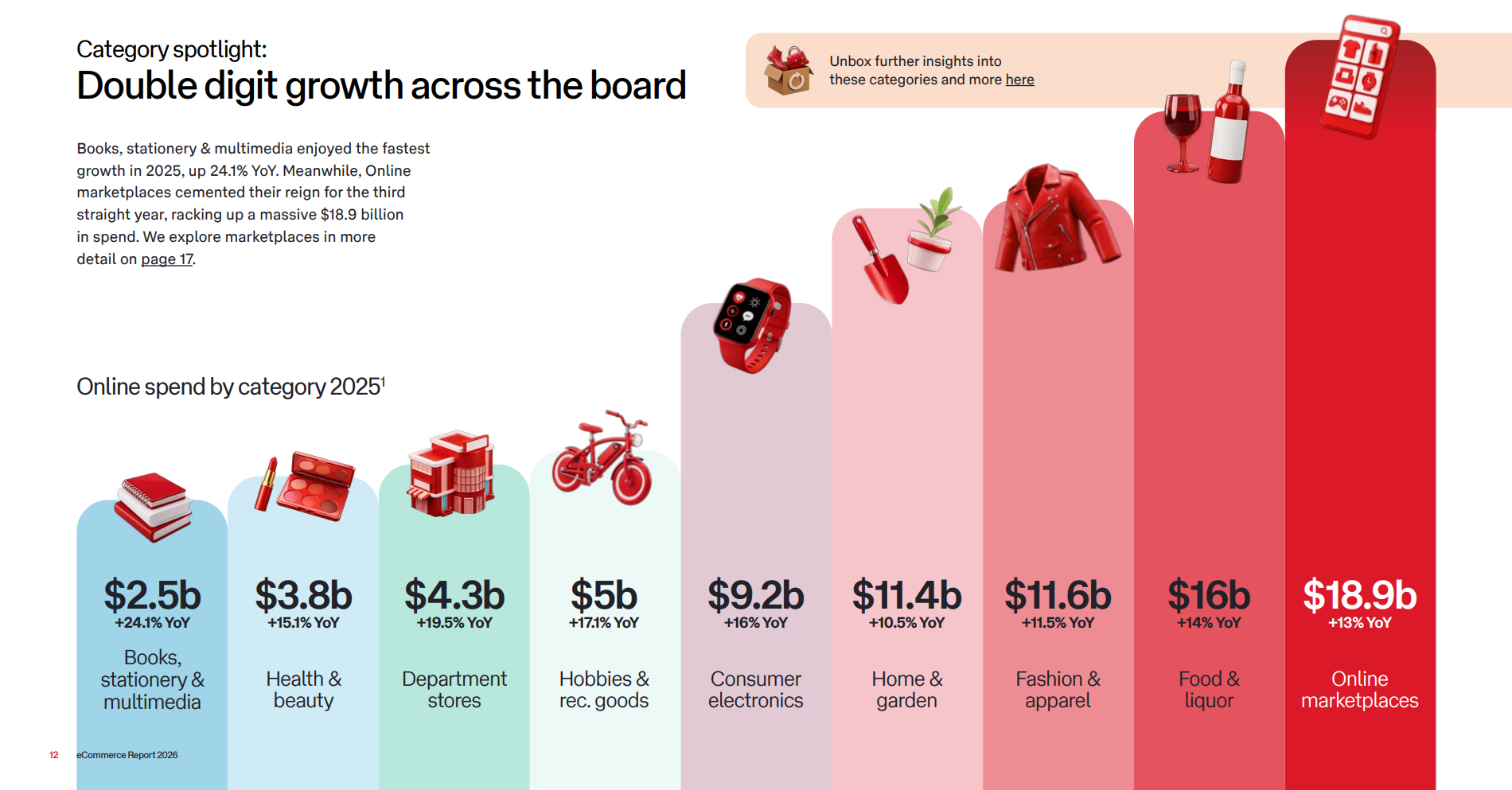
Price strongly influences purchase decisions. In 2025, 81% of Australian consumers actively looked for deals, while the average basket size fell to A$96. Online marketplaces also play a major role in how Australians shop. Marketplace spending reached A$18.9 billion in 2025, and 69% of consumers used marketplace apps. Because shoppers can compare prices and delivery terms across channels so easily, a new dropshipping store is unlikely to stand out by selling widely available products alone.
Demand alone should not determine your product selection. You also need to consider price competition and why shoppers would choose your store. Instead of offering a broad mix of generic products, build your range around a specific audience or situation. A pet store, for example, could target people who often travel with their dogs by offering car seat protectors, portable water bowls, and other travel essentials rather than an unfocused assortment of pet products.
Seasonal Demand and Product Opportunities
Australia is in the Southern Hemisphere, so its seasons are the reverse of those in Northern Hemisphere markets such as the United States and Europe. Summer runs from December to February, winter from June to August, and Christmas falls in summer. The year-end Christmas shopping season often overlaps with demand for summer travel, outdoor activities, and vacations, followed by the back-to-school season early in the year. Plan your product range around these local seasons and sales periods.
Black Friday, Cyber Monday, Christmas, and Boxing Day are also major shopping events in Australia. Use Google Trends to review a product's historical search interest in Australia, then check local retail sites and consumer reviews before deciding whether to test it.
Seasonal products need to be tested well before demand peaks. A seller offering car boot organizers, for example, could complete product research and order samples before Australia's summer travel season, working backward from supplier processing and shipping times to set the testing schedule.
Shipping Costs and Delivery Times Across Australia
Australia's size means delivery costs and transit times can vary significantly by region. A shipping option that works for Sydney or Melbourne may not suit regional or remote areas. Carriers also use different delivery zones and pricing structures, so quotes for major cities alone are not enough to estimate nationwide shipping costs.
When fulfilling orders through SourcinBox, enter a specific Australian postcode in the app's shipping method selector to view available options, estimated rates, and expected transit times. Select Australia, then enter the relevant four-digit postcode, such as 2566, in the ZIP field. These estimates can help stores serving Australian consumers compare regional delivery costs and make better-informed pricing and shipping decisions.
【Check shipping methods and estimated costs for Australian postcodes in the SourcinBox App.】
Shipping quotes for the same postcode may vary across delivery methods because carriers use different zones and pricing structures.
Delivery options also influence purchase decisions. According to the Australia Post 2026 eCommerce Report, 69% of consumers want a choice of delivery methods at checkout, including collection points and Parcel Lockers, while 26% expect same-day or next-day delivery when they need an item urgently.
Dropshippers should state expected delivery times, even when shipping from overseas. Clearly show order processing times, estimated transit times, and shipping fees, then provide timely tracking updates after the order ships.
Is Dropshipping Legal in Australia?
Dropshipping is a legal fulfillment model in Australia, but sellers must still follow applicable business registration, tax, consumer protection, and product safety rules. The exact requirements depend on the business entity, sales method, product type, and shipping origin.
Business Registration and ABN Requirements
An ABN is a unique 11-digit number used to identify your business or organization to the government and the wider community.
Before applying for an ABN, choose a suitable business structure, such as a sole trader, partnership, or company. Setup costs, tax obligations, and legal liability vary by structure.
| Business Arrangement | What to Consider |
|---|---|
| Operating an online store in Australia | If you operate in Australia, you generally need to check whether an ABN is required for your circumstances and apply if necessary. Eligibility depends on the entity type and whether it is carrying on, or preparing to carry on, the relevant business activities. |
| Operating overseas and selling to Australian consumers | An ABN is not always required. Selling to Australian consumers alone does not require every overseas seller to obtain one. Whether you need an ABN depends on your business activities in Australia and the applicable registration requirements. |
If your business name differs from your legal personal name or registered company name, you will generally need to register it. You can register the name with your ABN application or do so separately afterward.
GST and Import Tax Rules
Selling goods from overseas to Australian consumers can involve two separate tax issues: GST at the point of sale, and any customs duty, import GST, or processing charges that arise when the goods enter Australia. The treatment depends on the value and type of goods, the sales channel, and the actual import arrangement.
| Customs Value | Customs Duty & Import Charges | GST |
|---|---|---|
| ≤ A$1,000 | Most ordinary goods generally do not incur customs duty or import charges at the border, except for certain products such as alcohol and tobacco. | When the low-value imported goods rules and GST registration requirements apply, 10% GST is generally collected at the point of sale. |
| > A$1,000 | An import declaration is generally required, and customs duty and import processing charges may apply. | Import GST is generally handled when the goods enter Australia, depending on the actual import arrangement. |
💡 Note: Tax treatment depends on the product category, customs value, sales channel, import arrangements, and who is responsible for importing the goods. Customs duty rates also depend on tariff classification, country of origin, and any applicable trade arrangements.
GST registration threshold (A$75,000): You generally need to register for GST when your GST turnover reaches or is expected to reach A$75,000, and complete registration within 21 days of meeting the requirement.
Low-value imported goods (≤ A$1,000): Special GST rules apply to imported goods with a customs value of A$1,000 or less. Eligible overseas merchants, electronic distribution platforms, and other entities may need to collect GST at the point of sale. When goods are sold through an eligible electronic distribution platform, the platform may be responsible for GST.
High-value goods (over A$1,000): An Import Declaration is generally required when the goods enter Australia. Customs duty, import GST, and processing charges may also apply. There is no single duty rate for all products; the rate depends on tariff classification, country of origin, and relevant trade arrangements.
Who Pays Import Duties and Fees?
For orders that may incur import taxes or fees, confirm with the supplier and shipping provider who will file the import declaration and who will pay customs duty, import GST, and clearance charges. If the customer may have to pay extra before delivery, disclose this clearly before checkout to reduce the risk of refused parcels, refunds, or complaints over unexpected charges.
Australian Consumer Law and Product Safety
Dropshippers selling in Australia need to pay attention to the Australian Consumer Law (ACL) and product safety requirements.
Consumer Guarantees: Products must be of acceptable quality, fit for purpose, and match their descriptions. If a product has a quality problem, the seller must provide the appropriate refund, repair, or replacement under the ACL. Businesses may set their own return and exchange policies for non-quality issues such as a change of mind, but those policies cannot remove consumers' statutory guarantees.
Clear Product and Delivery Information: When using dropshipping, provide clear information about stock availability and expected delivery times. Be transparent about where products ship from, and do not give consumers the impression that an item ships from within Australia when it does not.
Product Safety: Online sellers must ensure that their products meet applicable mandatory safety standards in Australia and must not offer banned products.
How to Start Dropshipping in Australia Step by Step
Starting a dropshipping business in Australia takes more than choosing products and building a store. You also need to plan your business structure, suppliers, shipping, and day-to-day operations. The steps below cover the practical process from initial preparation to launch.
Step 1. Choose a Niche and Find Products to Sell
Start by choosing a niche you want to develop over the long term rather than picking products at random. Evaluate Australian consumer demand, competition, pricing, and margin potential to decide whether the niche is worth pursuing. Pet supplies, home products, and outdoor gear are a few areas to research further.
Once you have chosen a niche, look for specific products within it. Use Google Trends, TikTok, Instagram, and Amazon to study search trends, consumer interest, and competing products in Australia, then shortlist a few products to test. Beginners do not need to launch dozens of SKUs. Testing a small number of promising products makes it easier to control costs and assess the market response.
Niches Worth Exploring in Australia
| Niche | Product Examples |
|---|---|
| Pet Supplies | Pet travel accessories, interactive toys, grooming tools |
| Home & Garden | Storage organizers, garden accessories, home decor |
| Beauty & Personal Care | Makeup organizers, beauty tools, toiletry bags |
| Outdoor & Travel | Camping accessories, travel organizers, portable gear |
| Arts, Crafts & Stationery | DIY kits, journaling supplies, craft organizers |
Step 2. Choose the Right Selling Platform
Once you know what to sell, choose where to sell it. You can build your own online store with Shopify or WooCommerce, or tap into existing traffic on marketplaces such as eBay Australia and Amazon Australia.
| Selling Platform | Main Advantages | Main Limitations | Best Suited For |
|---|---|---|---|
| Shopify ↗ | Strong control over branding, page design, customer data, and marketing, with a mature app ecosystem | You must generate your own traffic and cover subscription, payment processing, and app fees | Sellers that want to build an independent brand for the long term |
| eBay Australia ↗ | Built-in search traffic and an established buyer base | Subject to platform policies, seller performance standards, and fulfillment requirements | Sellers with compliant supply arrangements and consistent fulfillment |
| WooCommerce ↗ | Highly flexible, with extensive control over site design and functionality | You are responsible for hosting, maintenance, security, and plugin compatibility | Sellers familiar with WordPress or supported by technical resources |
| Amazon Australia ↗ | A large buyer base and mature ecommerce infrastructure | More complex platform rules and fees, with significant seller responsibilities | Sellers with proven products and established operating experience |
Check the platform's dropshipping policy before opening a store. If you plan to sell on eBay or another marketplace, make sure your fulfillment method is allowed.
On eBay Australia, for example, sellers may use third-party fulfillment, but they must purchase or own the inventory in advance, and the packaging and documentation must clearly identify the seller. Buying an item from another retailer or marketplace only after receiving an order and having it shipped directly to the buyer does not comply with eBay's dropshipping policy.
Step 3. Find and Evaluate Dropshipping Suppliers
After choosing a selling platform, find suppliers that provide the products you need, meet the platform's requirements, and can ship to Australia. Common options include Australian suppliers, global supplier platforms, China-based dropshipping agents, and direct factory sourcing. Each offers a different balance of sourcing cost, product selection, and fulfillment support.
| Supply Model | Advantages | Main Risks | Suitable Stage |
|---|---|---|---|
| Australian Suppliers | Usually faster domestic delivery, with easier returns and after-sales communication | Potentially higher sourcing costs and a smaller product range; local stock must be confirmed for each item | Products with time-sensitive delivery requirements or clearly established demand |
| Global Supplier Platforms (e.g., AliExpress) | A broad product range with little need to buy inventory upfront, making low-cost testing easier | Product quality, stock location, and processing times may vary, while overseas returns can be difficult | Early product research and testing |
| China-Based Dropshipping Agent (e.g., SourcinBox ↗) | Can source products based on your requirements, work with factories, help obtain quotes, arrange samples, coordinate quality inspections, and support custom packaging, inventory management, and order fulfillment | Service scope, pricing, inventory arrangements, and after-sales terms vary by provider and plan, so each point must be confirmed separately | Sellers looking for broader sourcing and fulfillment support or more differentiated products |
| Direct Factory Sourcing | Better suited to product customization, branded packaging, and long-term supply chain management | May require MOQs, upfront investment, longer development times, and inventory risk | Sellers with validated demand that are ready to build a private brand or scale their business |
Do not compare suppliers on product price alone. Confirm the following details for the exact model and variants you plan to sell:
- Inventory and processing time: Confirm the actual stock location, available inventory, and order processing time.
- Delivery and shipping costs: Review available shipping routes to Australia, estimated transit times, and rates. Compare delivery conditions for major cities with those for regional and remote areas.
- Orders and after-sales service: Check tracking availability, packaging, the return address, and the procedures and compensation terms for incorrect, damaged, or lost shipments.
- Product compliance: For products covered by Australian safety standards or other rules, request test reports, labels, and any other required compliance documents for the exact model.
After this initial review, shortlist the suppliers worth testing before moving to the next step.
If you want to reduce the work involved in finding products, contacting factories, and coordinating fulfillment, consider a China-based dropshipping agent. SourcinBox, for example, can help source products, obtain quotes, arrange samples, communicate with factories, inspect quality, and fulfill orders. Evaluate these services for each product by checking the sourcing price, scope of service, shipping options, and after-sales terms rather than simply comparing how many services each provider lists.
Step 4. Order Samples and Test the Fulfillment Process
Once you've shortlisted suppliers, order samples and test shipping to Australia using your planned delivery method. Check the following:
- Product quality: Compare the item's dimensions, color, materials, accessories, and workmanship with the product page description.
- Packaging: Check how well it protects the product, its condition on arrival, and the overall unboxing experience.
- Processing and delivery times: Record how long the supplier takes to dispatch the order and how long the parcel takes to reach the target address in Australia.
- Tracking: Check how regularly tracking information is updated and whether the shipment can be followed throughout the journey.
- After-sales response: Confirm the supplier's process, response time, and compensation terms for damaged, incorrect, or lost shipments.
After the test, recalculate costs and margins using the actual shipping rate, delivery time, and product quality. If the results differ significantly from what the supplier originally stated, investigate the reason and reassess the arrangement. List the product only after confirming that the conditions meet your expectations.
Step 5. Calculate Your Costs and Set Your Price
Estimate the cost of each order before setting the selling price. Product costs are only part of your total expenses. You also need to include shipping, platform and payment fees, customer acquisition costs, and expected after-sales costs from refunds, replacement shipments, and similar issues.
Estimated amount remaining per order = Selling price − Product cost − Shipping cost − Platform and payment fees − Customer acquisition cost − Estimated after-sales cost
For example, suppose a product sells for A$40 and has the following estimated costs per order.
| Cost Item | Amount |
|---|---|
| Product cost | A$12 |
| Shipping cost | A$5 |
| Platform and payment fees | A$2 |
| Customer acquisition cost | A$8 |
| Estimated after-sales cost | A$4 |
| Total listed costs | A$31 |
| Amount remaining after the listed costs | A$9 |
💡 Note: These figures illustrate a per-order cost calculation only and do not represent average costs in the Australian dropshipping market. The example does not separately include applicable taxes or other fixed operating expenses. The A$9 is the amount left after the costs shown in the table.
That A$9 can help cover other operating expenses, such as the store subscription, so it should not be treated as final net profit.
When setting your price, compare similar products in the Australian market and consider what customers are willing to pay. Compare the total amount the customer pays, including shipping. If you offer free shipping, include the shipping expense in your cost calculation. Your price must remain competitive while leaving enough margin.
If too little remains after all costs are deducted, look for a better sourcing option, revise the shipping arrangement, or adjust the price. If the product still cannot cover operating expenses and provide a reasonable return, consider testing another product.
Step 6. Set Up Your Online Store
After creating your store, configure its pages and checkout for Australian shoppers. Beyond the home page, product pages, cart, and checkout, pay attention to the following:
- Currency and pricing: Set the store currency to AUD and make sure displayed prices, applicable taxes, and shipping fees match your actual settings.
- Localized product information: Use natural Australian English and metric units where appropriate. For clothing and similar products, provide accurate measurements rather than simply converting overseas sizes into Australian sizes.
- Shipping settings: Base delivery areas, shipping rates, and estimated arrival times on the supplier's actual options, and clearly identify any locations you cannot serve.
- Payment methods: Depending on the platform and your eligibility, offer suitable options such as card payments, PayPal, Apple Pay, Google Pay, or Afterpay.
- Policies and contact details: Clearly display your contact details, shipping information, return policy, privacy policy, and other essential information so customers understand the purchase and after-sales arrangements before ordering.
Product pages should accurately show key details such as dimensions, materials, accessories, and directions for use. Images and descriptions must match the actual item.
Step 7. Connect Your Store to a Dropshipping App
Once your store is set up, you can connect it to an all-in-one sourcing and fulfillment service. This brings product sourcing, purchasing, and order fulfillment together in one workflow, simplifying order processing and making day-to-day store management more efficient.
Shopify users, for example, can connect their stores to SourcinBox and link each store listing to the corresponding SourcinBox product.
- Connect your store: Select Shopify on SourcinBox's Manage Stores page, then follow the prompts to install and authorize the app.
- Connect products: Confirm that every product in your store is linked to its corresponding SourcinBox product.
- Source products: If you cannot find a matching product on SourcinBox, submit a Sourcing Request with the product details, images, or link so SourcinBox can help locate it.
After connecting the store and products, run a test before launching your marketing. Check the product and variant details, the order processing workflow, and tracking updates after dispatch.
Step 8. Market Your Store
Once the store is ready, you need to put your products in front of Australian consumers. Social media, paid advertising, and SEO can all generate traffic, but the right mix depends on the product and your target customers' shopping habits. For a new store, test a few suitable channels, then decide where to invest based on actual sales results.
- Social Media Marketing: TikTok and Instagram Reels are well suited to product demonstrations and real-life scenarios. If the product has strong visual appeal, create a small batch of content and test several creative angles.
- Paid Advertising: Meta Ads can help you reach potential customers, while Google Search and Shopping are better suited to products with clear search demand. Before running ads, check whether your price, competitive position, and shipping costs can support paid customer acquisition.
- SEO: Attract organic traffic through product-related search terms, how-to guides, and FAQs, gradually reducing your reliance on paid advertising.
Plan around Australian seasons and major shopping events such as Black Friday and Christmas, leaving enough time for sourcing and delivery. Limit ad coverage to areas the supplier can actually serve so the delivery times you advertise match the service available.
Begin with a limited budget for product and creative testing. Judge performance by conversion rate, cost per acquisition (CPA), and contribution margin per order. Increase marketing spend gradually only when a product generates consistent orders and retains a reasonable margin after the relevant costs are deducted.
How Much Does It Cost to Start Dropshipping in Australia?
Dropshipping avoids the need for a large upfront inventory purchase, but it is not free to start.
The budget below covers the first three months of product testing. Actual spending depends on the selling platform, product type, marketing approach, and whether you build the store yourself or outsource some of the work. It excludes business name registration, company registration, trademark registration, accounting or tax advice, product-specific compliance testing and insurance, and bulk inventory purchases.
Shopify's regular monthly price for the Basic plan in Australia, for example, is A$56, or the equivalent of A$42 per month when billed annually. The table calculates three months at the regular monthly rate and excludes temporary promotions.
| Expense | Low-Budget Setup | Higher-Budget Setup |
|---|---|---|
| ABN application, if eligible | A$0 | A$0 |
| Online store subscription, three months | A$168 | A$168 |
| Domain name | A$20–40 | A$20–40 |
| Store setup, theme, and pages | A$0–150 | A$150–500 |
| Product samples and test shipping | A$80–250 | A$250–600 |
| Apps and tools, three months | A$0–240 | A$240–600 |
| Content and marketing asset creation | A$0–200 | A$200–600 |
| Initial marketing test | A$300–800 | A$800–1,800 |
| Estimated testing expenses | A$568–1,848 | A$1,828–4,308 |
| Reserve for refunds, replacement shipments, and working capital | A$300–800 | A$800–1,500 |
| Recommended total funds | A$868–2,648 | A$2,628–5,808 |
These figures are planning estimates, not fixed startup costs or industry averages. The Low-Budget Setup assumes a self-built store, free tools, and controlled marketing spend. The Higher-Budget Setup allocates more to store development, samples, and marketing.
Estimated testing expenses cover planned spending on the store, samples, marketing, and related items. The reserve is money set aside for unexpected expenses and cash flow needs, not an amount you will necessarily spend in full.
Even without buying inventory upfront, you may need to pay the supplier for the product and shipping before the payment platform releases the customer's payment. A working capital reserve helps you fulfill orders and process refunds on time without disrupting operations.
With a limited budget, you can build the store with free tools and test demand through SEO and social media. Even without paid ads, however, you still need funds for sourcing, shipping, and potential after-sales issues.
Frequently Asked Questions
1. Is Dropshipping Legal in Australia?
Yes. Dropshipping itself is not illegal, but sellers must follow applicable Australian Consumer Law (ACL), product safety, advertising, and tax rules. Using a third-party supplier for shipping does not remove the seller's legal responsibilities to the consumer.
2. Do You Need an ABN or GST Registration to Start Dropshipping in Australia?
If you operate a business in Australia, you may need an ABN depending on your circumstances. Eligible applicants can apply free of charge. GST registration is usually required when GST turnover reaches or is expected to reach A$75,000, although the exact obligations depend on the business entity and transaction arrangements. Overseas sellers should also confirm the tax requirements that apply to their business setup.
3. Can You Dropship from China to Australia?
Yes. Sellers can work with Chinese suppliers to ship products directly to Australian consumers. Compare more than the sourcing price: check product quality, delivery times, and total shipping costs. If you need help finding products, working with factories, or coordinating inspections and fulfillment, consider using a China sourcing agent.
4. How Long Does Dropshipping Take to Australia?
There is no standard delivery time for every order. Actual delivery depends on stock location, supplier processing time, shipping route, destination postcode, and customs clearance, and it may differ between major cities and remote areas. Show processing time and shipping time separately on the product page, using the actual shipping arrangement to set realistic expectations.
5. Is Dropshipping Profitable in Australia?
It can be. Profitability depends on whether the selling price covers product costs, shipping costs, platform and payment fees, customer acquisition costs, and after-sales costs. Use actual shipping quotes and order data to calculate contribution margin per order, then account for fixed expenses such as the store subscription. Increase marketing spend only after real sales show that the margin is sustainable.
Is Dropshipping in Australia Worth It in 2027?
Dropshipping in Australia can still be profitable in 2027, but results depend on product demand, supply chain reliability, and cost control. Avoiding a large upfront inventory purchase lowers the initial investment, yet shipping fees, advertising spend, and after-sales costs still affect actual profit. Evaluate the full fulfillment cost, not just the product price, and whether you can consistently meet customer expectations for delivery and after-sales service.
Beginners should start with a small number of promising products, order samples, and verify the actual shipping costs and transit times for their target postcodes. Use small-scale tests to evaluate real orders, margins, and supplier performance before increasing marketing spend. Consider local warehousing or brand development only after validating both product demand and the supply chain.
If you're planning to sell to Australian consumers through dropshipping,SourcinBox can help with product sourcing, product costing, sample testing, quality inspection, and order fulfillment.


Share Article: